
We went out twice on Day 3, once in the morning and once in the evening during the golden hours of sunrise and sunset.
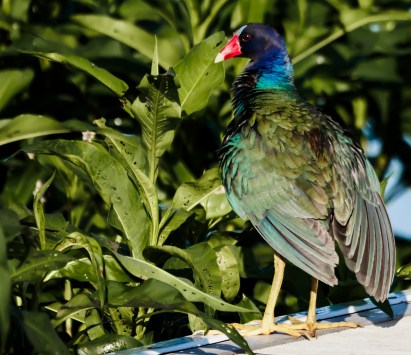 The choice of Star of the Day was actually quite difficult, as several lovely and not-so-lovely candidates had to be considered.
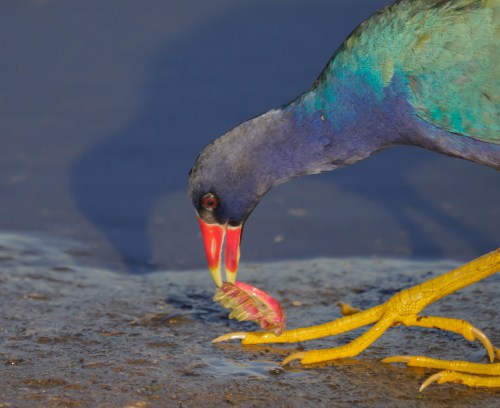
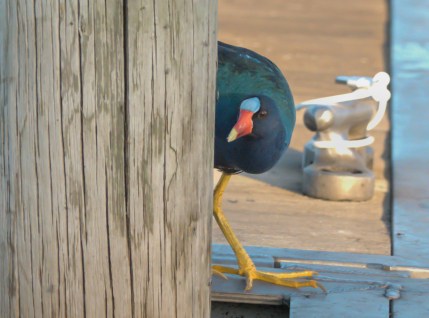
The first candidate would have to be the purple gallinule.
The morning light glistened off its iridescent feathers — definitely a contender for Star, even if it is a rather common animal.
This one entertained us by nosing around so close to us that we hardly needed a telephoto lens.
 And then there was the black-necked stilt who traipsed through the water, undetered by fear of alligators or fear of boat-tailed grackles.
Actually, the grackles were more of a threat, but this little one didn’t seem to mind at all.
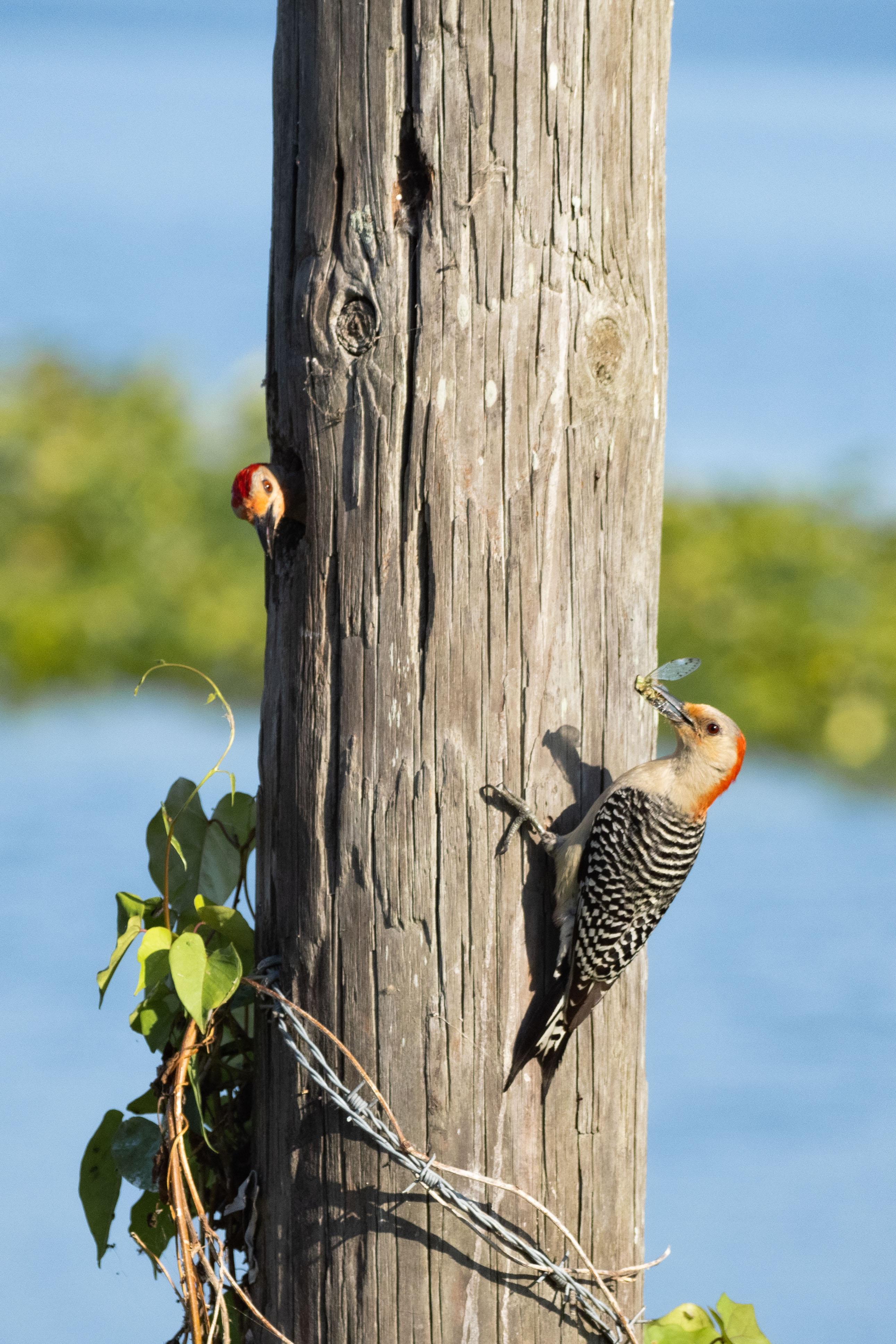
So, if I have to choose (and I realize I do), The Star would have to be the red-bellied woodpecker family.
Definitely. Their antics were so cute! and our nearness didn’t bother them at all.
We saw only two of them, the mom and the dad, but clearly there were young ‘uns nestled in their pole-home:
Mama: “Don’t make me come in there!”
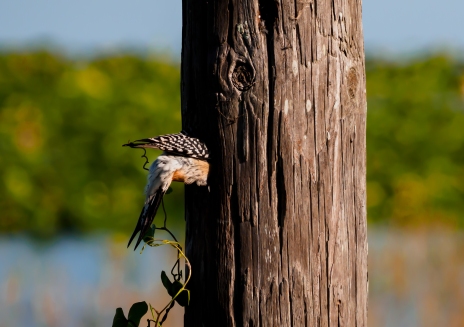
Papa with a tasty morsel for the kids:
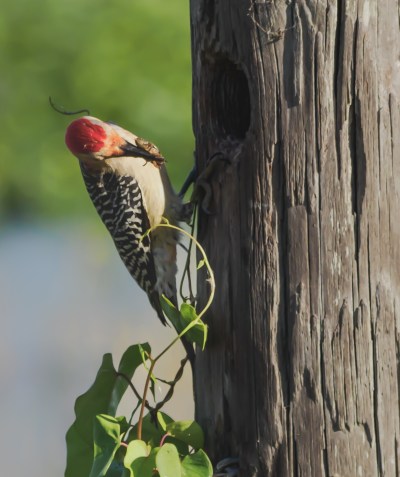
Mama’s turn to feed the children and Papa’s turn to warn them that Mama was on her way:
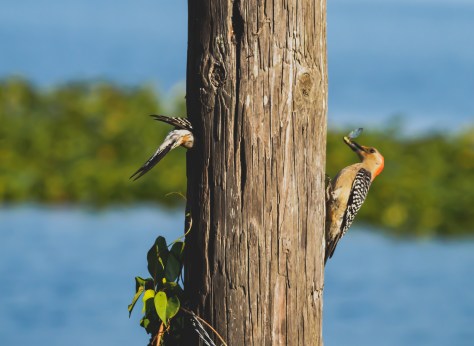
So, the red-bellied woodpeckers it is — congratulations!
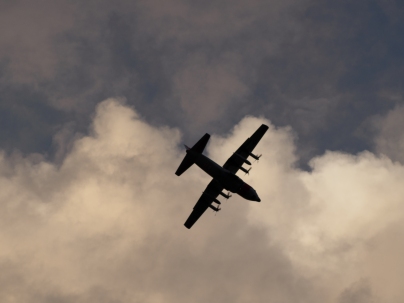 By 9:00 the light was getting harsh, and we headed back to the motel.
Andy spent some time showing me the wiles and ways of Adobe Camera Raw.
Another lesson: There is a difference between Camera Raw and Photoshop.
The former helps you reproduce what you saw, the latter helps you produce what you wish you saw. Using Camera Raw will enhance your photos. Using Photoshop will manipulate your photos. 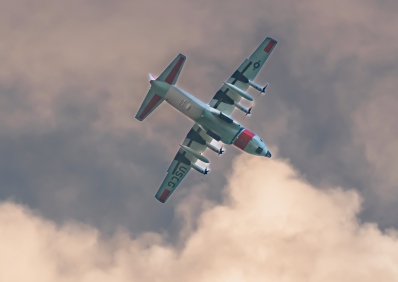
It’s a big difference.
Photoshopped images, Andy said, will be thrown out of any competition to which they are submitted.
However, the enhancements and corrections provided by Camera Raw are perfectly acceptable. And it is a powerful program! Look how I was able to recover this backlit airplane!
But I digress.
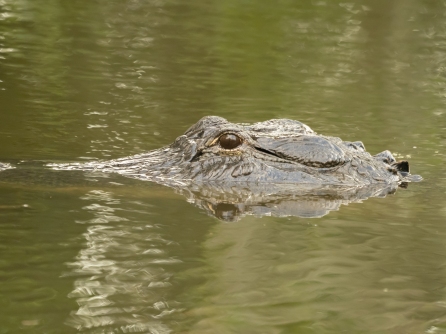 Our second expedition was to an out-of-the-way trail with the intention of finding alligators!
Which would have earned my vote for Star of the Day hands down.
However, the weather did not cooperate.
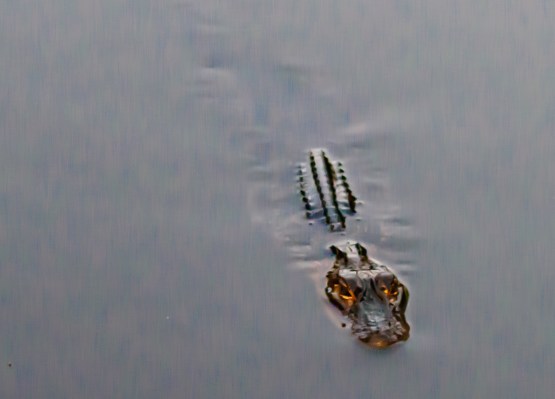
Too hot and humid, even for alligators. They stayed pretty much in the water.
Also, whatever illness I had contracted on the plane was taking hold.
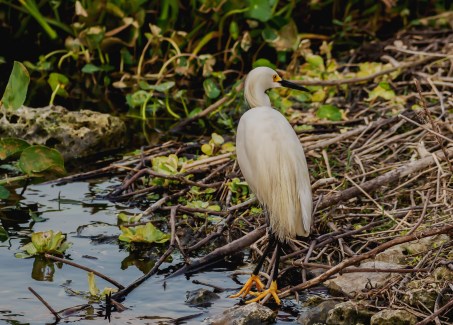 I could hardly keep up with Andy as he raced (or so it seemed to me) to the best alligator spots.
Dang. Stupid weather! Stupid upper respiratory symptoms!
Anyway.
We did see some great things, like sandhill cranes.
They looked beautiful in the receding golden light.
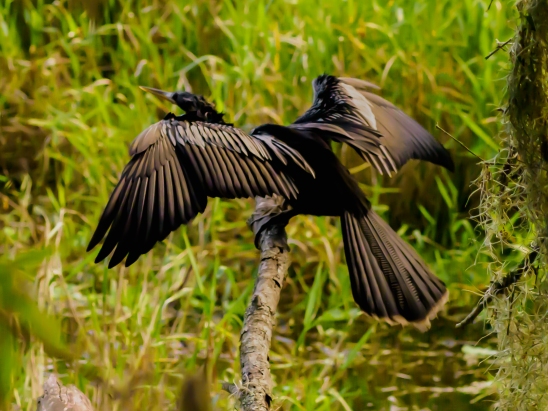
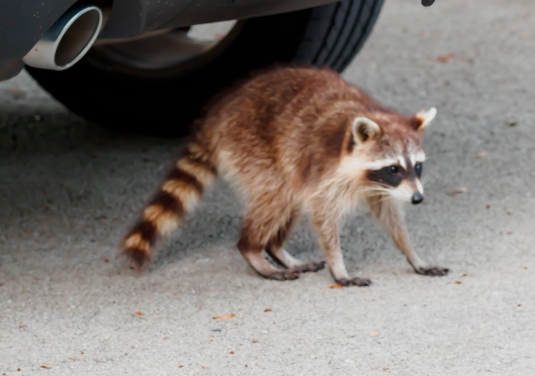
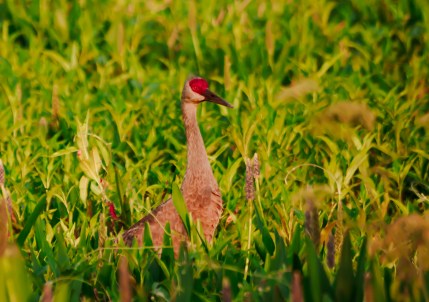 We also saw some anhingas, some snowies, and even a raccoon.
Then we saw something on the side of the road.
It could be a log.
Or it could be an alligator.
We approached as slowly and quietly as we could, just in case.
With our very looooooooooooooooong lenses.
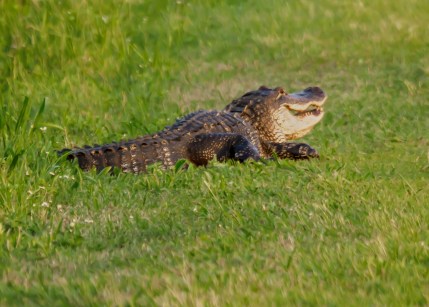 It was an alligator! which hurried back into the bush as soon as it sensed our footsteps.
As scary as it was seeing an alligator so close, I couldn’t help but think it was smiling in this photo.
However, even though it was a thrilling sight, the alligator simply could not compete with the little red-bellied family for Star of the Day.
Some more photos from Day 3:
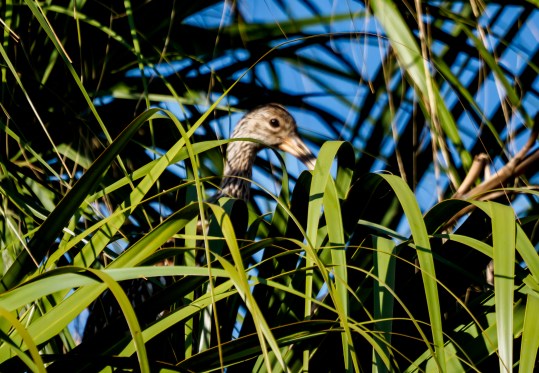
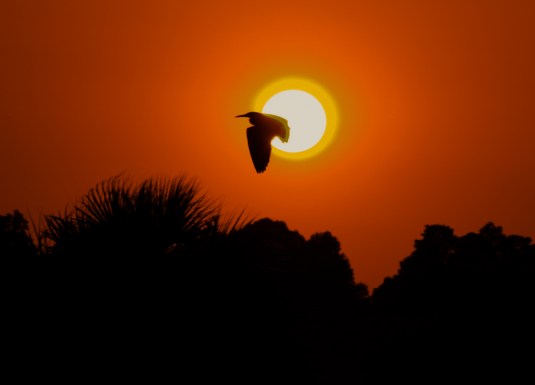
![P5051568 - ]path](https://straightfromthecamera.blog/wp-content/uploads/2022/05/p5051568-path.jpg?w=538&h=717)
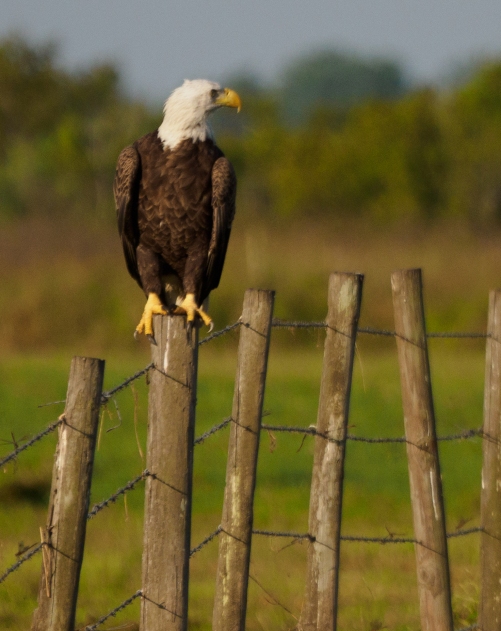
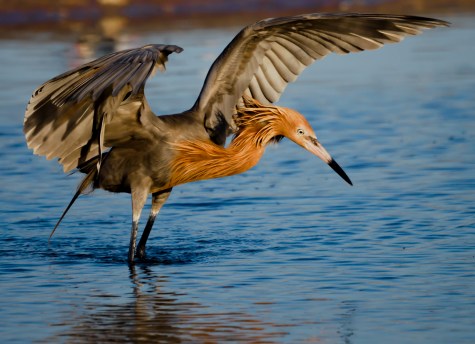
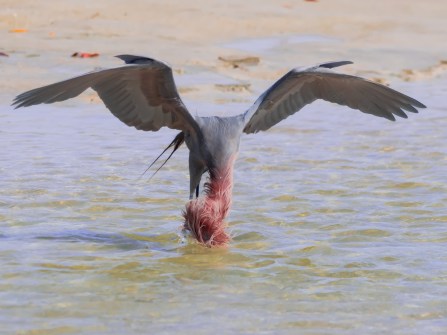
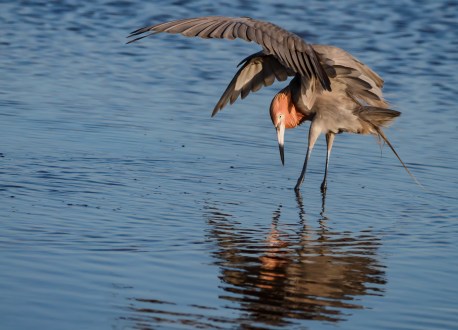
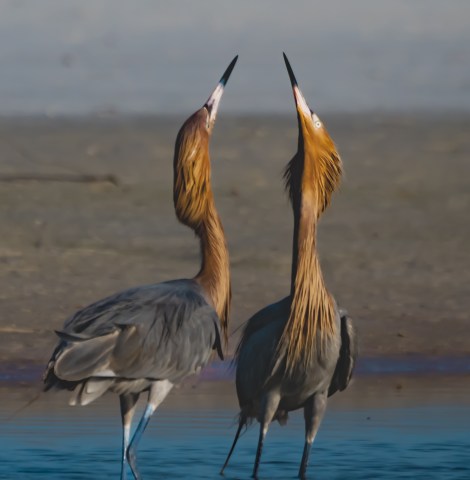
No problem choosing The Star of the Day for Day 2, the uncontested winner was the reddish egret.
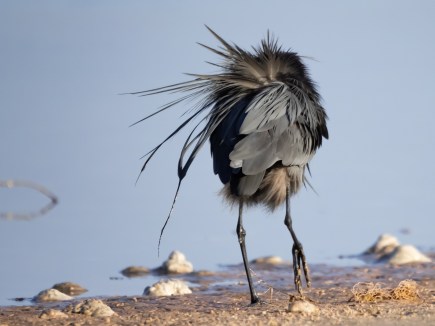 “In the stately and dignified world of herons,” according to AllAboutBirds (Cornell University), “Reddish Egrets are the swashbuckling cousins.”
And right they are!
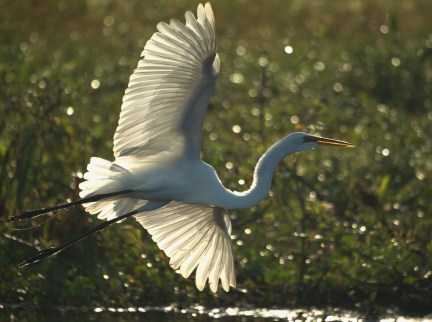
Anyone who has watched great blue herons or great or snowy egrets patiently stalking their prey will be quite surprised at the tactics utilized by reddish egrets.
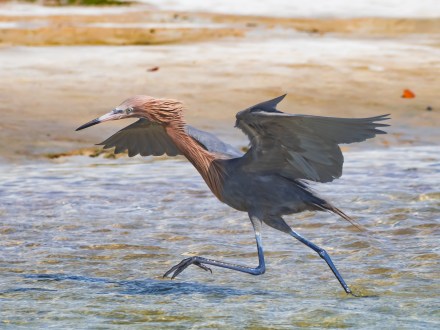 They put on an elaborate display, creating a sort of canopy with their wings and darting from place to place to lure fish from their hiding places.
Or they may kick up the sand with their feet and then pounce upon the frightened fish.
Or they may use a combination of these tactics.
Whatever they do, the end result is lunch (for them) and a fabulous show (for us).
The light was perfect, and my confidence had returned, so I took far too many photos o f The Star of the Day.
 With such good light —
and with Andy cuing me for proper settings —
I had very few problems with noise even with my beloved M4/3 gear
(Olympus EM1x wearing the 100-400 f/5.0 – f/6.3.
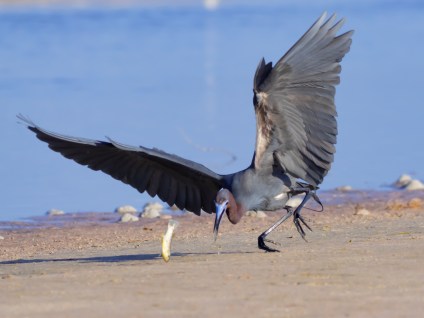
Oh, there was other wildlife present, including a delightful little blue heron who struggled to catch a fish.
 It finally succeeded — but then dropped it!
Undaunted, it finally captured and swallowed the fish, a triumph happily appreciated by all who witnessed the event.
We were treated to much more than The Reddish Show, although I admit it was difficult for me take my eyes off the entertaining view.
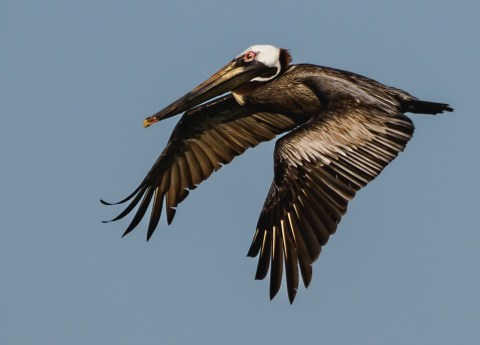
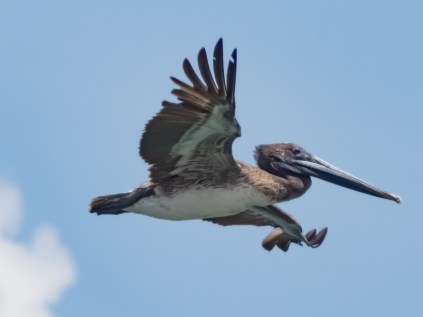
But I did, and I managed to catch a pelican flyover, a godwit, and some gulls.
And our old friend from yesterday, the pink spoonbills, also made an appearance. I even managed to capture one in flight!
 If there was a runner-up for Star of the Day, it would be the black skimmers.
The beach was crowded with them!
And some of them did what they do best — skimming the water for fish.
They fly very low, and you can tell when they are getting ready to skim when they circle over the intended area.
Or, you could listen for Andy warning you to get ready with the camera because here they come!
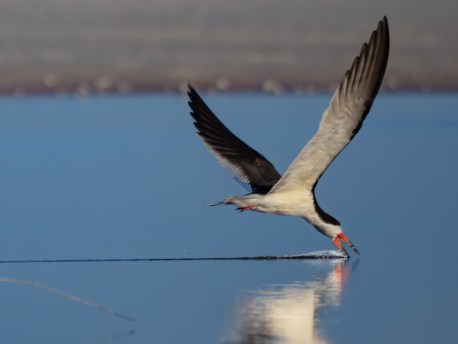 Both methods are very reliable.
There was also the occasional white ibis, or what my Aussie friend calls “bin chickens.”
Despite their beauty, they will not hesitate to forage for tasty morsels in trash cans.
We even saw a rare color morph!
Juveniles have a similar color distribution, but their legs and bills are pink.
Andy knows all of these things, and I could listen to him all day talking about the birds.


Day 2, like Day 1, came to an end much too soon!

The Star of the Day was really hard to choose. Of course, my immediate choice, and likely the one Andy intended, would be the spoonbills.
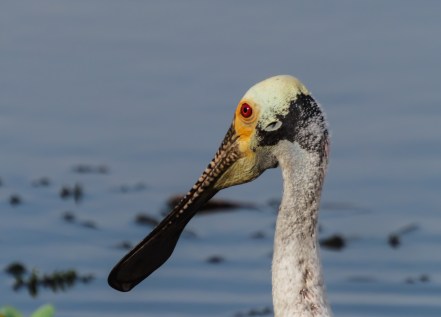 Spoonbills are large, pink wading birds with distinctive spoon-like bills — you really can’t miss seeing them!
And you really can’t miss taking photos of them, unless you are me. 😦
This being my first workshop and its first day, I was understandably a bit anxious.
Maybe too anxious.
My mind went blank as I tried to manipulate the camera. Having just gotten off the airplane, I didn’t think to check the switches and controls to make sure they hadn’t gotten bumped around.
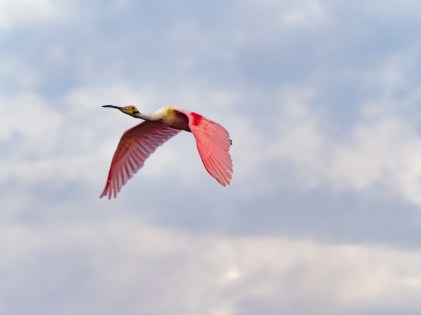 They did, and my photos proved it. The first few were dismal failures. The ensuing ones weren’t much better. Andy, the true master and patient instructor, dug into the menu and re-set some vital settings, but the rest was up to me.
A hard lesson to learn, but I learned it: Know your gear. Be more than familiar with the settings and switches. Train your muscle memory to know them by touch alone.
Even so, I entirely flunked birds-in-flight. The “good” ones were those taken from a distance. But, they were too distant to be “good.”
 But the stills weren’t so bad, even if they were only “portraits.” Birds-in-flight skills will take time and practice.
PRACTICE PRACTICE PRACTICE!
The second lesson learned on Day 1 was not to insult other photographers who give you their business card by telling them no thanks, you have already hired a brilliant expert to guide you.
That’s why Arthur Morris doesn’t like me.
 The thing is, if you are a famous photographer who has written books and all that, your work should speak for itself.
You shouldn’t have to tell strangers all about your legendary talent and then attempt to lure customers from your colleages.
Just sayin’.
Anyway.
I was amazed at the variety of Florida wildlife I saw that day.
Most amazing (to me, a Yankee from western NY) were, of course, the alligators. They were everywhere!
 But, back to the Star of the Day.
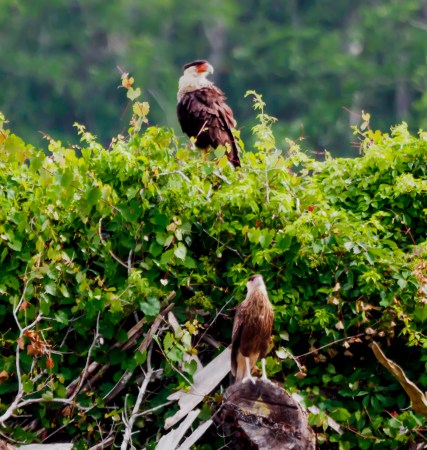
Even before we arrived at the lake, we stopped roadside to see a raptor’s nest. This wasn’t just *any* raptor. It was the nest of a caracara, and both mom and baby posed nicely for us for several minutes of picture-taking.
Oh, how I wish I was a better photographer!
And then there were the sandhill cranes. . .again, seen simply on the side of the road.
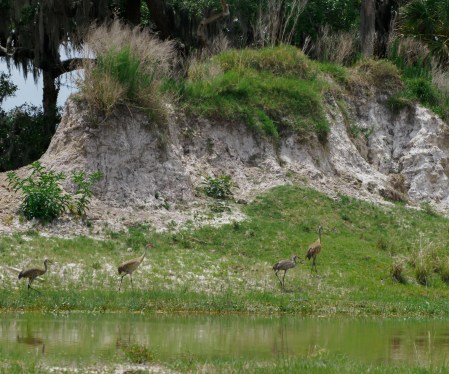 What was spectacular about these sandhill cranes is that they were moseying along near a group of (what else?) sand hills.
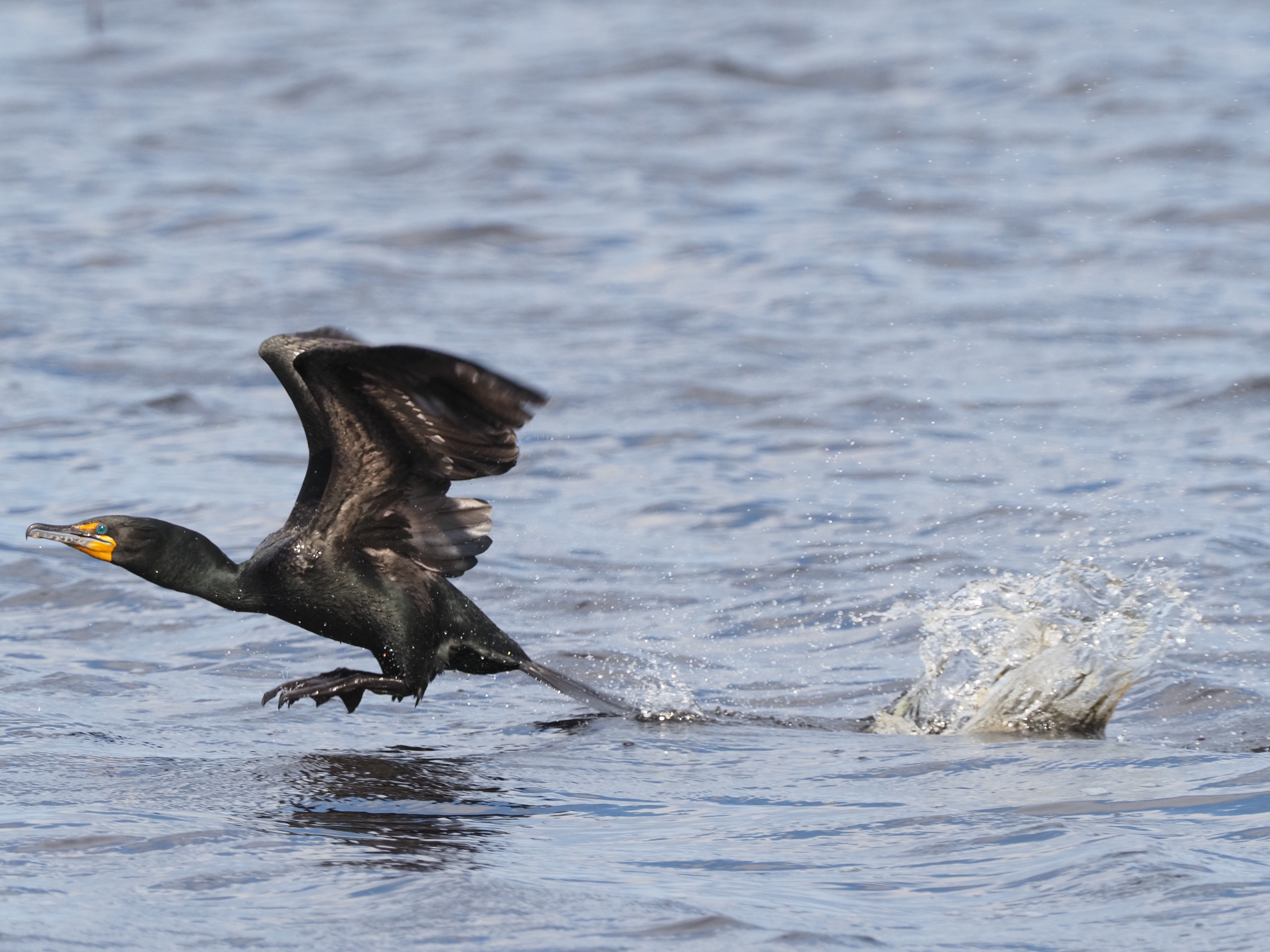
And a double-crested cormorant — not so exciting in and of itself. . .
. . .but its struggle to consume a catfish (?) nearly as big as it was made it something to see!
And the mamma limpkin with her baby, strolling for a snack.
Rounding out the category of not-so-amazing-but-truly-amazing-nonetheless was a lovely eastern meadowlark singing its heart out.
It didn’t even hear me coming.
 It was singing so intensely that it allowed me to get some good captures with the camera.
I took far too many photos with far too few keepers. But it was a glorious day for wildlife!
And even though I have lots to learn, I think I can put in the necessary practice, now that I know HOW to practice.
All in all it was a wonderful first day.
 With lots of stars!
Having just returned from the Florida 2022 workshop, I can’t say enough good things about Wild Wings Photography and its proprietor, Andy Nguyen.
 Andy is an excellent photographer – but he is much more than that. His technical and artistic skills with the camera are matched only by his extensive studies and field experience, not only with bird life but with all forms of wildlife.
Truly amazing!
There wasn’t a question that he could not answer quickly and authoritatively with explanations that were easy to understand.
 Andy is passionate about his work, which was evident in the way he planned and conducted this workshop. He was always available for questions, and not once was he impatient or condescending.
I was sincerely impressed by his willingness to show me, a relative newbie with the camera, how to use it to produce the best in-camera results.
In fact, I can truly say that he treated me as if I was the only person attending the workshop, and the results were astonishing.
 I came to Florida shooting JPGs in shutter mode with auto-everything-else. By midweek, I was shooting in raw and almost entirely manual – even using manual ISO!
Some of my photos were abject failures, but I returned home at the end of 7 days with a large number of keepers, larger than I had ever expected.
I think the two most valuable lessons I learned were these: Know your gear. Know where all the buttons and switches are and know exactly what they are designed to do. Learn now to locate them with your eyes closed.
 The other: Know that you will always be learning. Practice may make perfect, but know that we are never perfect. There is always something new to know, and be open to that no matter how skillful you think you are with your gear.
Oh, and a third lesson – don’t forget your Swiss Arca plates!!!
This workshop was worth every penny and then some. The shooting locations Andy chose were awesome, and there was always a “star of the day.” SuperSaturday was truly super, but the final shots on Sunday were even better (which I couldn’t even imagine!).
 I know he has seen all these things thousands of times before, but it seemed to me like he was seeing each of them for the very first time.
Such passion and enthusiasm are contagious! as well as highly motivating, especially when you worry about never getting past the newbie stage.
I know Andy has more workshops planned, and I hope to attend each one. I think you should, too.
You can contact Andy at his Facebook page, Wild Wings Photography, here:
https://www.facebook.com/AndyNguyen600
Tell him Sue sent ya!
A couple of ewwwwww photos from Sterling today transformed Tuesday into a real T-EWWWWW-sday.
Well, not completely. There were some sweet photos of mamma herons, a mamma eagle, and some pretty flowers.
But definitely a good portion of ewwwww.
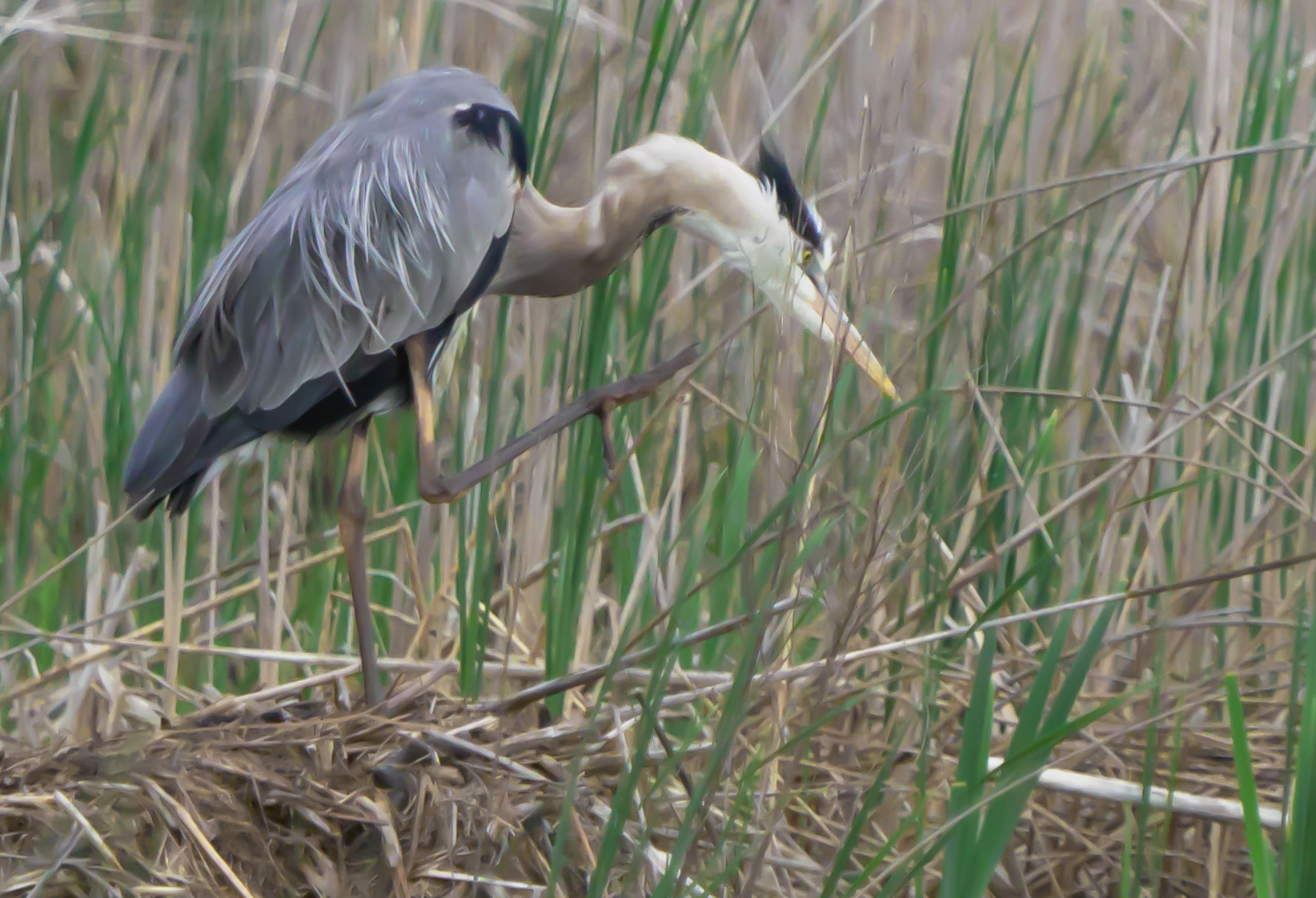
Sometimes when you see a dark thing sticking up from a soggy bog bottom, it’s inanimate and harmless. Maybe it’s just a branch or perhaps a big rock or something.
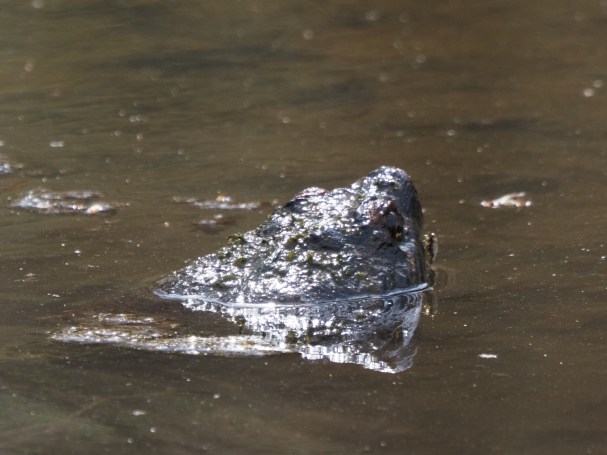
But look again. This one has nose holes and a dark eye!
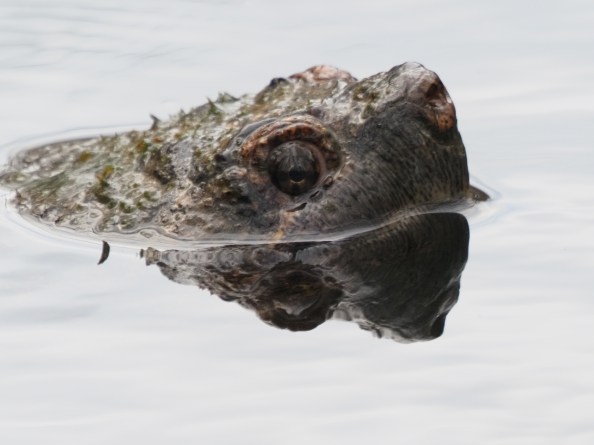
And if it has nose holes and a dark eye, it’s probably the head of a very large, very scary snapping turtle, which definitely falls into the ewwwww category.
Of course, garter snakes are rather harmless, or so I’m told:
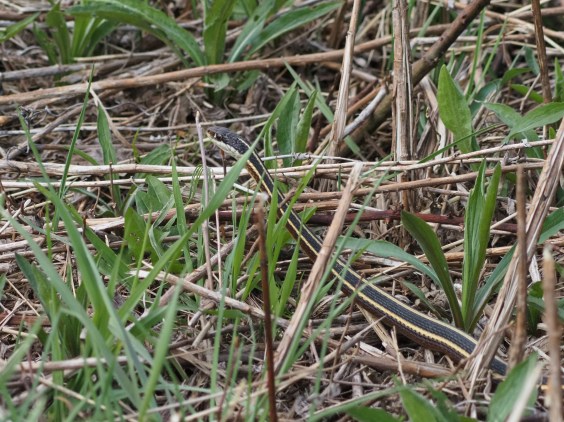
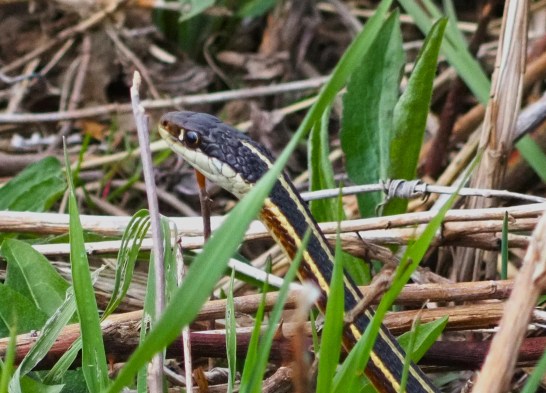
But I never stuck around one long enough to find out. They have a forked tongue and slither through the grass. And they are neither warm nor fuzzy so I award them a nice, big ewwwww.
Seen closer up, they warrant a more emphatic EWWWWW, written in all caps!
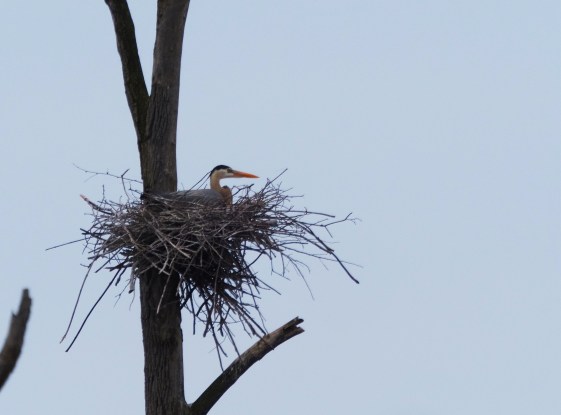
There was much nicer nature at Sterling today, too. The rookery never fails to delight, even though the herons are still pretty much egg-sitting. I didn’t see any little heads popping up on the nest edges — maybe they need another week or two to fight themselves out of that shell.
The eagle family has welcomed at least one (and quite possibly two) little hatchlings. Now Mamma Eagle can get up and stretch her wings. . .

. . .while Papa Eagle keeps a close watch nearby.

Wish he was a little closer to ME. . .and away from that fuzzy tree. . .(sigh)
Anyway, there was lots of beaver evidence along the heron trail and on the banks of the outlet stream. This is definitely one of the more artistic beaver-carved stumps I’ve seen.

It wasn’t long before I found the artist, or maybe a relative thereof:

When I saw him/her, we were both intent on avoiding the snapping turtle, so s/he took a turn to the southeast, and I hurried along the path.
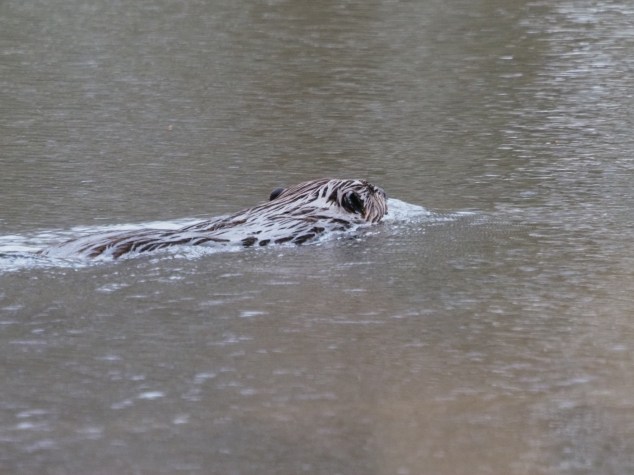
I’m happy to say that we were both successful.
All this plus a little bit of flourishing flora turned this Tuesday into a good mix of ewwww and ahhhh. Which pretty much defines every day spent at Sterling Nature Center.
Photos courtesy of EM1x and the 100-400 Olympus f5.6 – 6.3 lens with that fantastic focus limiter switch.
+ Birds, bridge camera, Crane, Ducks, eagles, egret, gear, Geese, heron, mirrorless, Red-tail hawk, swans, Uncategorized
Sony a7ii
by Susan
I really love my Olympus gear, but I can’t ignore the full-frame fuss any longer. So, I took the plunge and bought a (used) Sony — not the latest model and certainly not the most expensive — but one that Digital Camera World recommended as a very capable and affordable full-frame, as long as you don’t do video (https://www.digitalcameraworld.com/buying-guides/best-full-frame-mirrorless-camera).
Although still a relative newbie to the world of photography, I’ve had enough experience with The Big Three (Sony, Canon, and Nikon) to know that I won’t mess around with either Canon or Nikon anymore, because Sony has many of the features that I love in my Olympus gear, especially the color technology.
 The Big Three all sell mirrorless systems, but I was pleased to see that Sony was well represented in the list of full-frames on the Digital Camera World website.
It’s so weird. Olympus has state-of-the-art technology packed into their camera bodies, yet they struggled financially for a couple of years before being sold to JIP (Japan Industrial Partners). But this very technology — lightweight bodies, 5-axis IBIS, lag-less electronic viewfinders, live composite, etc. – could not keep Olympus Imaging afloat. . .ironically, this technology is precisely what the Big Three are scrambling to include in marketing their new mirrorless lines, even though such things have been around in Olympus bodies and lenses for years.
 Sheesh, Sony’s a7ii is the first of its cameras to feature 5-axis “Steady Shot,” but their gear is so heavy that it’s pretty meaningless. You still need to use a tripod — or at least balance the camera and lens on a pillow placed strategically on a rolled-down window or the top of your car or on a nearby tree limb.
The “steady shot” technology isn’t new to Olympus. Even their entry-level bodies (such as the EM10) have IBIS.
And their gear is light enough so that 5-axis IBIS is usable without a tripod. With it you gain about 3-5 stops of handholding. Tripods aren’t necessary unless you are pushing the limits of the system.
Even handheld “silky water” shots are possible! Let’s see you handhold “silky water” with a (much heavier) Sony system or worse, with a Canon body wearing a long L lens! Or with that silly overpriced Nikon p1000 with a lens that you can’t fully extend without it jiggling and ruining your photos.
Go figure.
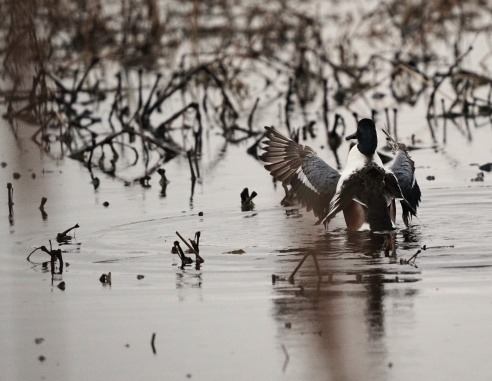 Anyway,
B&H had a good, affordable used a7ii, and I also picked up the G 200-600 f5.6 – 6.3 G OSS lens. This lens is great but very heavy (2412.5 gr) when compared to my Olympus 100-400. The Oly lens weighs in at 1325 gr, and even when paired with a 2.0 extender it’s still almost 2 lbs lighter than the Sony lens. Plus, you get much more effective reach from the Olympus — a whopping 1600 full-frame equivalent!
Oh, well, I guess that’s what tripods are for! (see above)
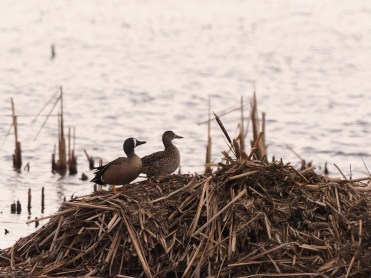 The argument against M4/3 has always been the small sensor, which measures 17.3mm x 13mm. These proportion out to 4:3, thus the name micro 4/3. Both full-frame (24x 36) and APS-C sensors (25.1 x 16.7), despite their differing size, proportion out to 3:2.
All of this is very nice, but what does it mean? It’s not so much the proportions, it’s the size. The full-frame sensor measurement of 24mm x 36mm is considered “standard.” Everything else (for our intents and purposes, anyway) is smaller. The APS-C used by Canon measures 25.1 x 16.7; the Nikon DX is slightly smaller at 24 x 16; the Sony cropped sensor is a tiny bit smaller than that at 23.5 x 15.6, and the Olympus is smaller still at 17.4 x 13.
(I’m not even going to consider the sensors employed in bridge cameras, which, except for the Sony RX10, measure less than an inch!)
Anyway, these smaller sensors are assigned a “crop factor” by a mathematical formula that calculates how much of an image is lost when compared to the same image produced by the standard full-frame sensor. Nikon’s DX sensors and Sony’s have a crop factor of 1.5, Canon’s APS-C sensors 1.6, and M4/3 (Olympus, Panasonic) figure in at 2.0.
All of the above photos were taken at a safe, non-stress-provoking distance, courtesy of the Olympus EM1x wearing the 100-400 f5.6 – 6.3 lens and a 2.0 extender.
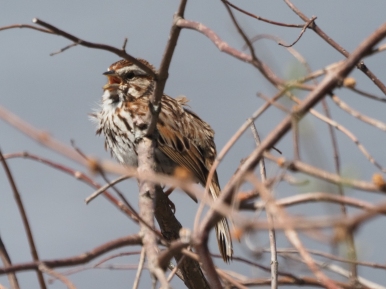
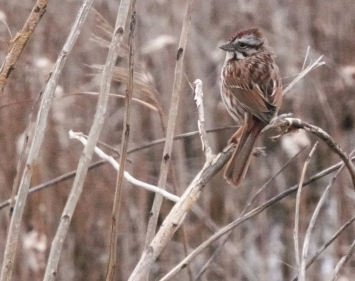 This grainy photo of a song sparrow, though, is the reason I am not concerned with bridge cameras. Their sensors are so small that their crop factor averages around 5.6! In fact, the only ones with sensors smaller than that are in cell phone cameras — they are reallyreallyREALLY tiny with a crop factor that hovers around 8. Both the bridge cameras and the cell phone cameras are great in good light but on a gloomy, dull day not so much.
Crop factors are both good and bad.
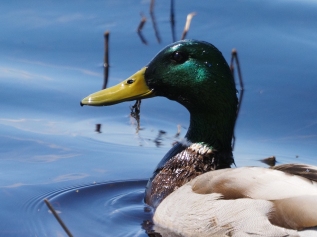
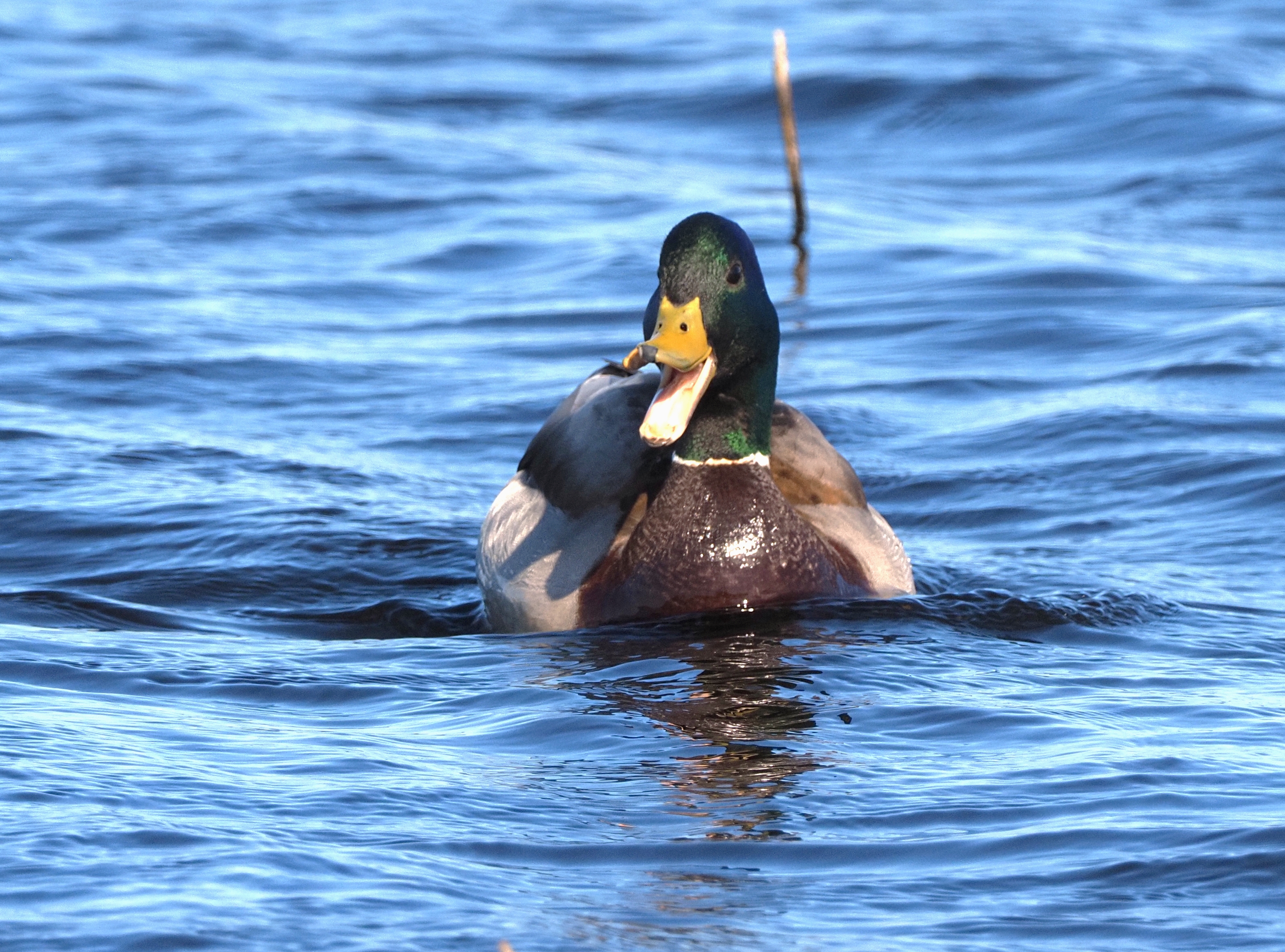
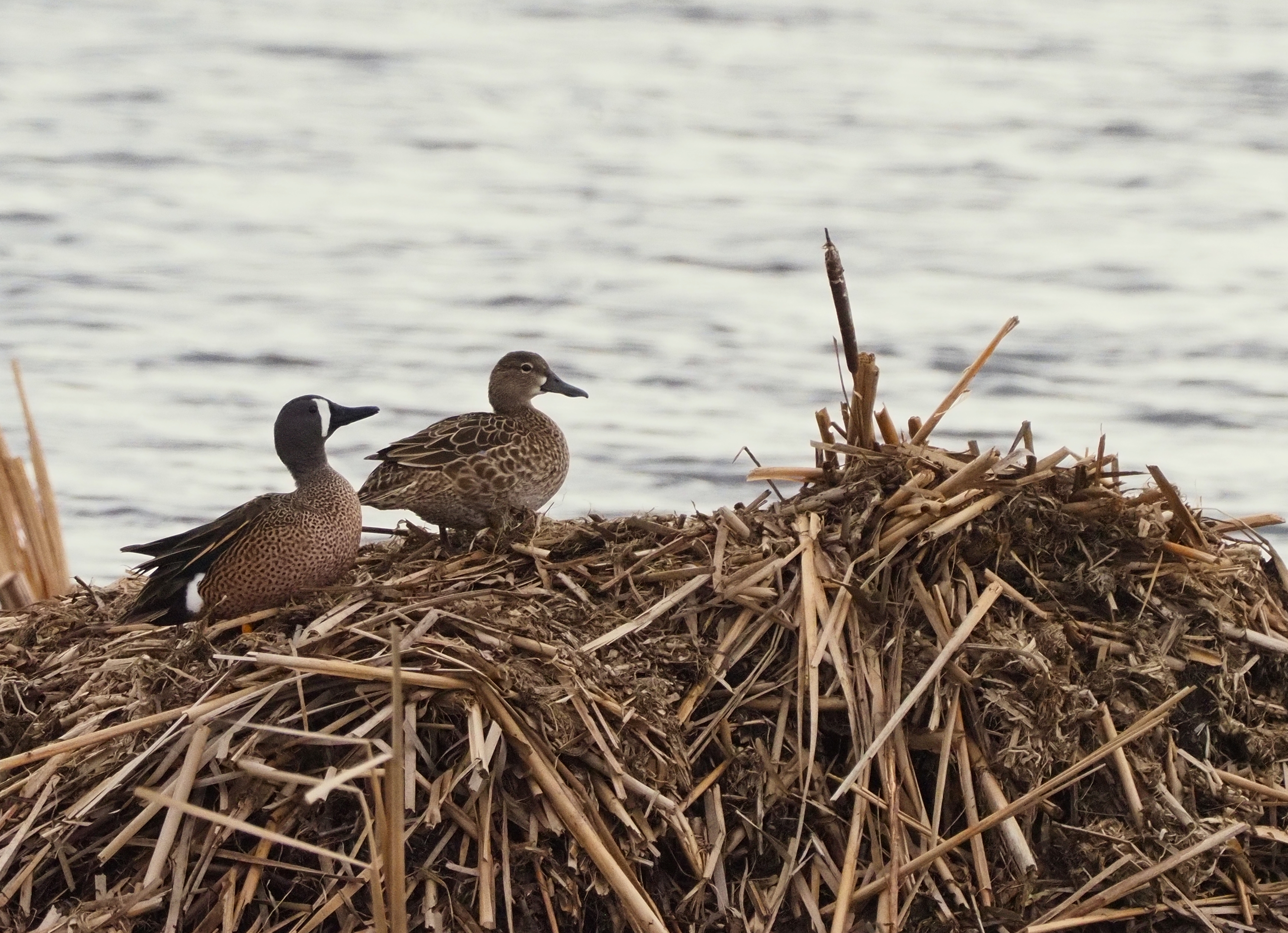
Good: Crop-factor sensors require less focal length to fill the frame of the image. So, a 600mm lens used on a full-frame camera produces 600mm of focal length. But a 600mm lens used on a Canon body with an APS-C sensor yields an equivalent focal length of 960mm (600 x 1.6). Even better for M4/3 systems: Their crop factor of 2.0 produces an equivalent focal length of 1200mm when you use a 600mm lens, as this decent mallard shot testifies.
Yes, I do shoot ducks — but only with a camera. That’s how real men and women shoot animals.
So, if you are a nature photographer and want to get more focal length for your dollars, M4/3 is for you.
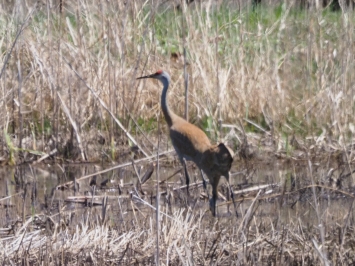 Bad: Smaller sensors have smaller pixels — and if they don’t, they have less of them. Since pixels are what admits light, smaller sensors can’t admit as much light as the larger pixels on a full-frame sensor. Even if they have the same number of pixels, they have to be smaller to fit into the smaller cropped sensors. That means that in low-light situations, users of smaller-sensor cameras have to fool around with the exposure triangle to make the most of the available light. That means either increasing the ISO, opening up the aperture, slowing down the shutter speed, or using some combination thereof to make the most of the available light. Each of these options poses its own problems. Even though I made several attempts to compensate for the distance and low light in the sandhill crane photo, it turned out blurry and just awful. (Even phase detect AF needs some sort of contrast to work properly!)
When I reviewed the dozens of bad sandhill crane photos I took that day, I could hear a Sony full-frame calling my name.
Even worse: The larger, full-frame sensor with its larger pixels also has a wider dynamic range that can detect and produce more color. Which makes it even better at low-light photography than most crop sensors (except for the ones in Olympus cameras)
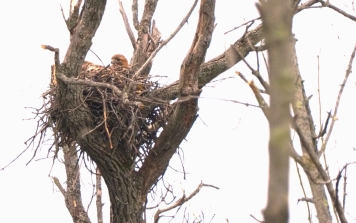 But it was only after getting some really bad photos of a mostly brown red-tail hawk sitting on a mostly brown nest in a mostly brown tree in a mostly brown forest on a mostly gray day with my beloved EM1x that I decided to try full frame.
Because, even after switching the 100-400 for the 300mm f/2.8 PRO I still had to bump up the exposure in the EM1x by several stops if I wanted to get any detail at all, the trade-off being a completely blown-out sky and some very pale trees. And whatever detail I managed to capture was lost if I cropped the photo even a little bit.
So, I bought the Sony a7ii and went back to visit Mamma Red-Tail. And I found a definite improvement.
Dammit.
Compare the results (above) with my later attempt on an equally dull day (we have a lot of those here in western NY) with the a7ii (below).
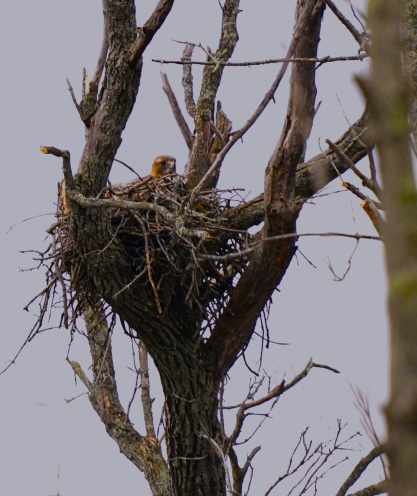 Even at a distance, there was enough clarity to see Mamma Red-Tail sitting patiently on her eggs, her dark head rising just above the edge of the nest.
The overall effect is sharper, and the sky isn’t blown out.
I was even able to crop the image, which I had to do because of the disparity between the full-frame 600mm lens and the 2.0 crop on the Olympus lens (see discussion about crop sensors, above).
I suppose I could get better results if I trudged into the woods and got a little closer. . .but that would be wrong. Mamma Red-Tail deserves to feel safe in her home, and I am pleased that she is willing to tolerate my visits-from-afar. The edge of the road is a respectful distance that allows her enough privacy to continue incubating those precious eggs while allowing me a glimpse of nature at work.
Still learning. . .
. . .but now I have some new toys! And better photos! Win/win!
+ Andrea van Beausichem, Andrea van Beusichem, Birds, Ducks, eagles, egret, Fish, Geese, grebes, heron, Migration, Montezuma, muskrat, osprey, swans, Uncategorized
Spring, Montezuma Style
by Susan
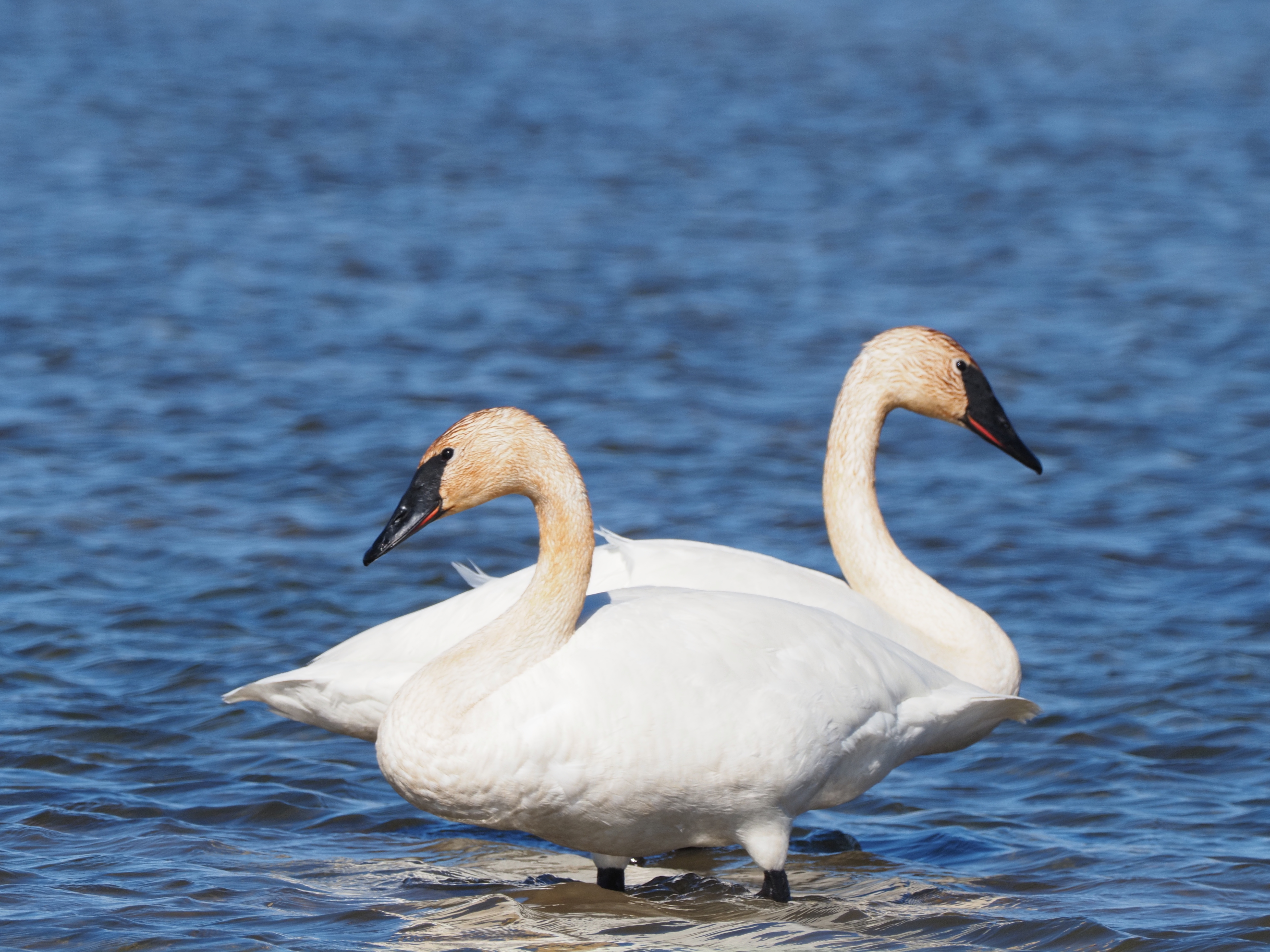
Winter is slowly losing its grip on western New York. Eaglets are hatching, osprey and herons are nesting, and ducks, geese, and swans have found their mates.
Although spring arrived meterologically on March 21, it wasn’t really spring for us nature photofolks until April 1st, when the gate to Wildlife Drive swung open.
Today was sunny (and warm!), so I packed a lunch and a couple of cameras into the car and headed south on Rt 89.
After last year’s no-water fiasco, it was gratifying to see decent levels in all the pools and marshes lining the Drive, decent and deep enough to have attracted much of the wildlife that have been driven away over the past four summers of “mimicking nature” by “simulating drought.”
(For the uninitiated, see Montezuma Waterfowl Refuge? here on this blog.)
Although I saw no muskrats, there were so many lodges that I stopped counting at 22.
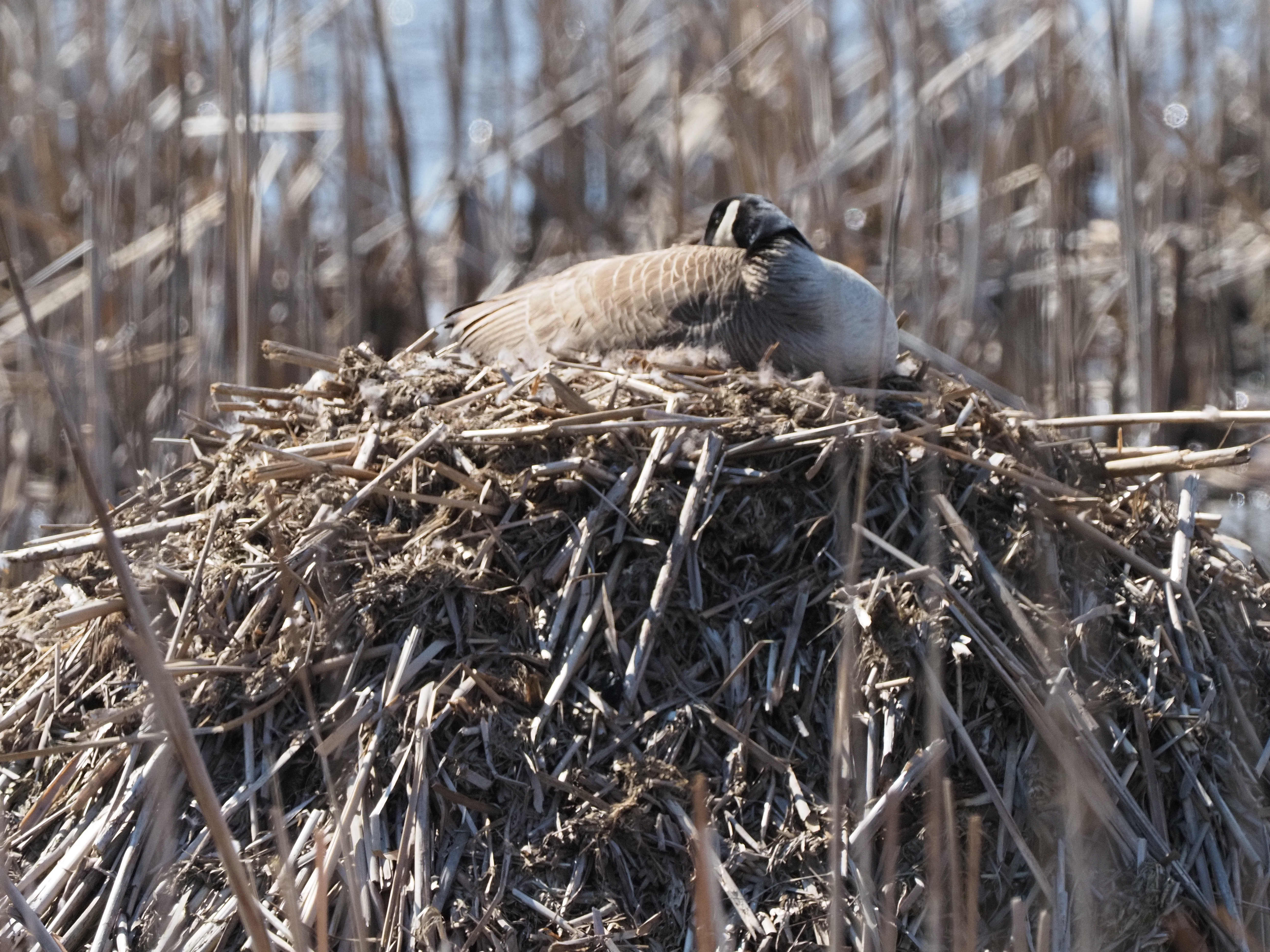
Muskrats are clever little things — they build their houses with cattails and sedges, so in times of need they have a ready stockpile of food.
They are quite generous in sharing their homes with geese and ducks, who nest on the top floor.
Muskrats need to be in and around the water, though, so seeing so many lodges is a hopeful sign of healthy water levels.
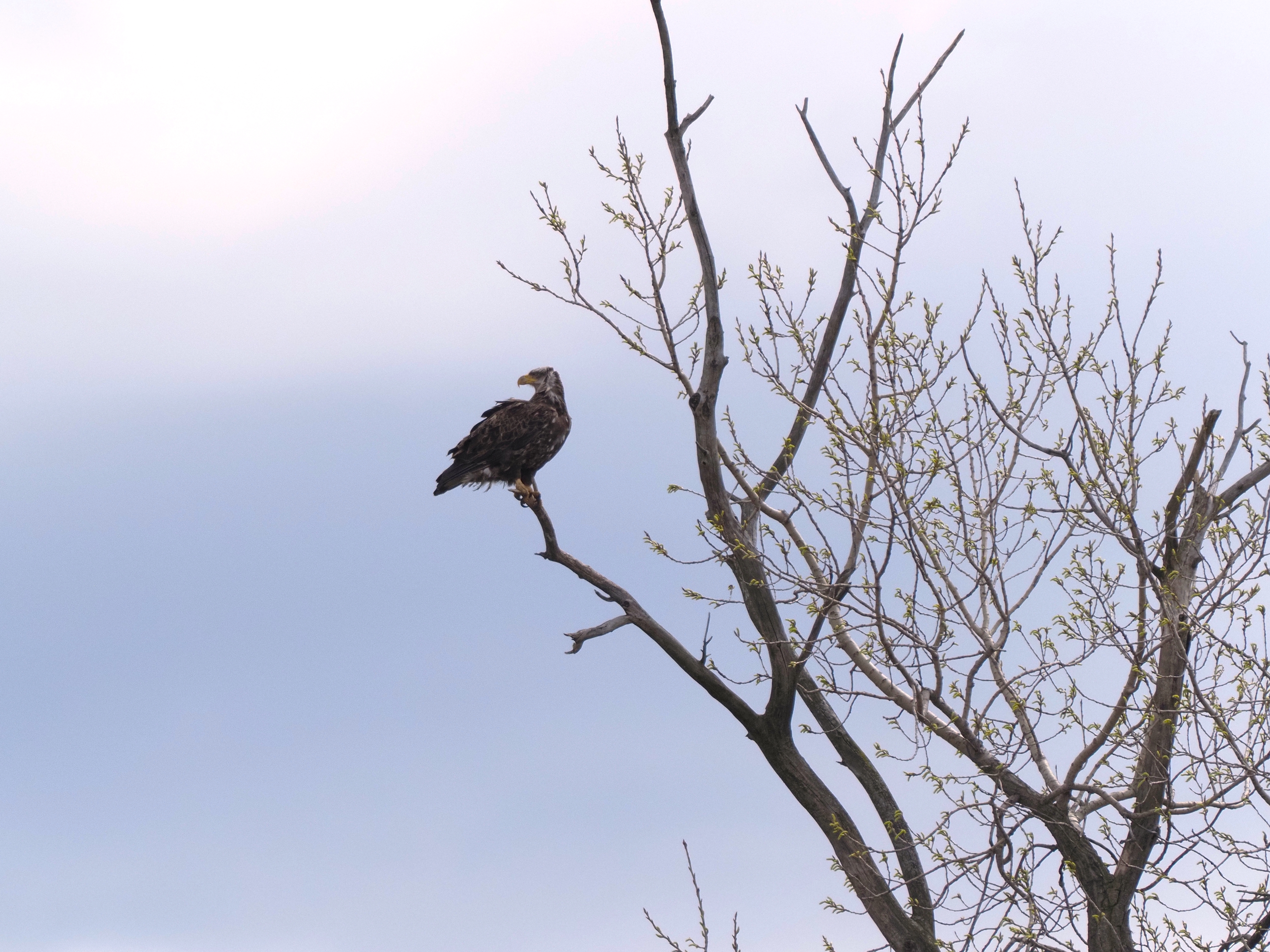
The Eagle Tree was empty today, but I did catch a juvie resting nearby. Earlier he had been fishing way out in the main pool, frightening both the fish and a couple of osprey who were also hoping for a meal.
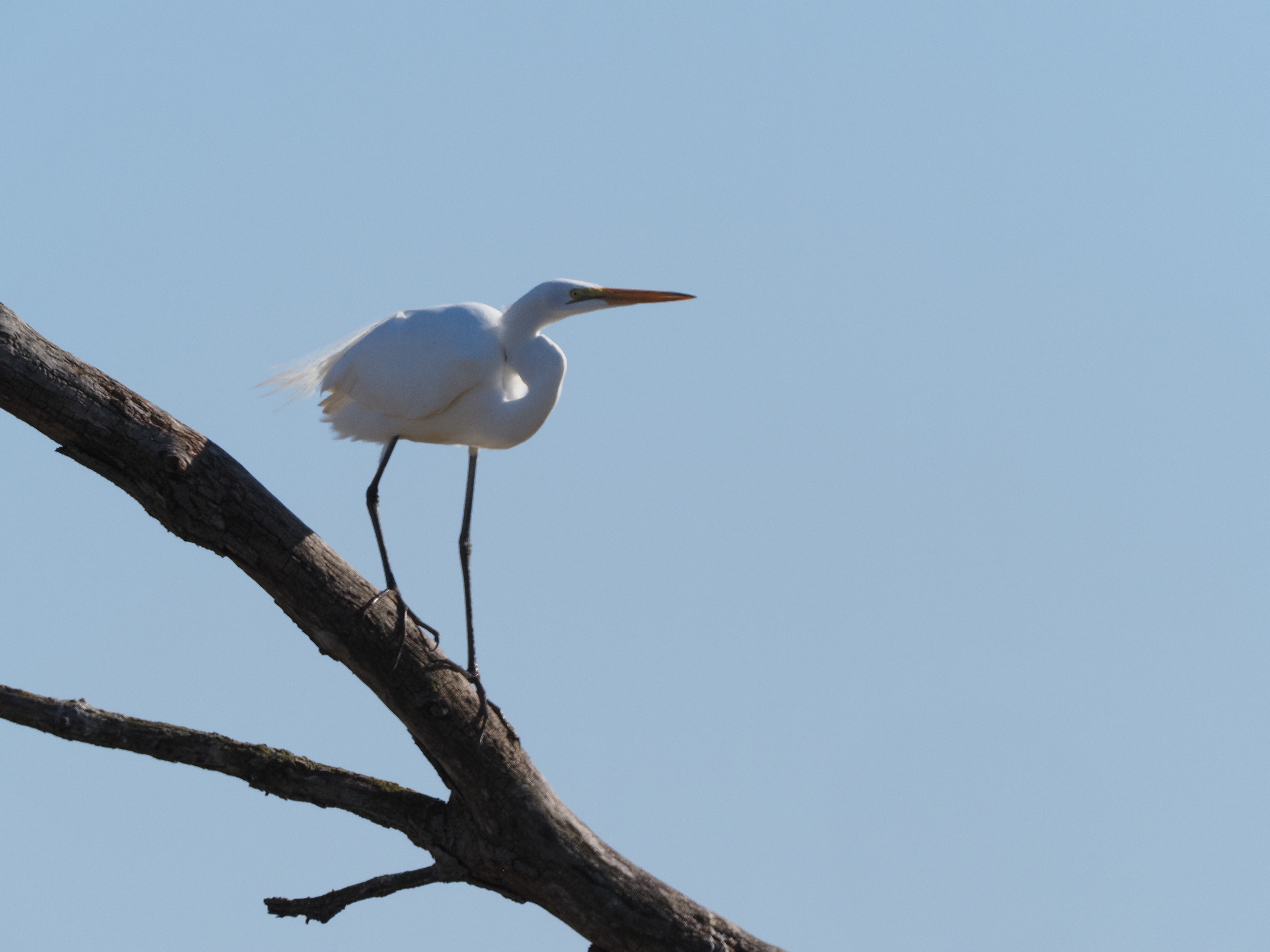
There weren’t many egrets; in fact, I saw only one, but it did not disappoint.
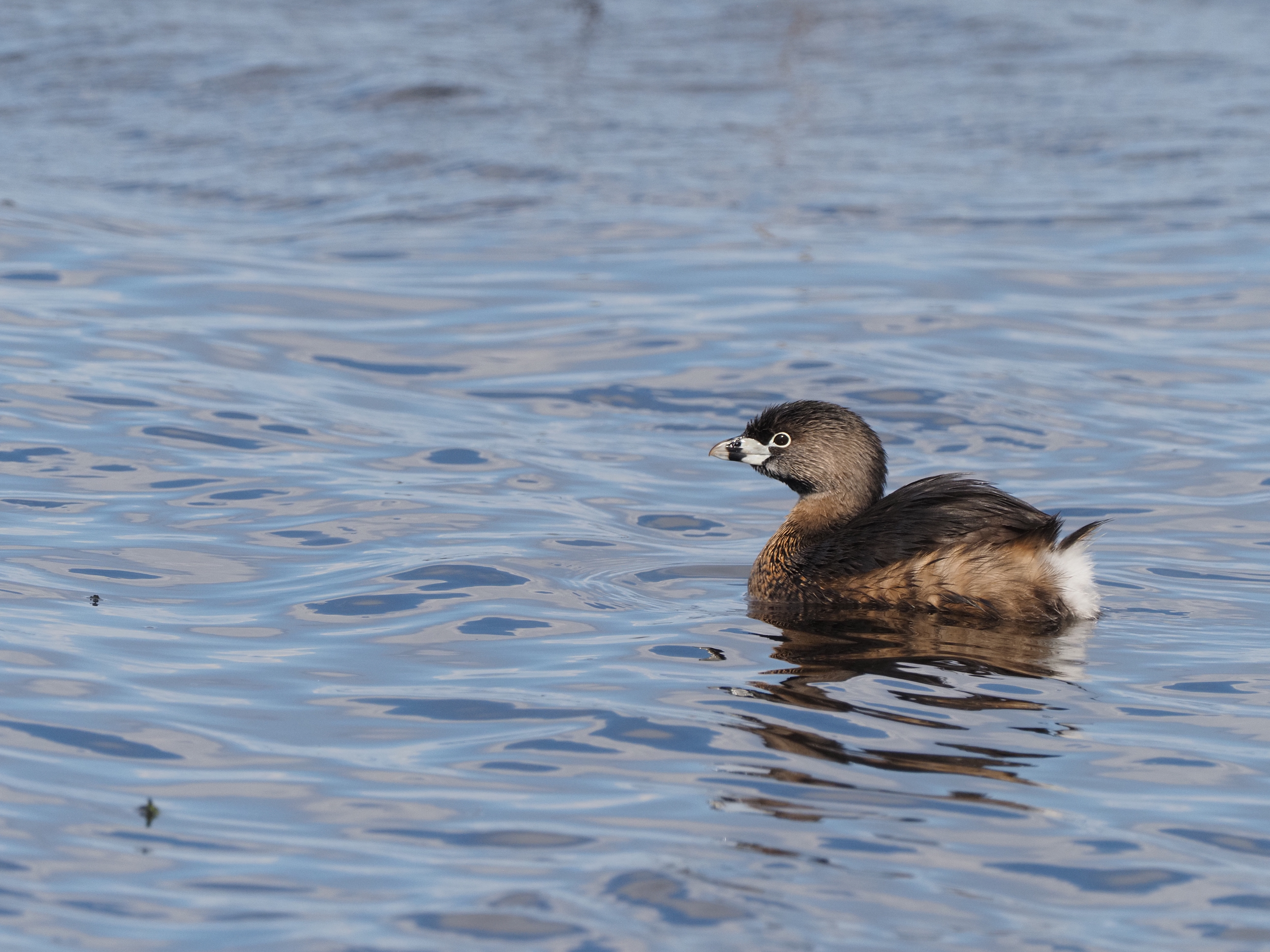
I saw only one great blue heron, and this on a brief fly-by; nobody else was fishing except for a single pie-billed grebe.
There were a few ducks foraging for vegetation and, of course, there were Canada geese squawking and nesting, but all in all it was a quiet day on the Drive.
I did see a couple of Fish and Wildlife agents doing bird counts, so I rolled down the window to ask whether they had plans to “simulate drought” this year.
The gentleman replied, “We aren’t going to drain the main pool, only a couple of the smaller ones.”
He said this was necessary to ensure an adequate supply of duck-friendly vegetation for the fall migration.
This is where the conversation became interesting.
When I asked why they were concerned about getting enough food in for the fall migration but apparently had no worries about the supply during spring migration, he thought about it for a minute before admitting “That’s a good question,”
His companion, though (I’ve seen her before, I think her name is Jackie), had a ready answer. The harsh winter weather, she said, would prevent anything from growing on the marshes. Instead, “The spring migrators forage on local farmland.”
When she said that, my eyes rolled so far back that I could see my brain.
On local farmland? Does she really think that the “harsh winter weather” affects only marshes and not the surrounding farmland? Does she really think that “local farmland” is planted with a winter crop of duck food each year that flourishes despite the “harsh winter weather,” just to help the MNWR attract ducks? And that flocks of crows and wandering deer haven’t scooped up all the harvest litter over the winter?
She was unable to tell me exactly where I could find “local farmland” crowded with foraging ducks.
In any event, these two agents very clearly dispelled the myths surrounding the MNWR managers’ penchant to “maintain the marshes [under their care]” by “replicating natural weather cycles” and “simulating drought.”
“We get our money from duck stamps. We have to document that we are doing everything we can to make this a duck habitat in order to get that money.”
When I protested that this practice supports ducks but exploits water-resident species and the wildlife that feeds upon them, he retorted, “this isn’t for your entertainment.”
My point is an important one. But it lies way beyond his grasp.
For those who may not know, the U.S. Department of Fish and Wildlife Service has a website where they explain “If you hunt migratory waterfowl and you are 16 years of age or older, you are required to purchase and carry a current Federal Duck Stamp. . .”
No duck stamp, no license.
No license, no hunting.
At $25.00 a pop, the sale of Federal Duck Stamps generates a small fortune for the national wildlife refuge system — 98% of the stamp income “goes directly to help acquire and protect wetland habitat,” or so says the U.S. FWS. . .but what they fail to explain is that refuges who receive those grants are prohibited from using duck stamp money for operating expenses. (This is explained more fully below.)
Since the Montezuma people definitely want their share of that 98%, there is no doubt that they will continue to distort the marsh food web by “simulating drought” year after year to ensure a good supply, not only of duck food but of ducks — just in time for the November hunting season.
Which will ensure that the fish the U.S. FISH and Wildlife Service are supposed to protect, are dried up and killed.
And that the very wildlife that the U.S. Fish and WILDLIFE Service are supposed to protect, will have to find food sources elsewhere.
Again.
Sigh.
Anyway, I circled the Drive a couple of times before the temperature dropped and storm clouds gathered.
And then I shook my head sadly all the way home.
Because I realized that I had been lied to.
Again.
Here’s the scoop: According to the advocacy group, National Wildlife Refuge Association, duck stamps are only one source of refuge funding, and a minor one at that:
Nearly all the funding that the Refuge System receives is through the Operations and Maintenance (O&M) portion of the federal budget. Other smaller contributions to national wildlife refuges come through legislation like the federal transportation bill, Great American Outdoors Act funding, [and] supplemental funding from things like hurricane or fire relief”
https://www.refugeassociation.org/funding#:~:text=The%20vast%20majority%20of%20the,through%20the%20Congressional%20appropriations%20process.
 The income from duck stamps is one of several federal programs that provide grant funds, not operating funds. These pay for wetland restoration (in MNWR speak, that is called “draining the marshes as often as we can”) and refuge expansion. (A portion also goes towards “philately,” and since duck stamp artists don’t get paid I assume that this money is set aside to produce the duck stamps).
Anyway,
“Wetland expansion” is where our friends from Ducks Unlimited grab some of that money and jump into the fray. They explain it like this:
All proceeds from federal duck stamp sales are deposited in the Migratory Bird Conservation Fund (MBCF), which was also established by the Duck Stamp Act. Duck stamp dollars typically account for 40 to 50 percent of funds in the MBCF; import duties collected on arms and ammunition are another major funding source.
But wait, there’s more! They don’t use these dollars to buy land, they use it to buy easements — with assistance from the realtors, who just happen to be DU employees. One of these realtors is Randy Renner:
A big part of what our conservation and realty specialists do is to help develop interest in easements among private landowners,” Renner explains. “We also do a biological evaluation of each property and work with the landowner to come up with an ideal agreement for all parties involved.” Renner says DU and the USFWS process over 500 easement contracts annually.
 Renner would like you to think that Ducks Unlimited uses its own money “to directly purchase easements that are then donated to the USFWS.” But he admits to using “public funding” — which is duck stamp money.
So, Ducks Unlimited, a private entity and financial partner of Montezuma National Wildlife Refuge, promotes its pro-hunting agenda using inter alia taxpayer and duck stamp dollars to supplement what it calls their “philanthropic contributions” to the US FWS.
It saddens but doesn’t surprise me that MNWR thanks its friends at Ducks Unlimited, for their “philanthropic contributions” by using duck stamp dollars to dry up the marshes — under the guise of “wetland restoration” to provide DU (and other) hunters with a good supply of ducks just in time for the fall duck-hunting season.
I don’t know why this issue bothers me so much. Maybe it’s because this all-too-frequent drainage actually results in more habitat destruction than it does preservation. Maybe it’s because I hate being lied to. Maybe it’s because the Iroquois National Wildlife Refuge, which lies in the same flyway that MNWR does, only rarely drains their marshes and never down to mudflats — probably because they remain committed to preserving wetland habitats and are not convinced to abandon that goal by partnering with a for-profit hunting group like Ducks Unlimited.
Maybe it’s because I’m the only one who sees a conflict of interest here.
 I suppose it doesn’t matter. Here in Corporate America, Ducks Unlimited is a big business. And we all know that big business puts the power in the hands of the moneyed few. My voice is drowned out by the voice of Ducks Unlimited. “We all benefit from land acquisition,” states another DU employee, who is apparently unconcerned that the DU/US FWS deals do not resulted in “land acquisition,” only easements on adjacent privately owned lands. “So, buy a duck stamp—actually, buy two and do twice the good. It’s a great investment for our kids and grandkids.”
A great investment for our kids and grandkids who will be trained by DU to enjoy killing ducks.
Update, May 15, 2022: Remember those muskrat lodges that I stopped counting once I reached 22? They are gone, all but a few. So is the much of the water in the main marsh pool. Let the fishkill begin!
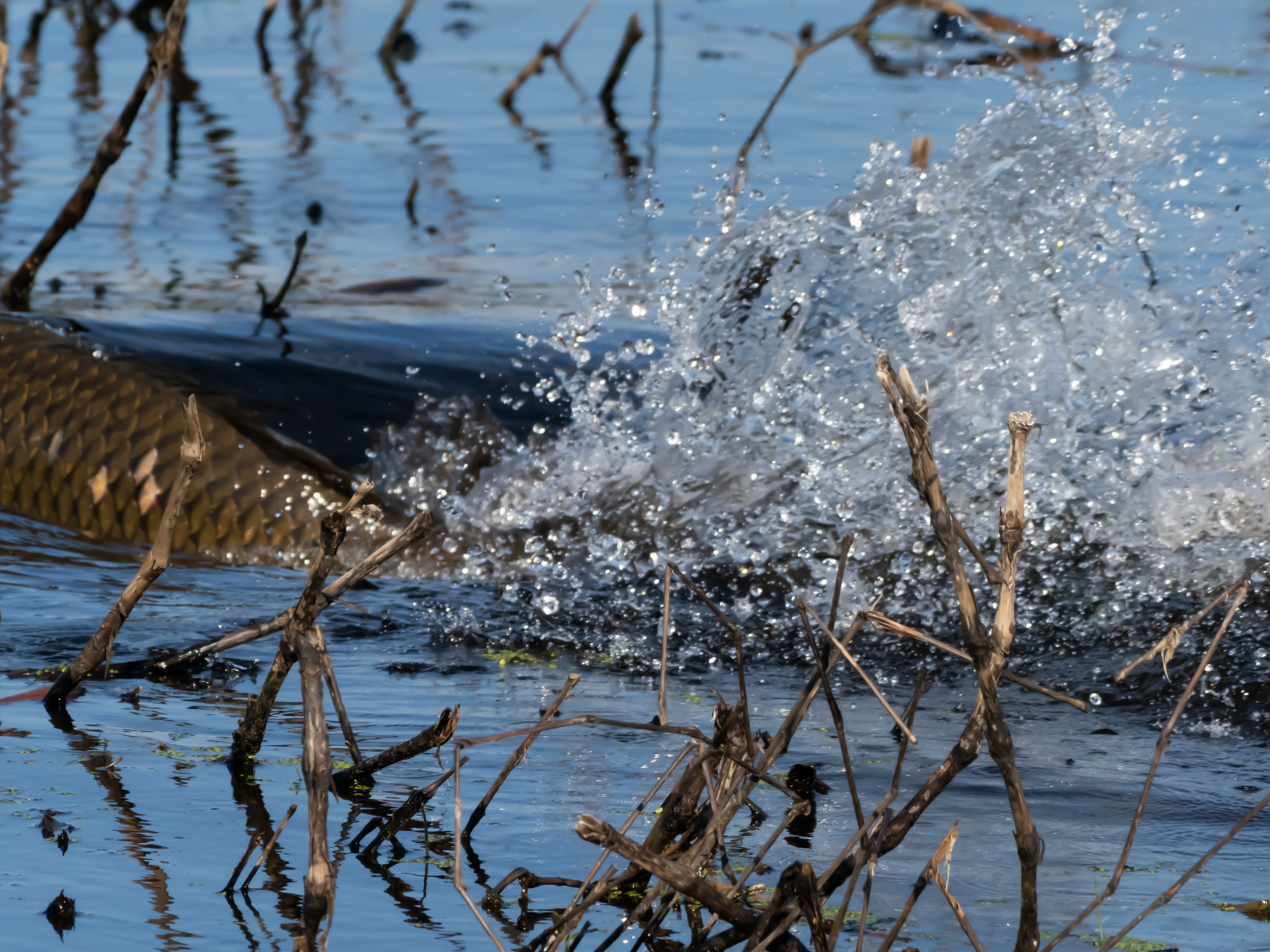
And not a moment too soon!

The year was a bad one for me. I missed the entire spring-and-summer photography season due to poor health and was sick for most of the year. I had 6 surgeries, spent some time on life support in the ICU, wore an ostomy for most of the year, and had a course of both chemo and radiation treatment, all of which took some time to recover from.
By December, though, I was ready to formally bid the year good-bye and good riddance by attending a guided nature walk at one of my favorite places, Sterling Nature Center, led by one of my favorite people, Jim D’Angelo.
And it was a sterling event, despite the cold and damp.
 It was the last hike in 2021, one of the last ones before construction equipment would arrive early in the new year to begin work on a spacious new visitors’ center and meeting hall.
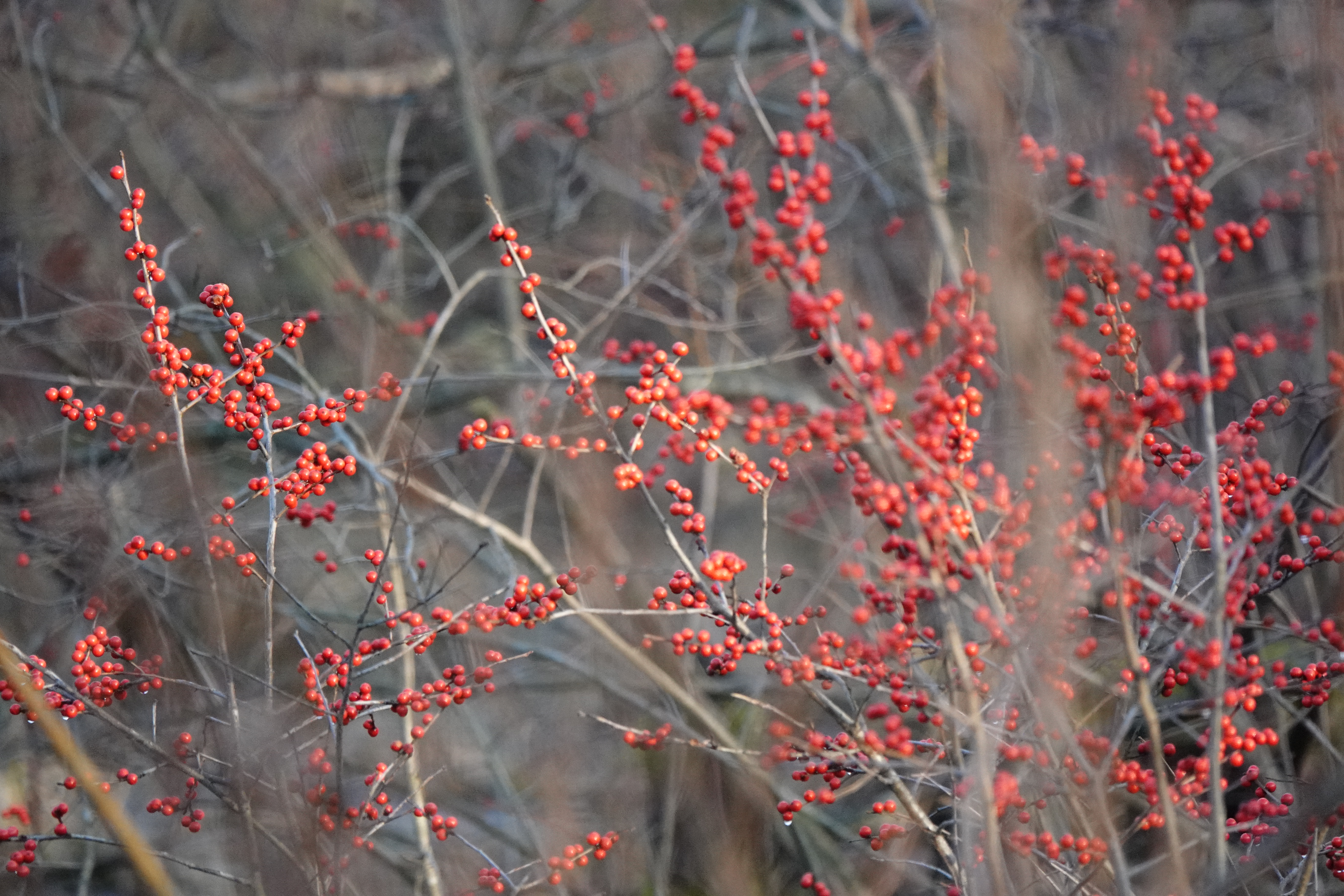
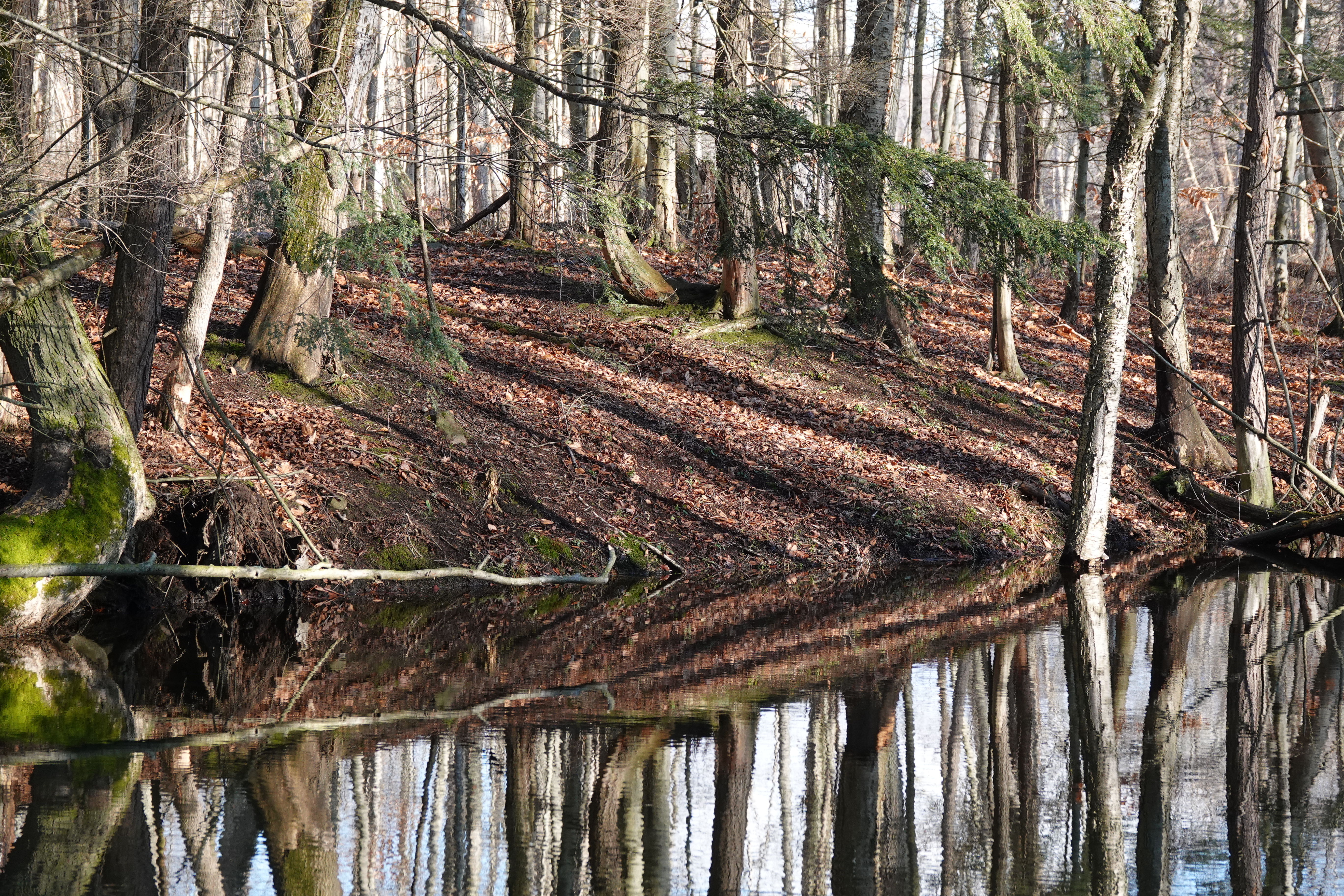
I didn’t expect to see much other than windswept snow, but I was pleasantly surprised to see a variety of winter flora and fauna, all oof which fared much better than I did in 2021.
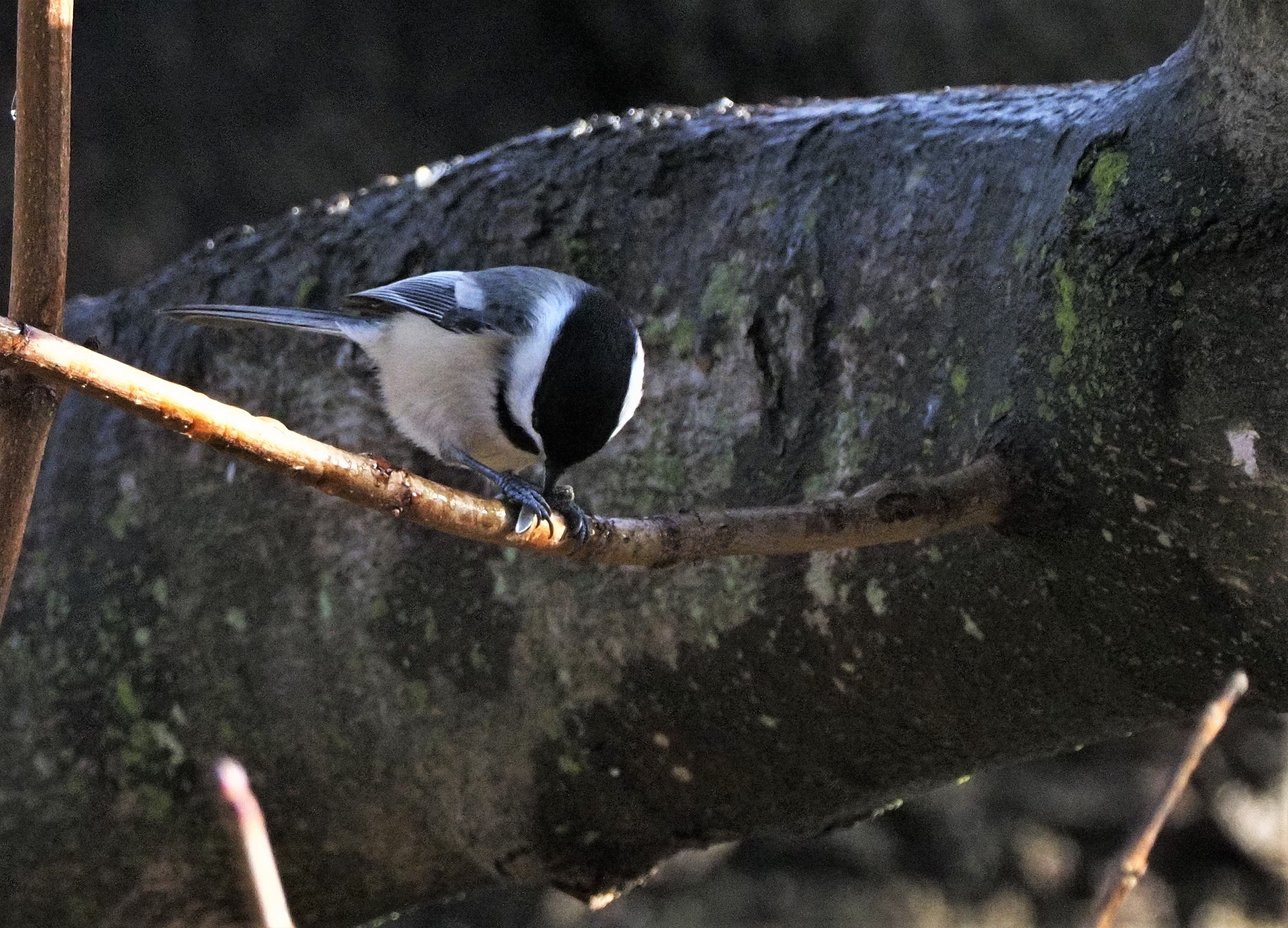
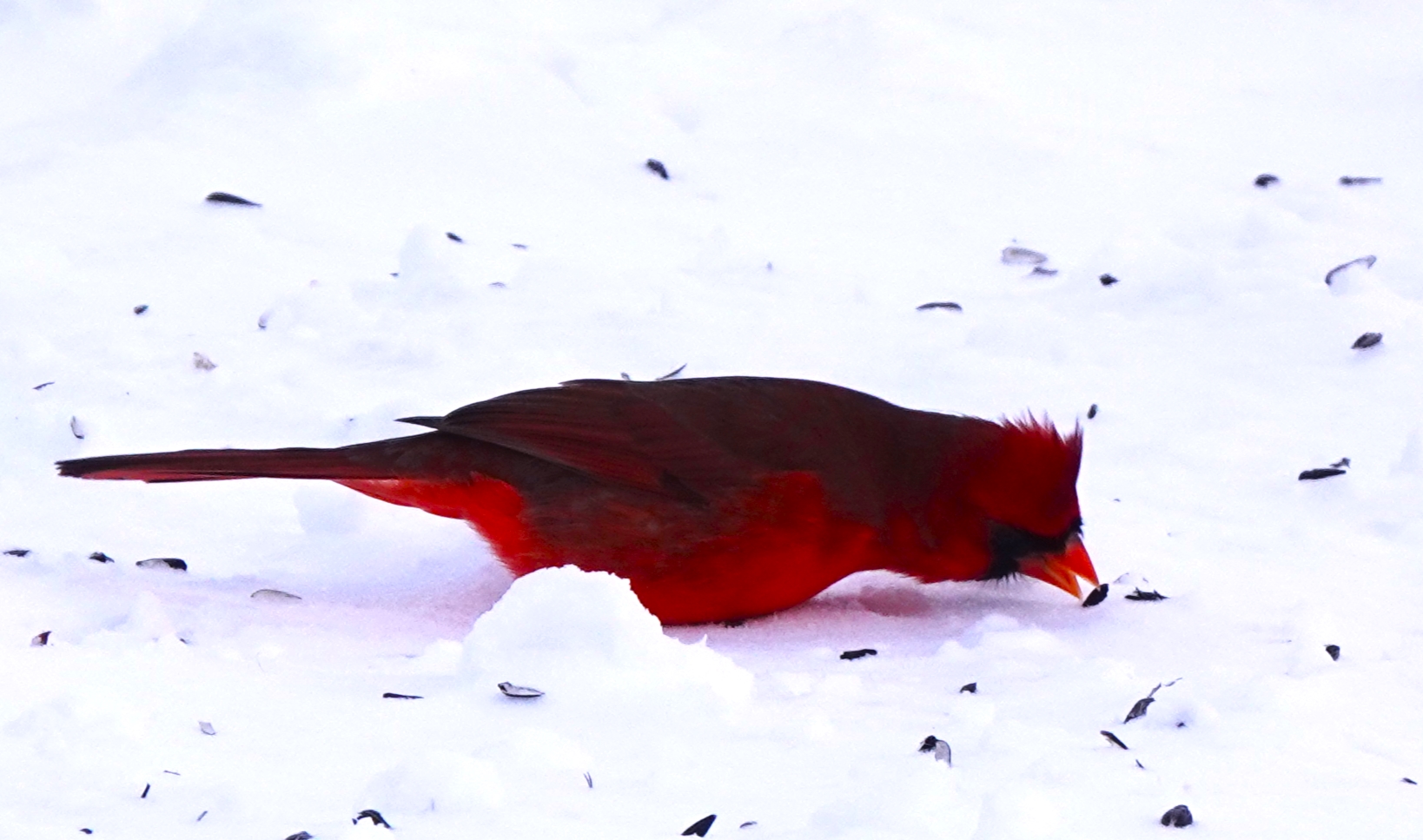
There was a variety of winter birds hanging around the feeders. They were the first wildlife we saw before heading toward the Heron Trail.
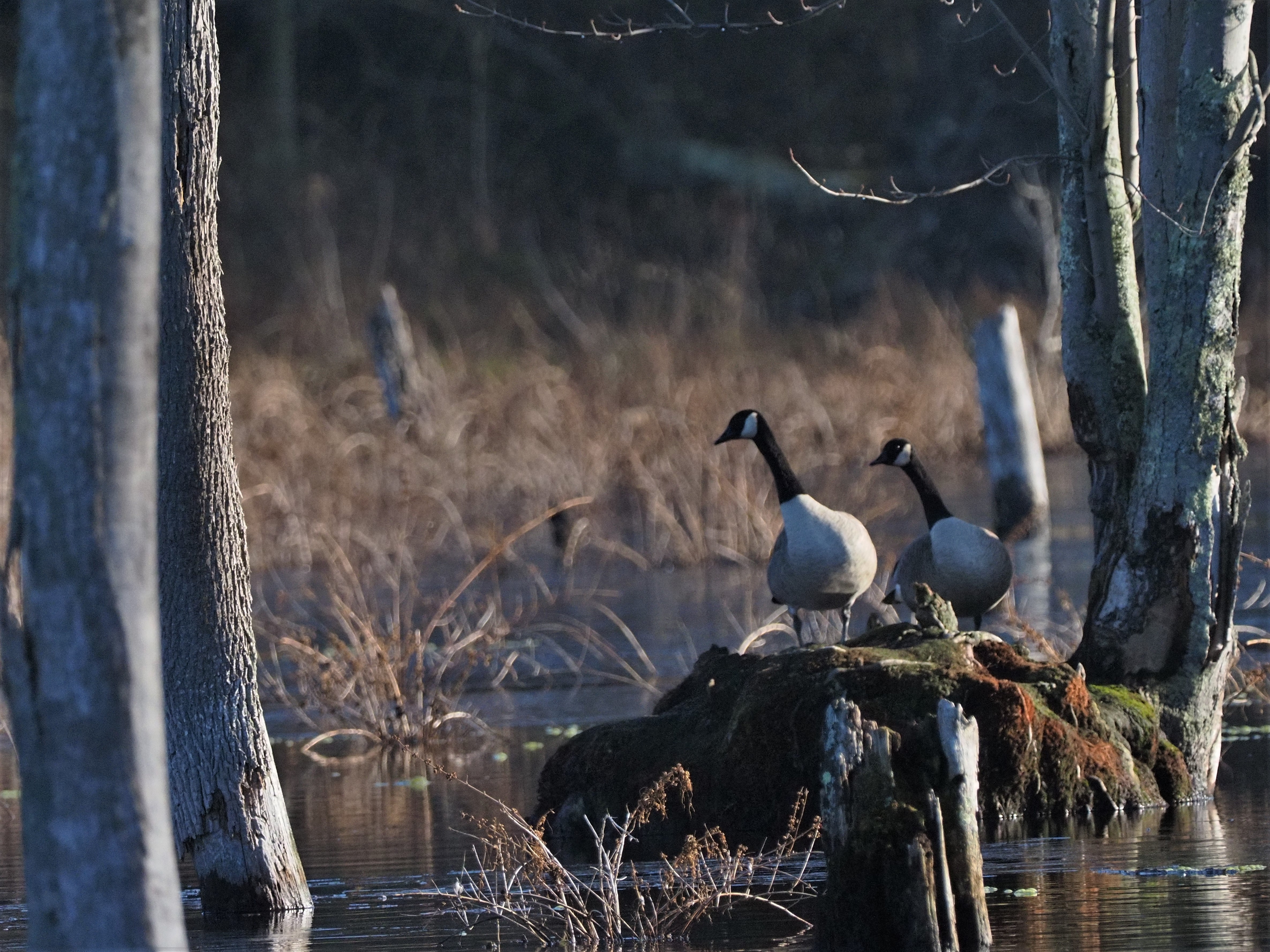
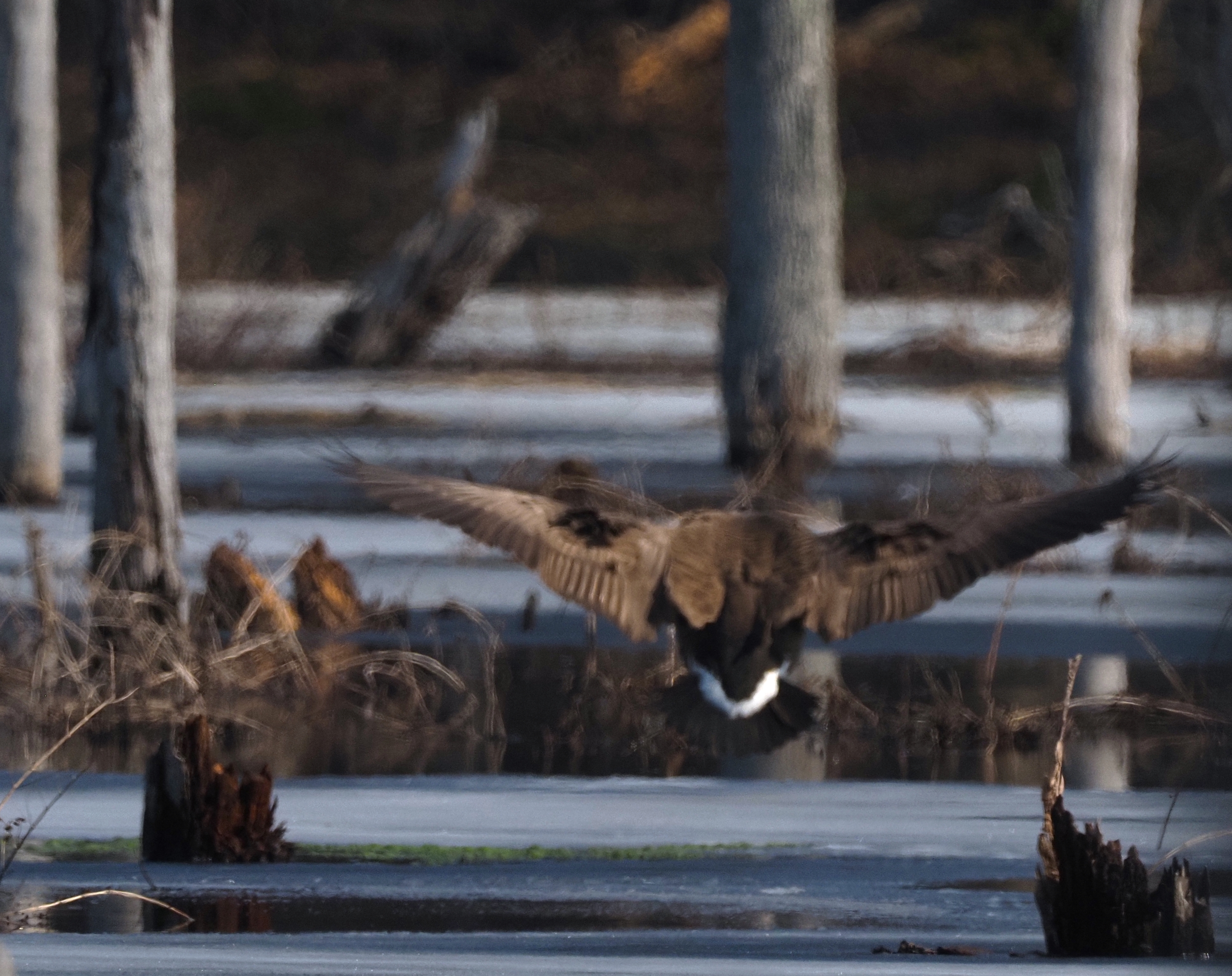 The rookery, of course, was empty, but there were plenty of Canada geese.
Who could miss them? They were making a terrible racket!
Perhaps they regretted their decision not to migrate and enjoy a warmer winter in the south.
Or maybe they just wanted some photographic attention.
In any event, they were duly noted and photographed.
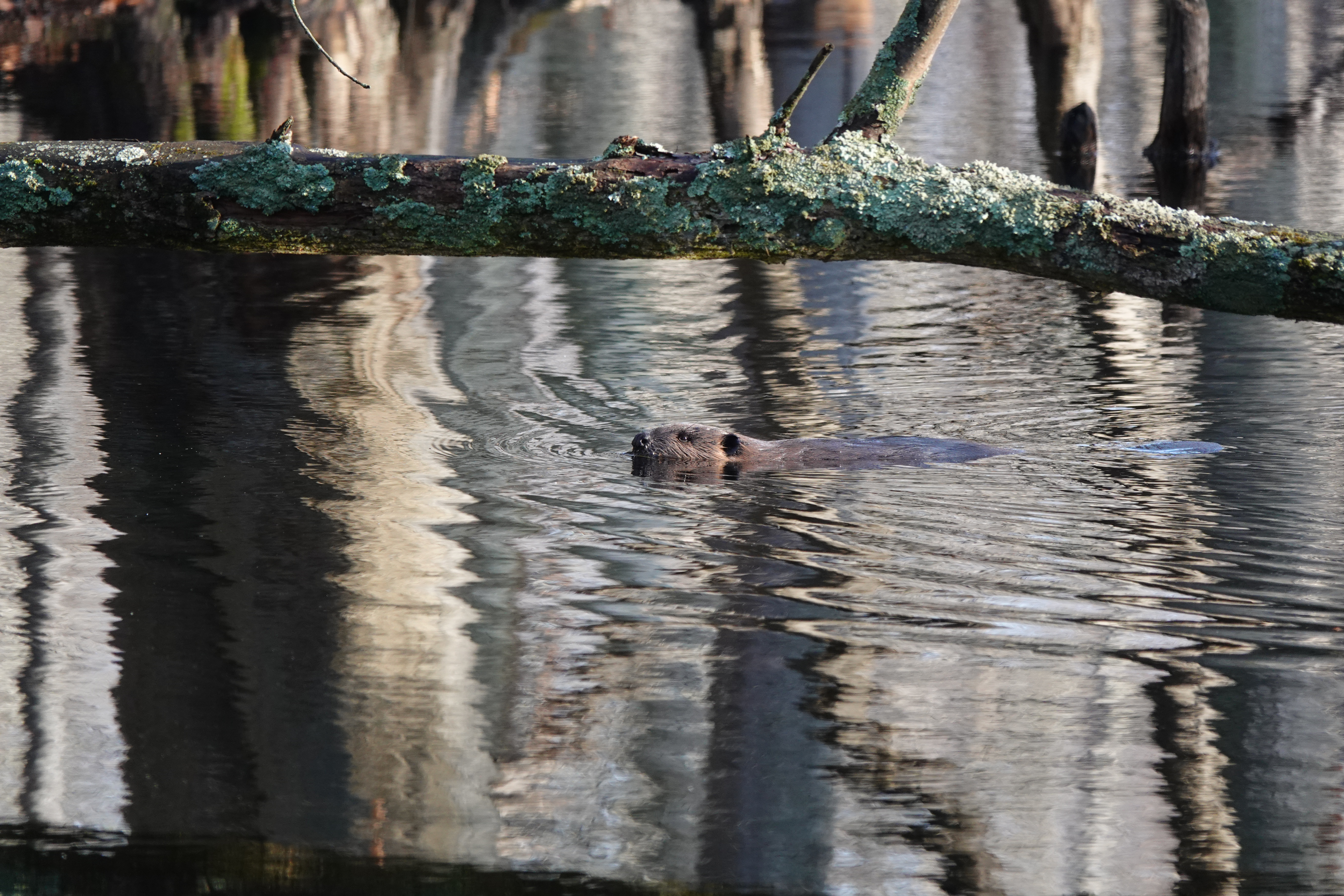 There was evidence of beaver activity on the banks of the outlet stream, and it wasn’t long before we saw one in the water.
They look a lot like muskrats, until you notice that they are quite a bit bigger.
And they have a paddle-like tail rather than the long, skinny rat-like tail that the muskrats have.
It was a cold day, and I struggled to keep the camera warm in between shots. But I was in the sunshine, enjoying nature, appreciating my health, and not worrying about tomorrow.
All in all, a really good day! and a fine way to bid good-bye to 2021 and welcome the New Year.
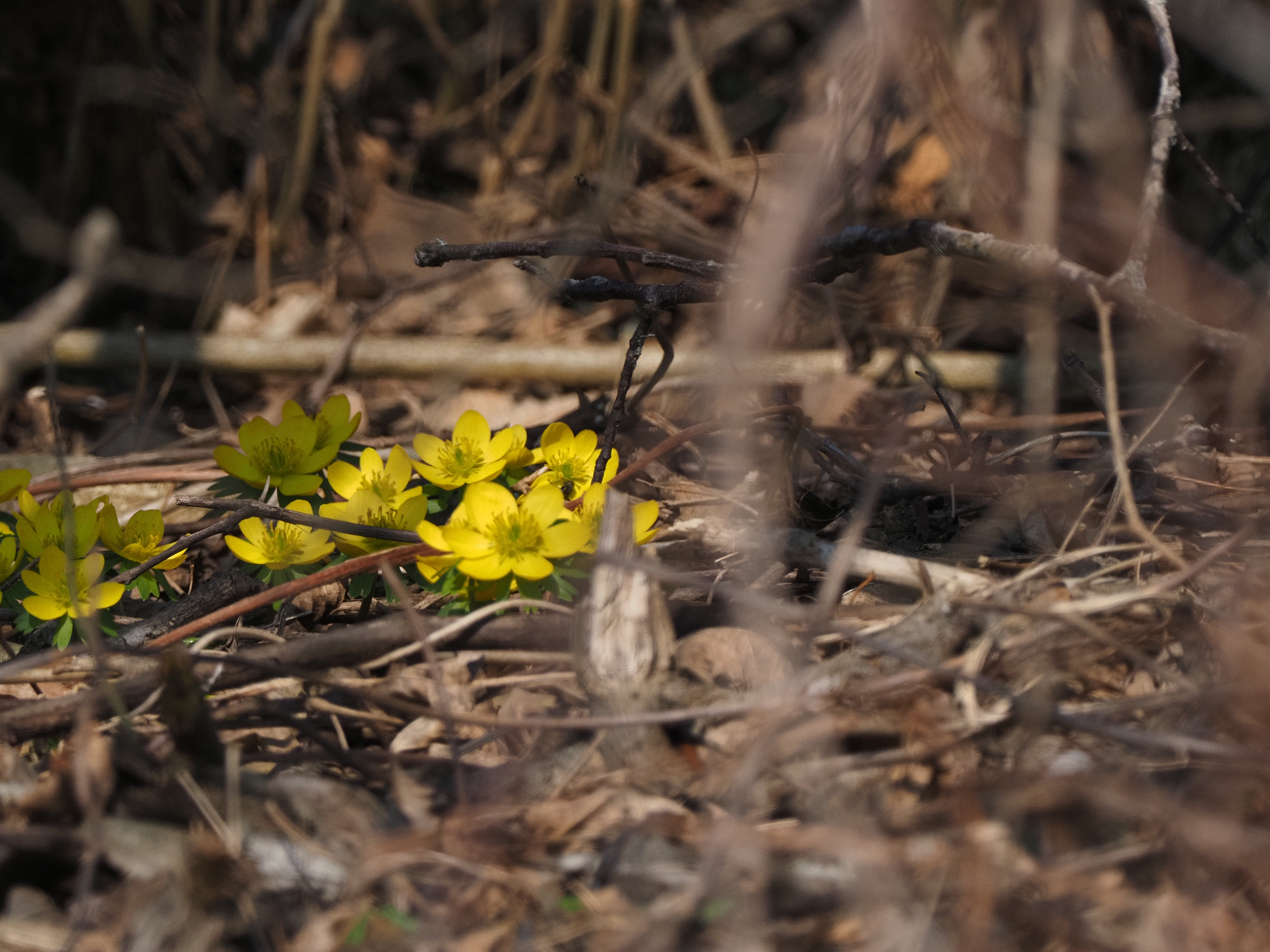
 Yay for the rain! Because it’s the rain — not the marsh managers — that is re-establishing the fish habitat at Montezuma National Wildlife Refuge. . .so keep it coming, Mother Nature!
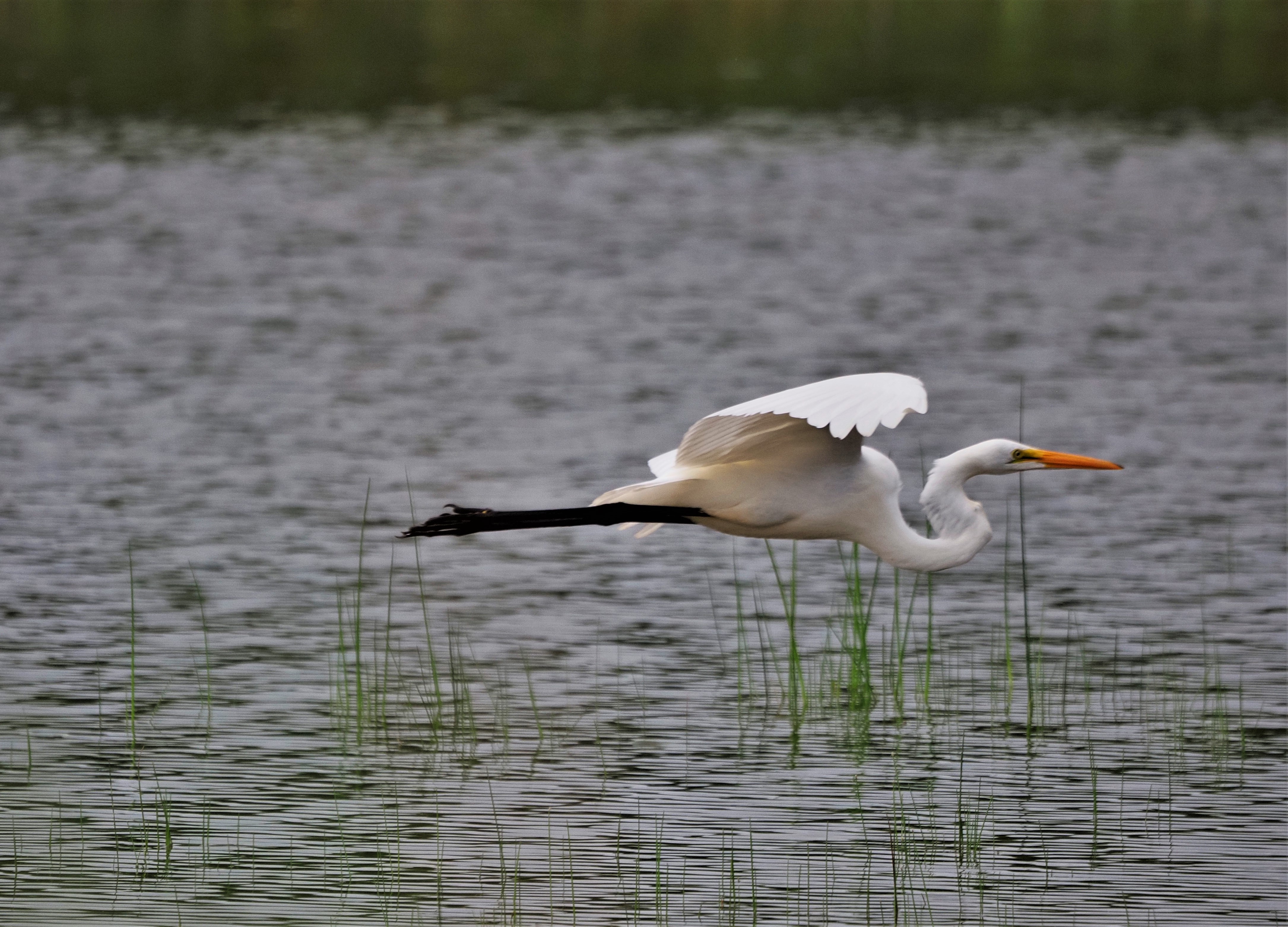 Oh, the rains aren’t enough to fill up the main pool, which was drained into mud flats way back in the spring and is now an overgrown grassland. But it’s enough to fill up the low spots in the main pool as well as to increase the water level in Seneca Flats and a couple of the smaller pools which, until this time, were too shallow to support fish.
Even with the rains, the levels aren’t deep enough to allow osprey, eagles, and other diving wildlife to swoop-and-scoop their dinner, but they are good enough for the waders, who watch, wait, and then plunge for the smaller fish.
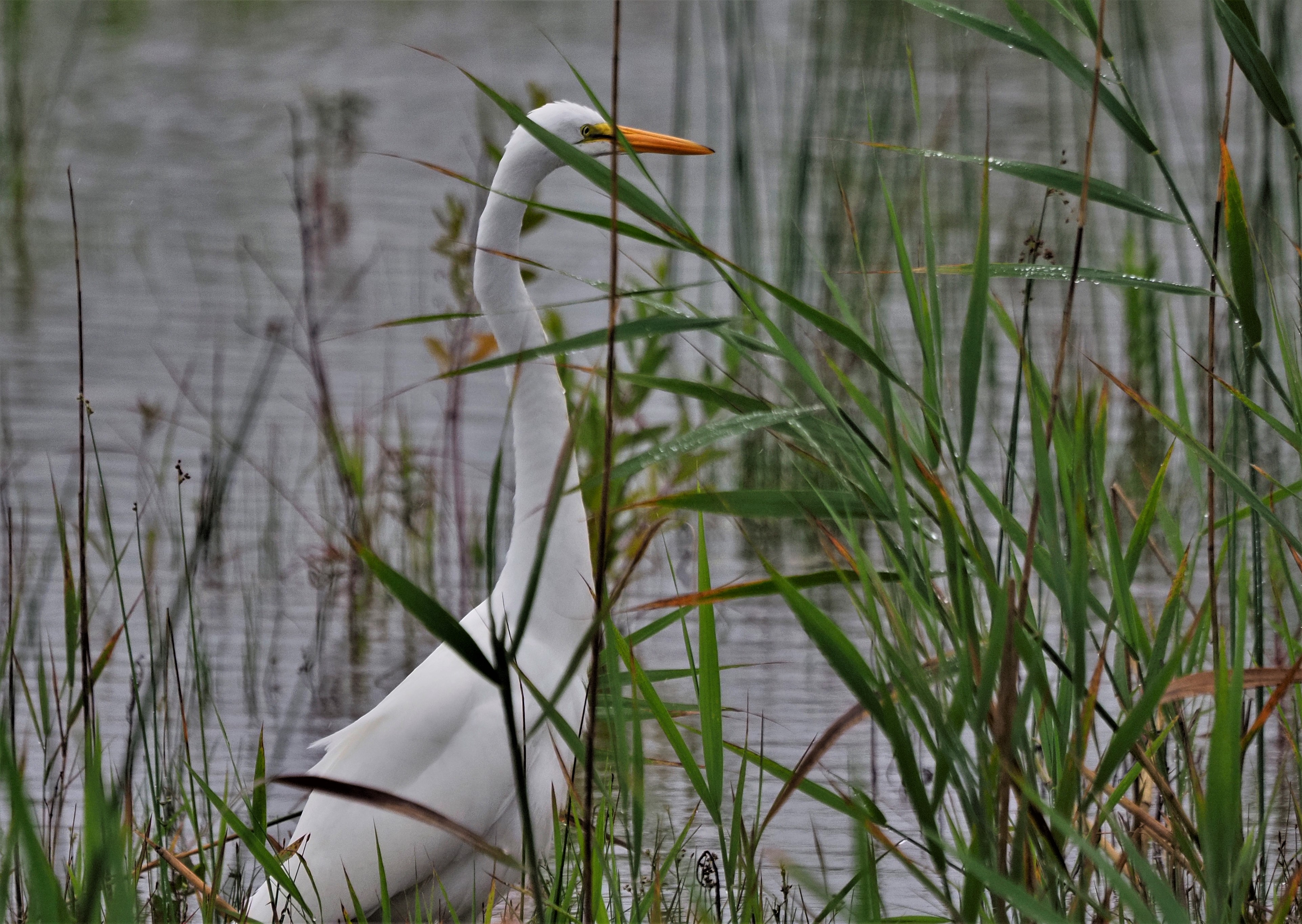 It’s just wonderful to watch the herons, egrets, and kingfishers return!
But nonetheless, the eagles, too, are beginning to return. Perhaps they instinctively know that the water levels will improve in the fall. . . when the MNWR managers will flood the main pool, just as they have for the past three years, to attract ducks to the submergents that have been growing all summer.
After all, the fall is only nine weeks away!
In the meantime, the eagles can find sustenance in the fish that thrive in the canal running alongside Wildlife Drive.
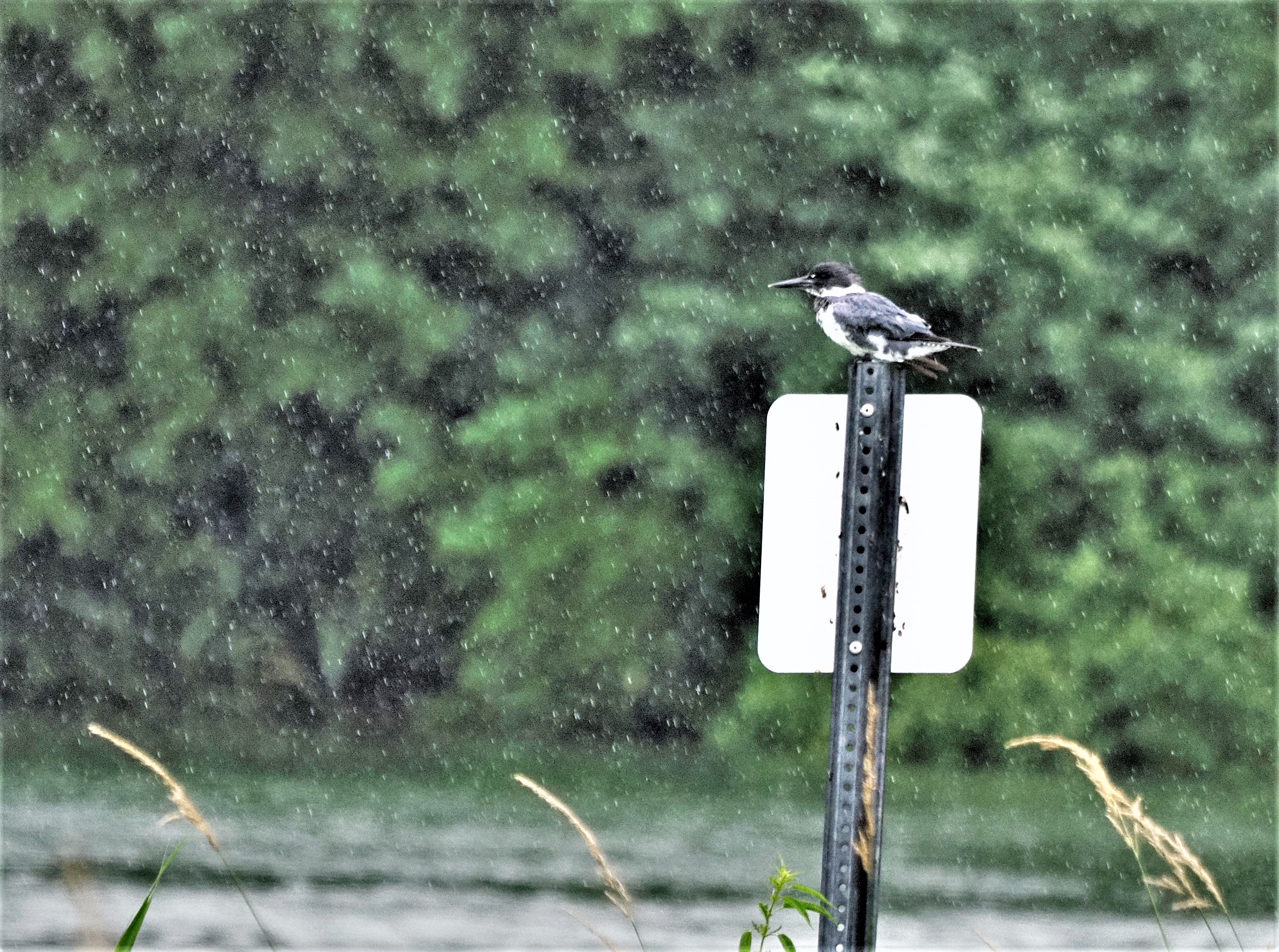
Kingfisher evaluating the fish potential in the Seneca Canal. In the pouring rain!
No one from MNWR messed with the canal, and besides, the recent rains have increased its water level, too.
So, the eagles won’t have to fear breaking their necks as they swoop-and-scoop fish from these deeper waters.
Today Mother Nature was doing her best to maintain and even increase the water levels, so the shooting conditions were challenging.
Everything (and everybody) was drenched.
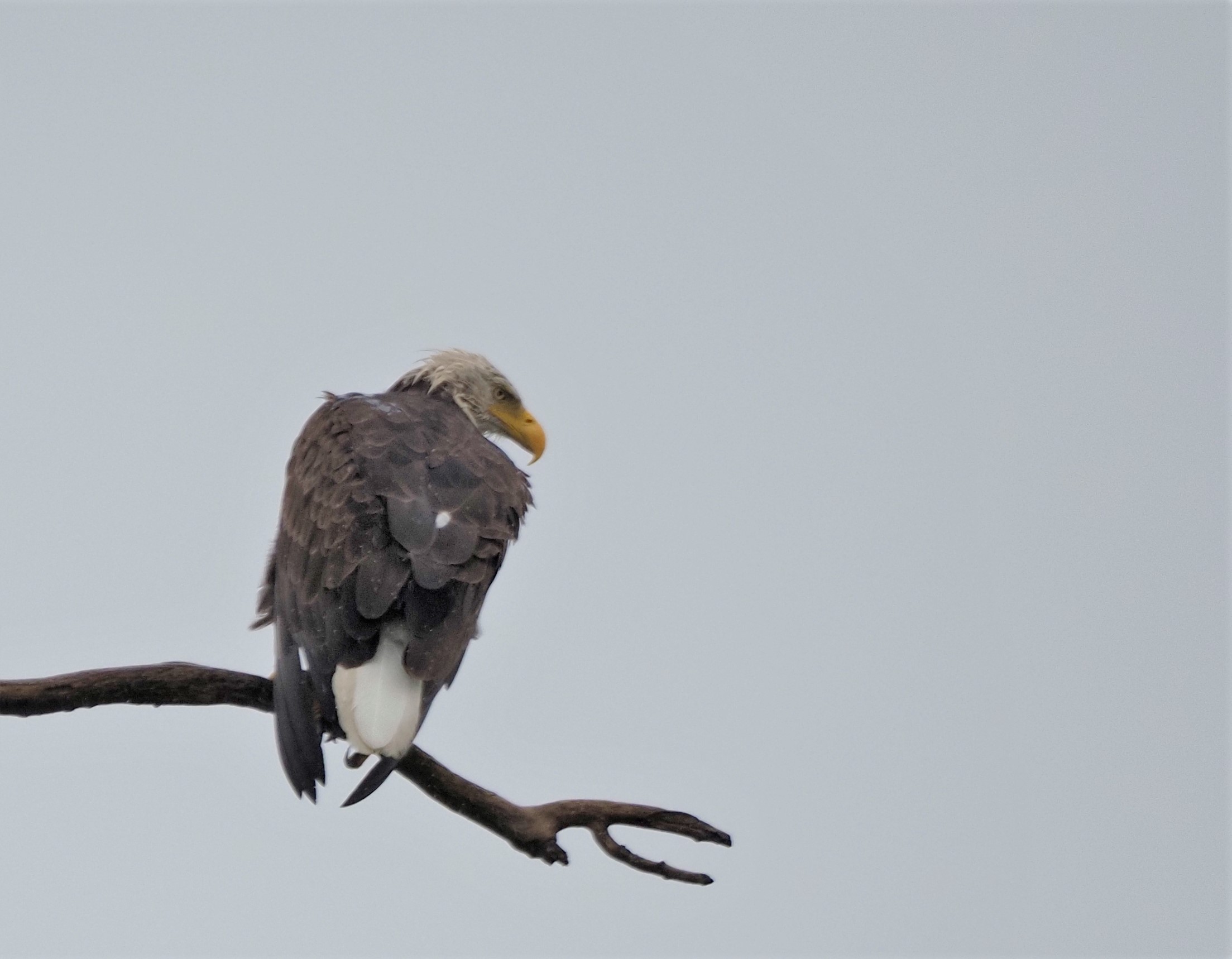
They don’t look so majestic when they are wet and muddy.
But it was wonderful to see the wildlife returning in increasing numbers. Whereas last week I saw maybe one one great blue heron, today I saw 11.
There were no less than 4 adult eagles, and one juvenile. The eagle tree hosted 3 of them trying to dry off their feathers.
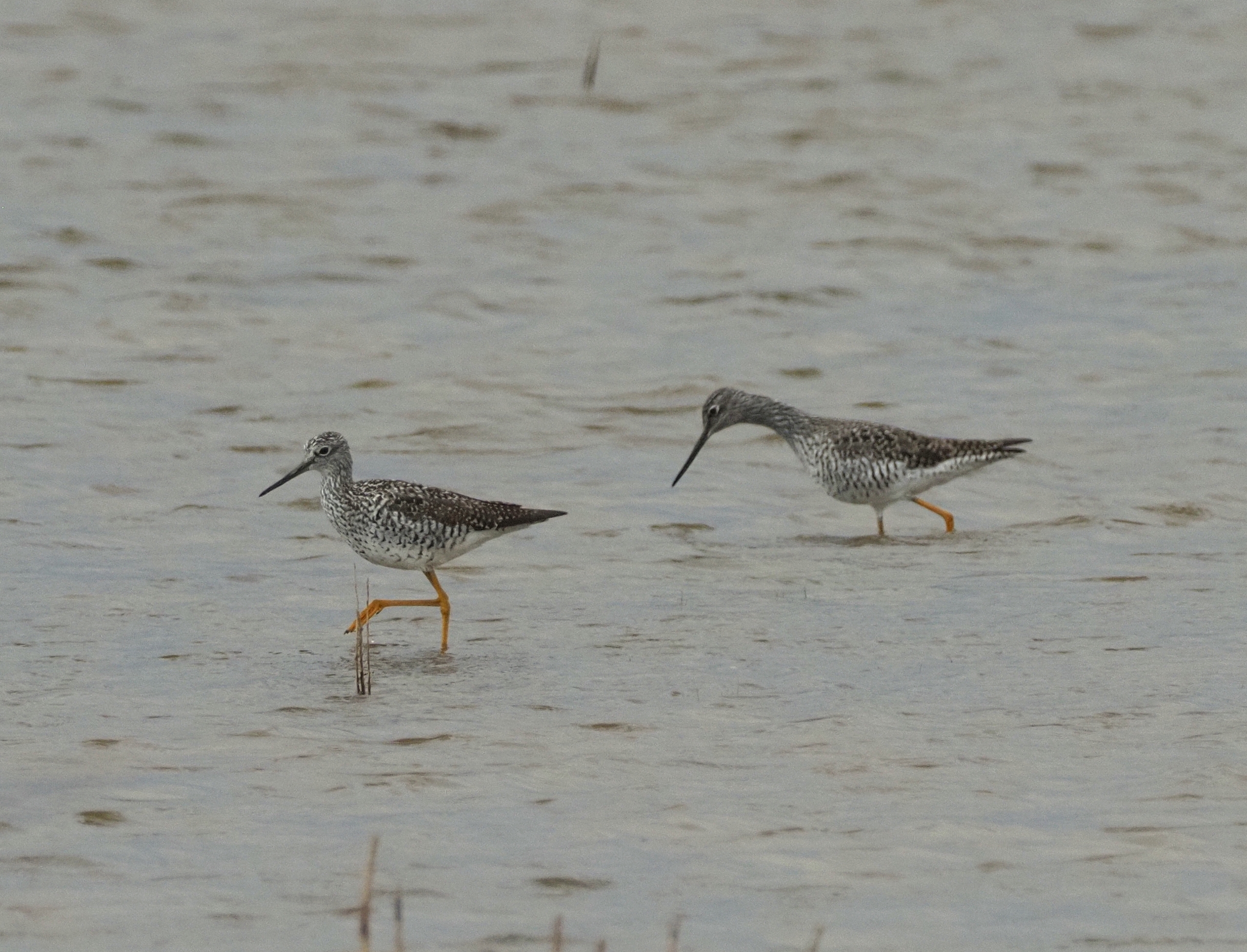
I spotted a single greater yellowlegs last week, but today there were several more.
The word is spreading fast!

Ducks in a row? Nope, these are greater yellowlegs (I think!)
The main pool is crowded with vegetation, and when it is reflooded in the fall there won’t be much room for fish.
So the fish getting this head start in the smaller pools is important both for the fish and the fish-eaters.
There was a lot I could hear but not see on the Drive today.
Too wet to risk my gear outside of the car!
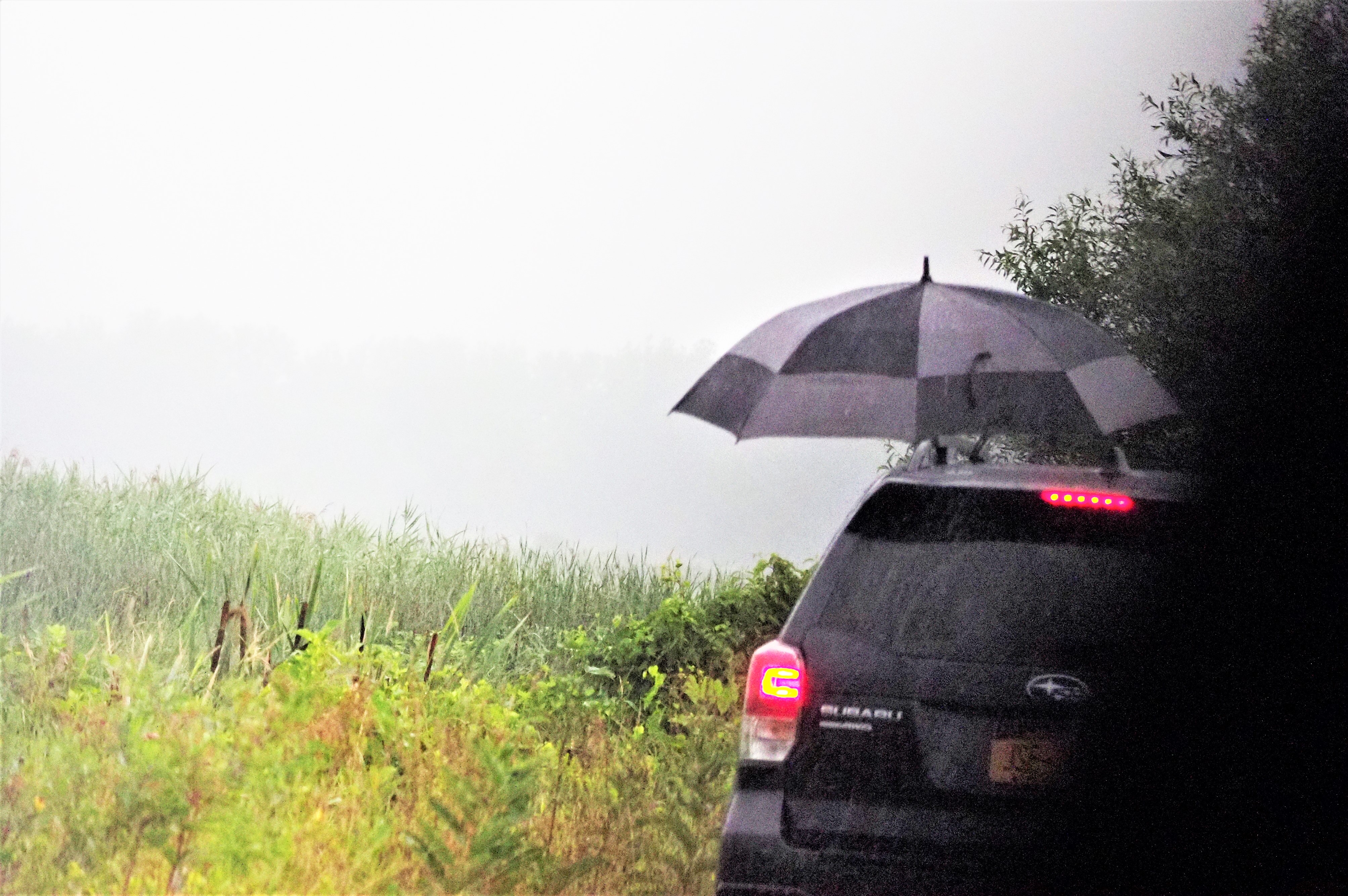
An umbrella and a couple of bungee cords will keep your gear dry even in the pouring rain
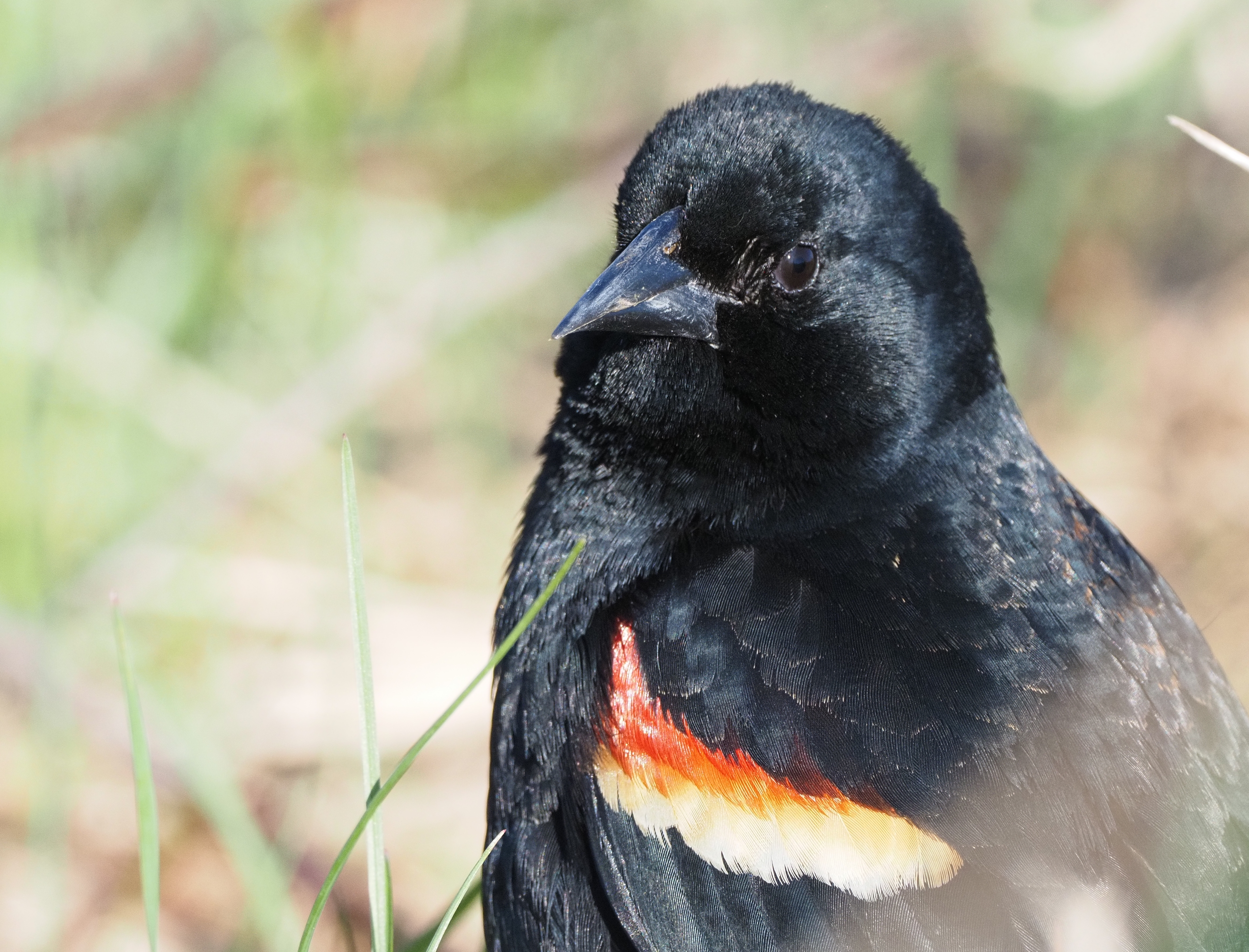
There were bullfrogs calling and marsh wrens warning and a few song sparrows and eastern kingbirds as well. . .and, of course, the redwing blackbirds — nothing shuts them up for long.
But I certainly saw enough to make the trip worthwhile. Thank you, Mother Nature!
A few more from today’s excursion:
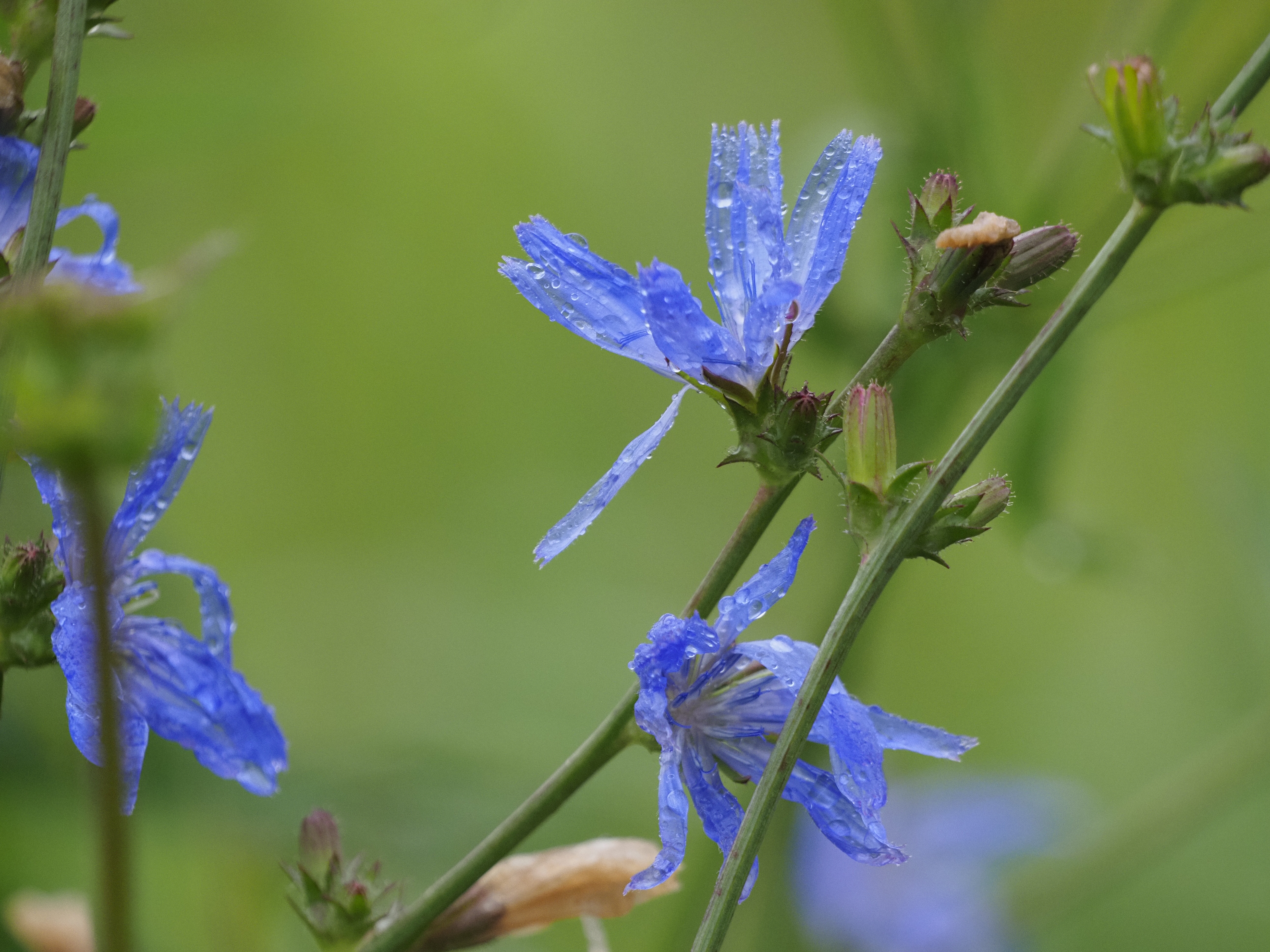

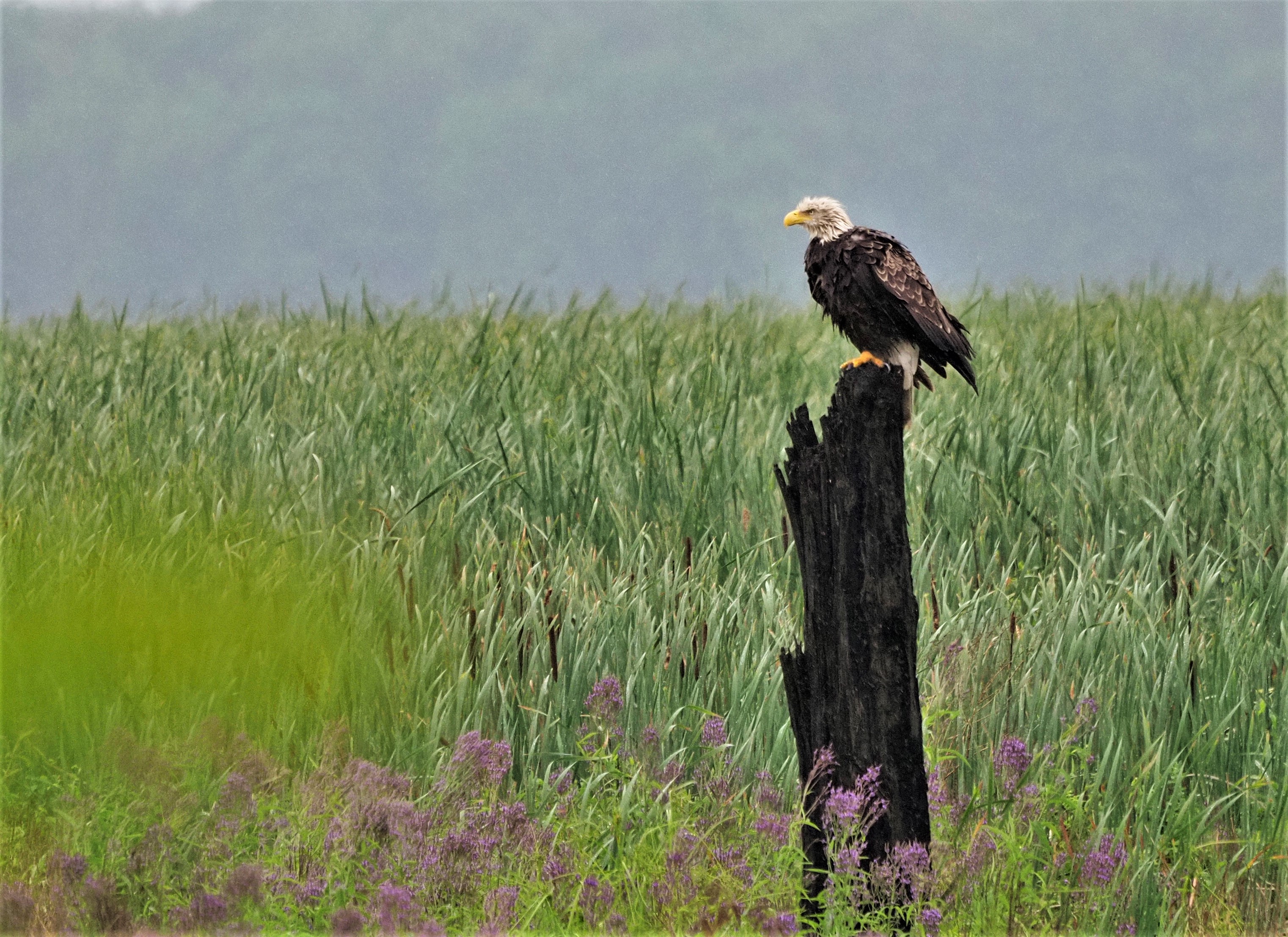
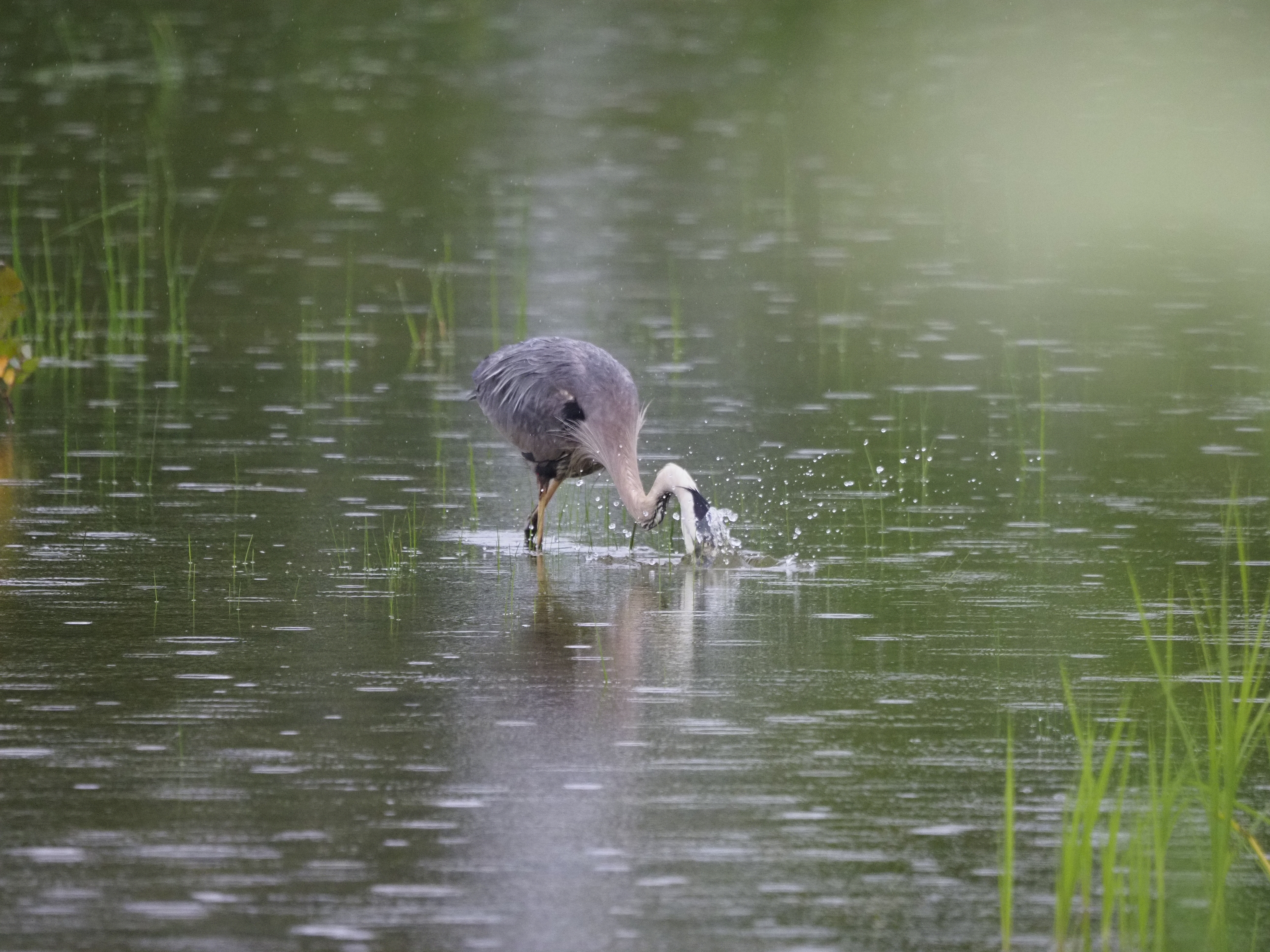

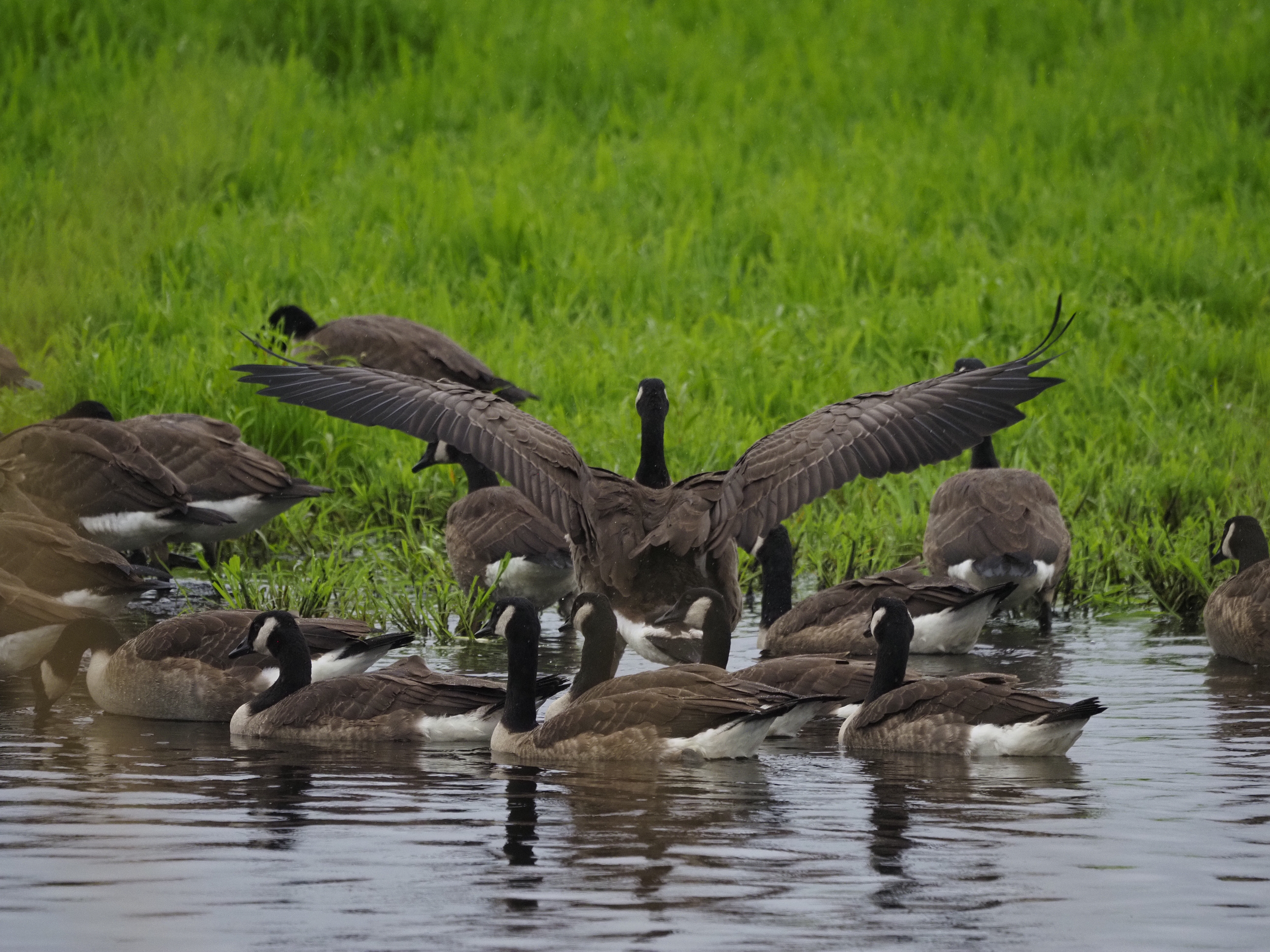
What drugs are they on? If stepping out of your car to set up a tripod disturbs the wildlife, what do they think draining the marsh and eliminating the entire fish habitat does? How do they hire people at MNWR — do they stand on street corners and ask passers-by “are you stupid?”
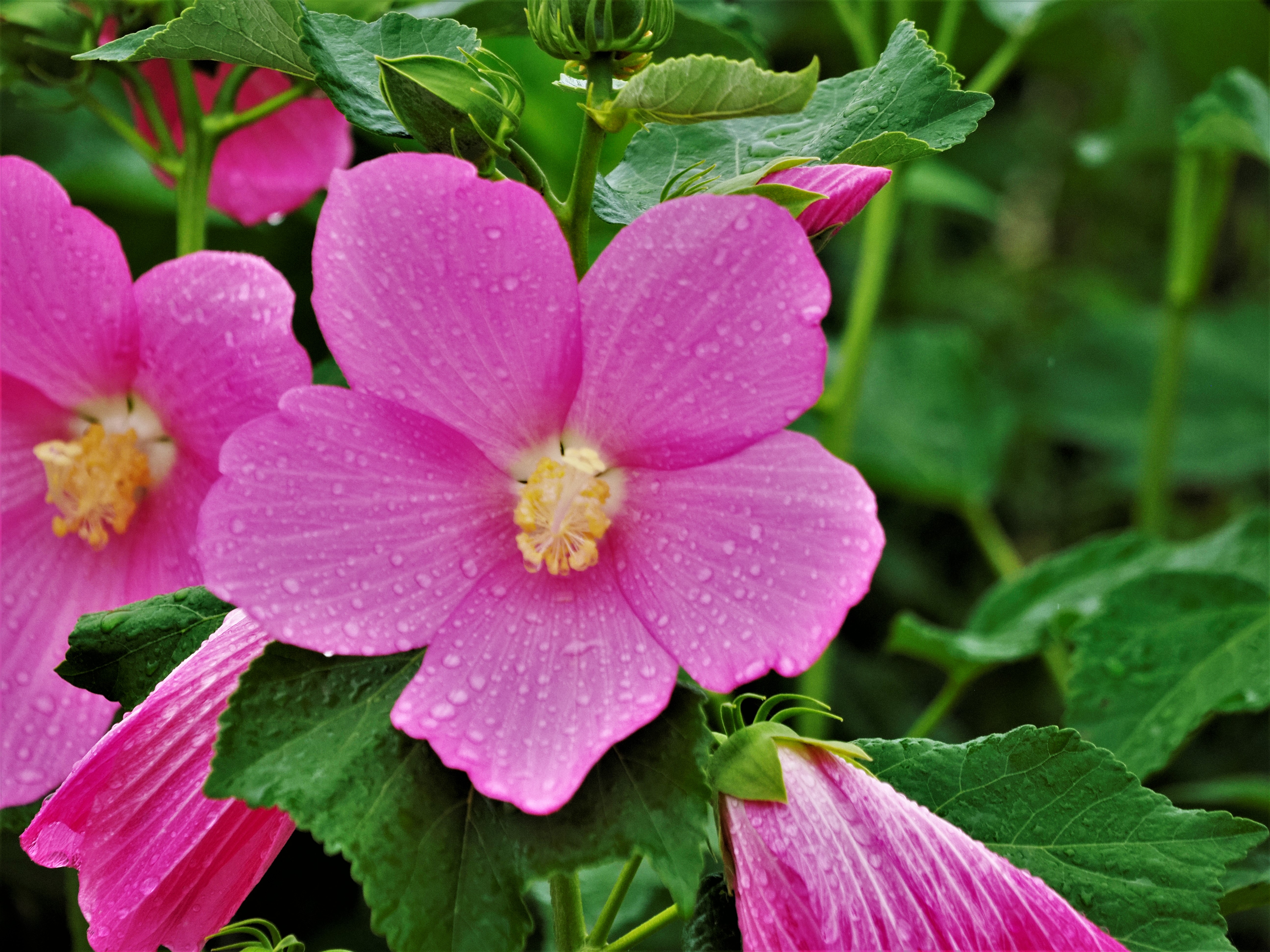
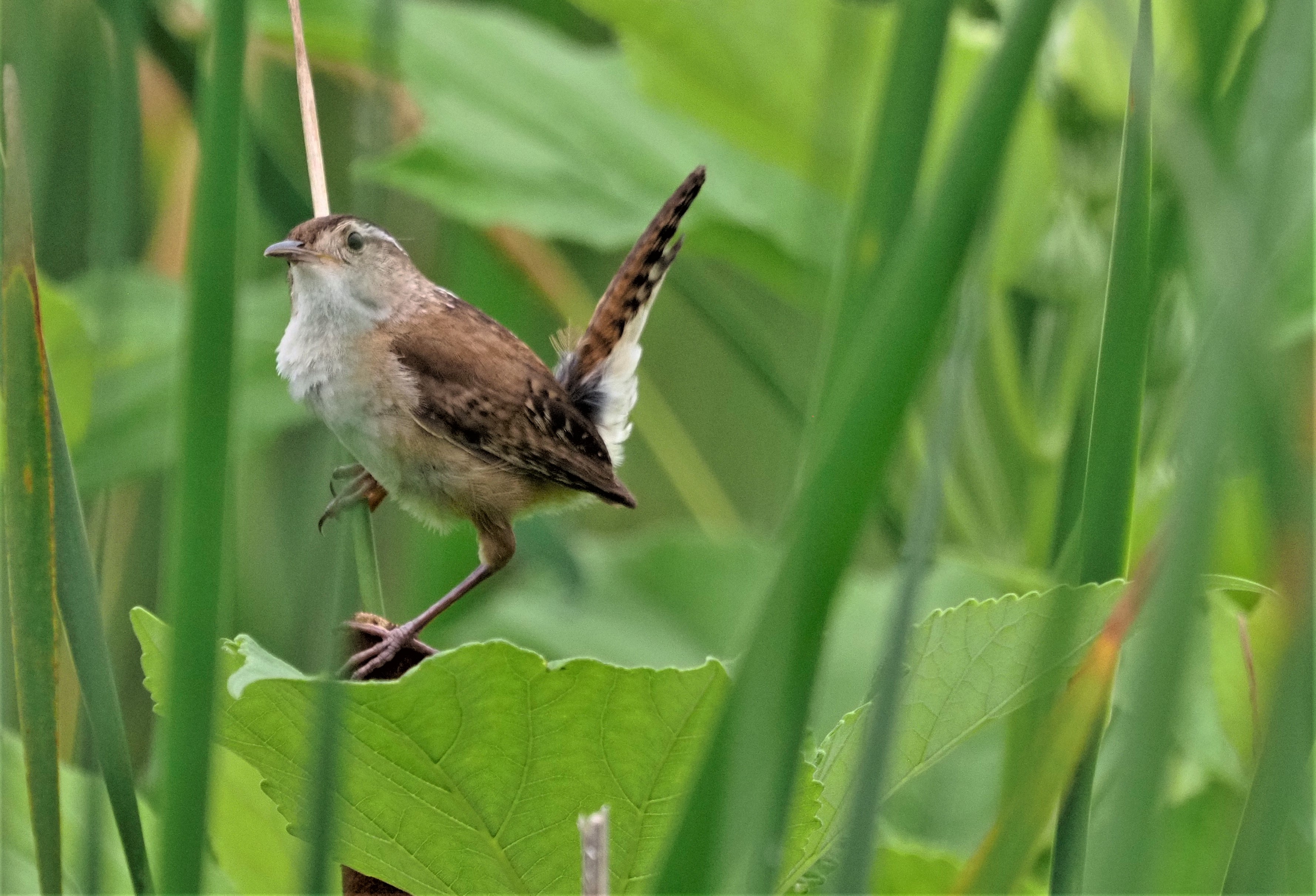
Marsh wrens like to splay their legs, often using two different plants to balance upon.
You can hear them in the cattails, but they are very hard to see.
That’s because they don’t sit at the top, like the song sparrows do; they much prefer to hide at mid-level, where the greenery is at its thickest.
So, get familiar with manual focus, because autofocus will fail miserably.
That’s because autofocus will struggle for a while and then settle on the nearest subject. So instead of getting an in-focus marsh wren, you will get a fuzzy one.

Song sparrows are drab-colored, too, but it’s easy to tell them apart from a marsh wren.
The marsh grass in front of it will be quite sharp, though.
Just a little tip from a newbie who learned the hard way 🙂
Marsh wrens have no distinctive coloring, like the redwings do. Their muted brown colors blend in with the rush thickets.
They really like to hide!
But get too close to a nest, and these tiny, drab-colored birds will rattle up a storm of protests!
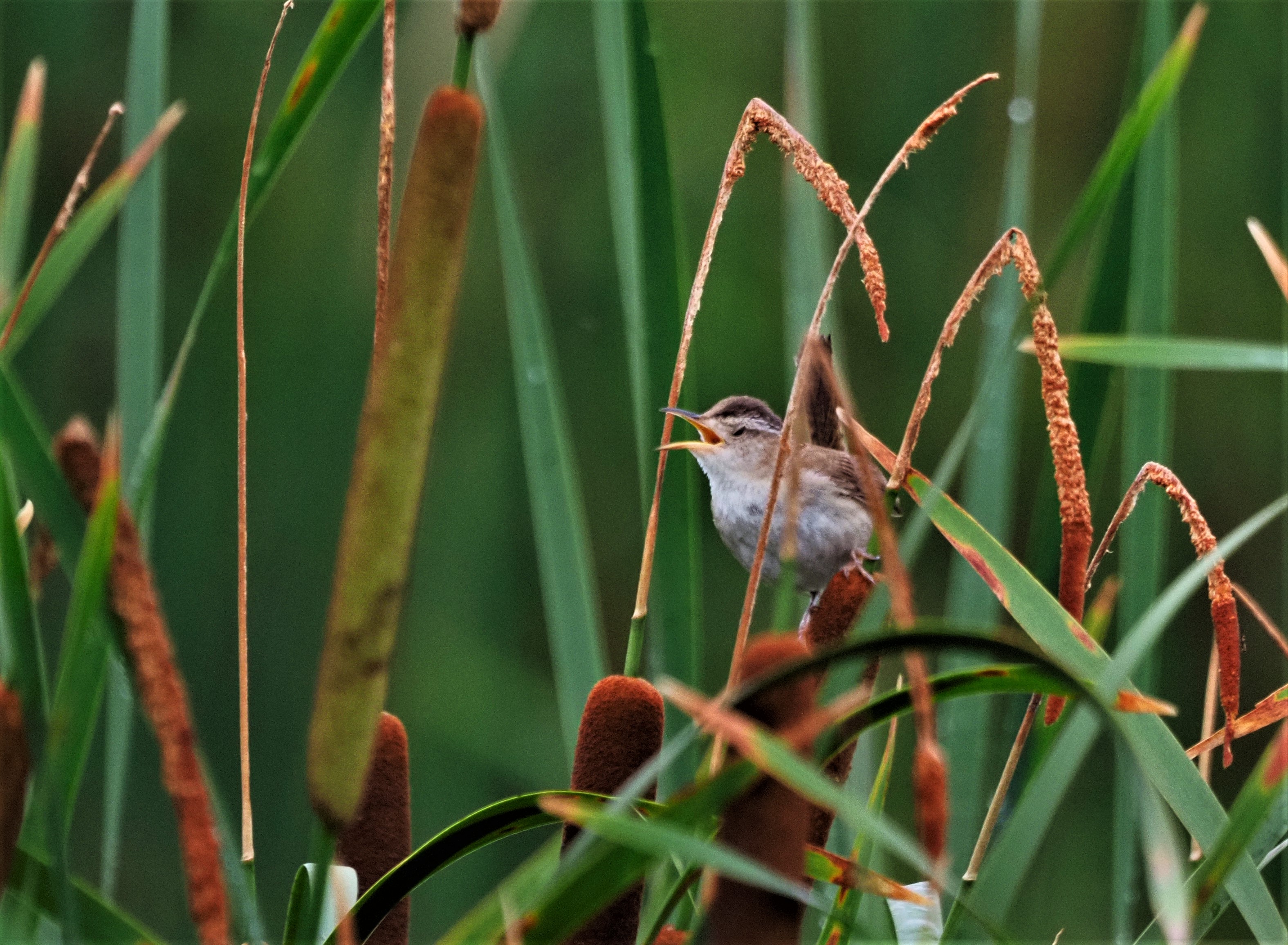
Noisy little thing!!!
There are lots of small, drab-colored birds that hang around marshes, but there are a couple of features will distinguish the marsh wren from the others.
Like, their rattly calls. And their tails, which they stick almost straight up in the air.
They are feisty birds, especially the males.
The males are not monogamous but will mate with two or more females. They not only build the nest, they will build many of them.
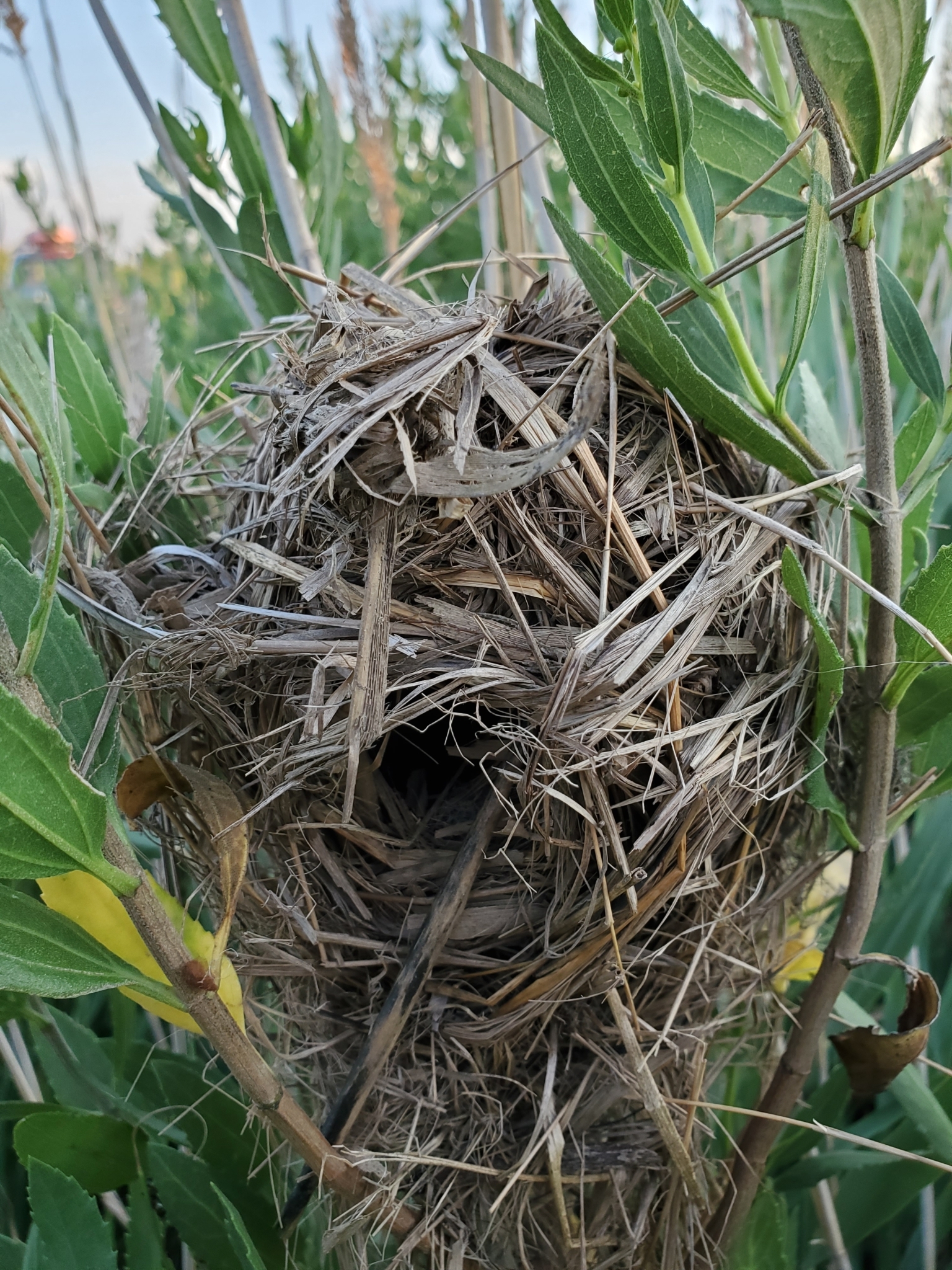
The nests are hard to spot. This one is in a Maryland marsh, https://www.marylandbiodiversity.com/view/1212
And they are quite territorial — the males are known to peck holes in the eggs of other birds as well as other marsh wrens.
So, it’s probably wise not to get on their bad side, especially if you live in a marsh.
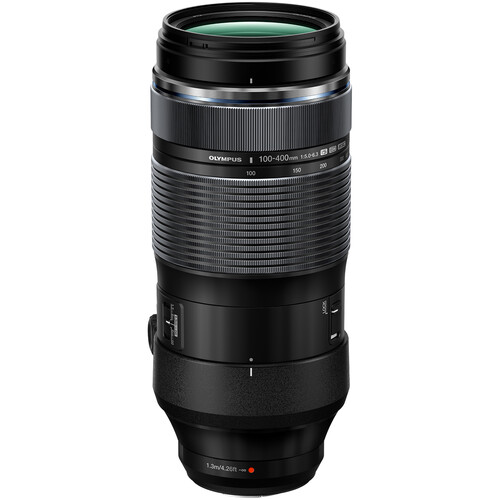
I love this lens! Just over half the cost of the Canon L series 100-400, it gets an impressive 800mm equivalent view, something that the Canon can’t do without an extender. And, again like the Canon, it’s versatile with a selection of distance ranges, as close as 1.3m to 6m to infinity. So, for less money (and less weight!) you get some pretty good results, even if you are a newbie like me.
Olympus makes better lenses, most notably the 40-150 f2 PRO and the incredibly expensive 150-400 f4.5 PRO, but it’s the 100-400 f5-6.3 that will satisfy most budgets. Even the experienced dedicated hobbyist should be pleased with what this lens can do.
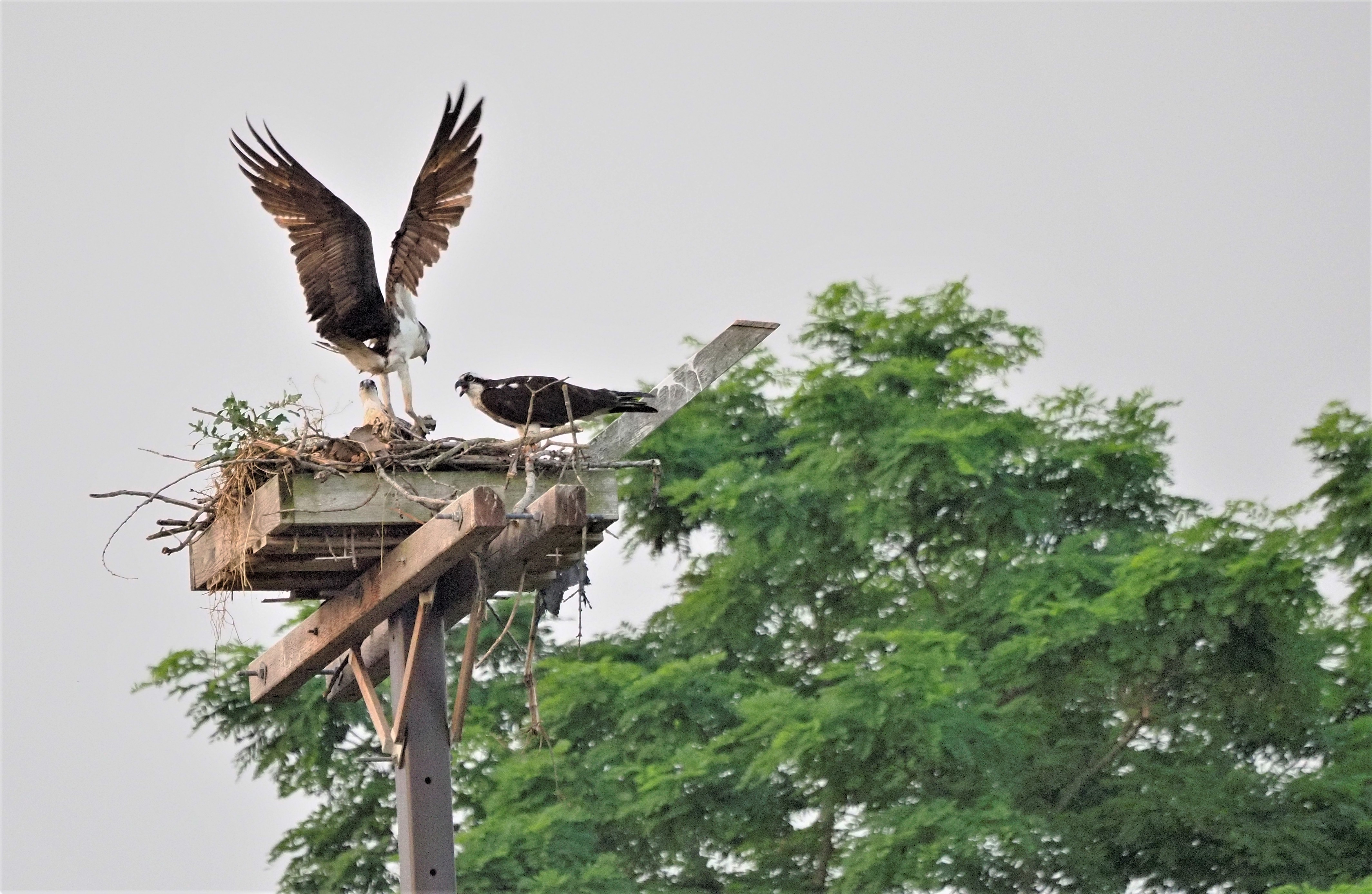
A quick roadside shot in some diffuse light.
I experimented with the Oly 100-400 at Montezuma National Wildlife Refuge a few days ago. Even though so much of the wildlife has been driven from the refuge due to restrictive marsh management, some fauna and flora remain, at least enough for me to practice on.
Working from Wildlife Drive also allowed me to bring all my gear without trekking over a hot, dusty trail, plus it was a lot easier to take notes and make lens adjustments while sitting in the car.
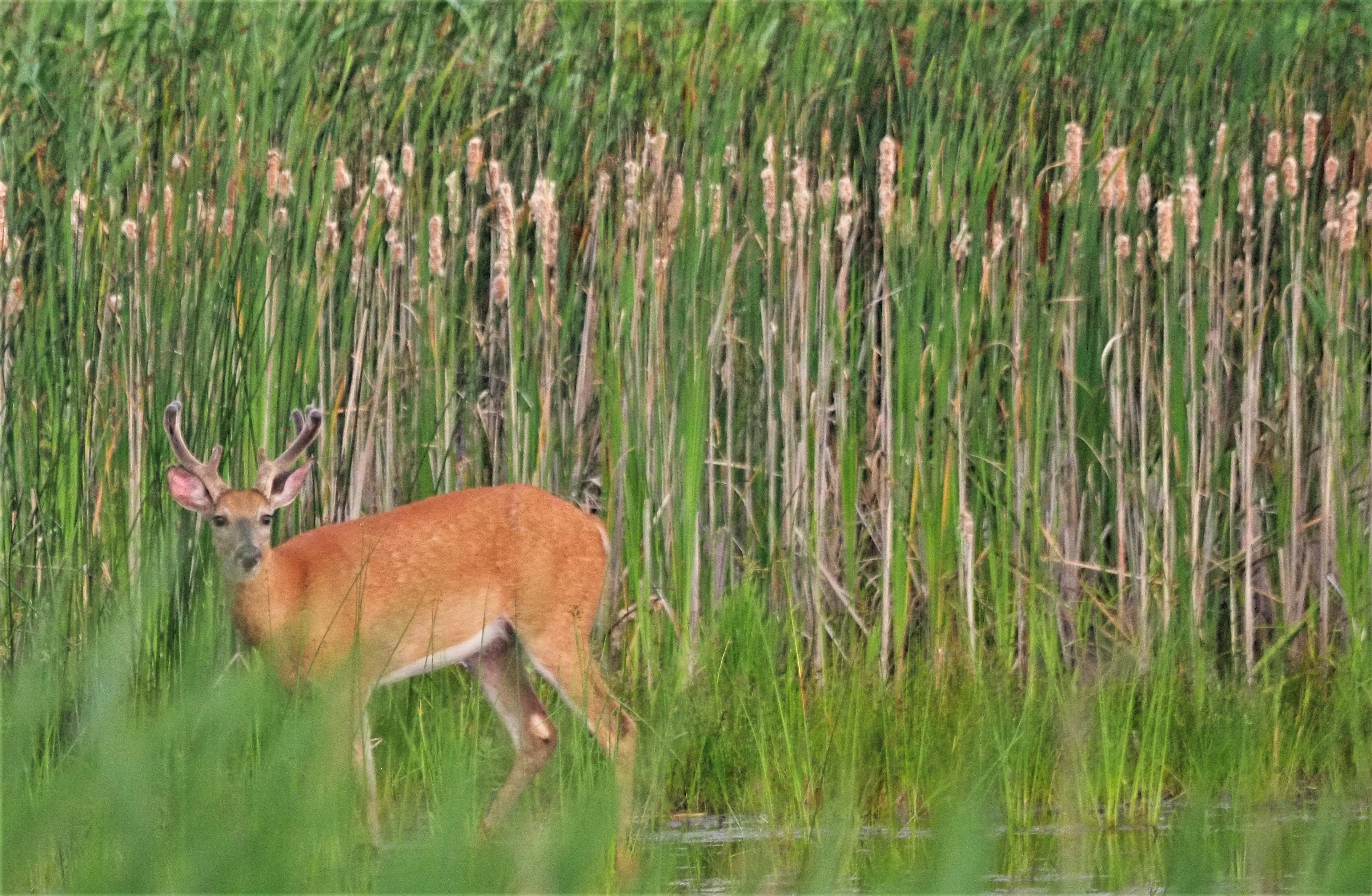
Even at a distance of almost 400′, the Oly 100-400 managed to capture the catchlight in the eyes of this young buck, still in velvet.
Most of the shots were straightforward point-and-shoots, but some required the additional use of manual focus, another feature that I avoided — until recently.
Emboldened by the success of range switching, I decided to experiment with the manual focus feature as well. I lost a lot of action shots (not too skilled using the focus ring yet), but the standstills were definitely worth the effort.
Of course, the weather worsened before it got better. A brief r4ainstorm cleared the cloudiness and revealed bright blue skies with great early-morning light. Even phase-detect needs good light (and some contrast) to do its best work! The Olympus OM-D EM1iii color engine has to be the best in the business, and the blue skies and deep color proved it.
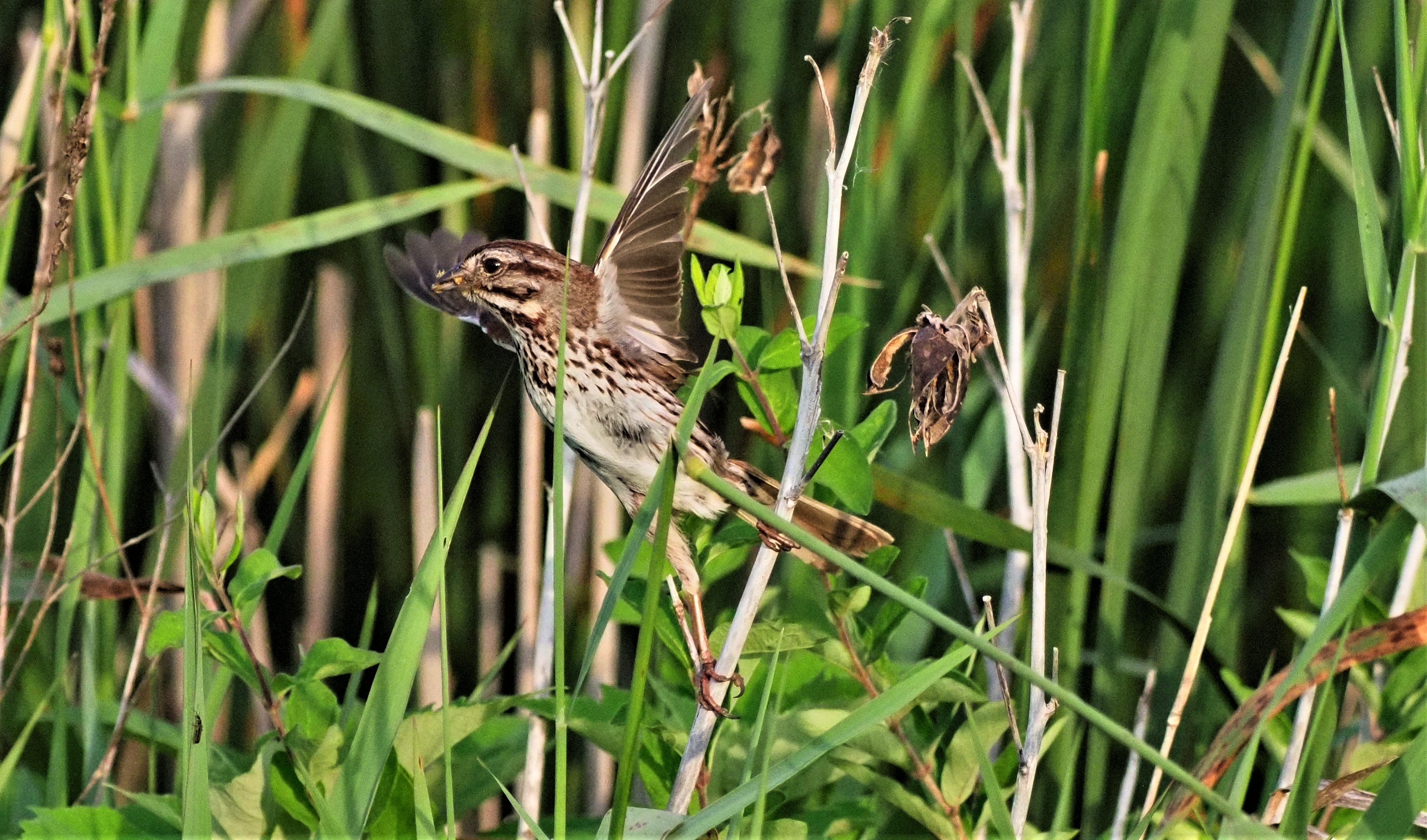
Autofocus would have struggled interminably and would likely have set focus on the grassy weeds in the foreground, rendering the bird a hopeless blur.
The combination of shorter distances plus manual focus resulted in some fairly good shots. Before I learned about these lens features, I would bring a different camera outfitted with a shorter-focal-length lens to get closer to my subjects — a real hassle that is simply not necessary any more!
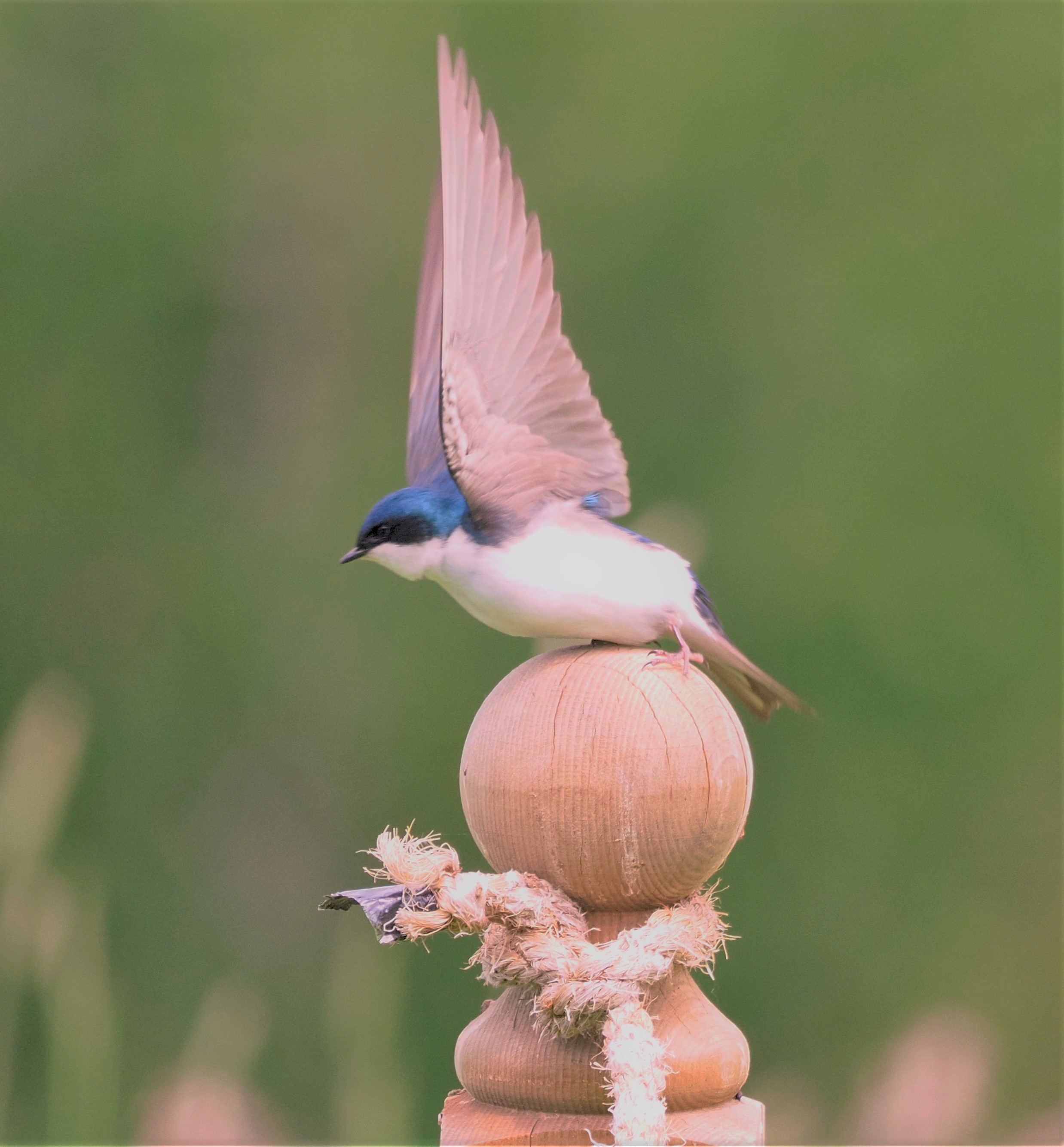
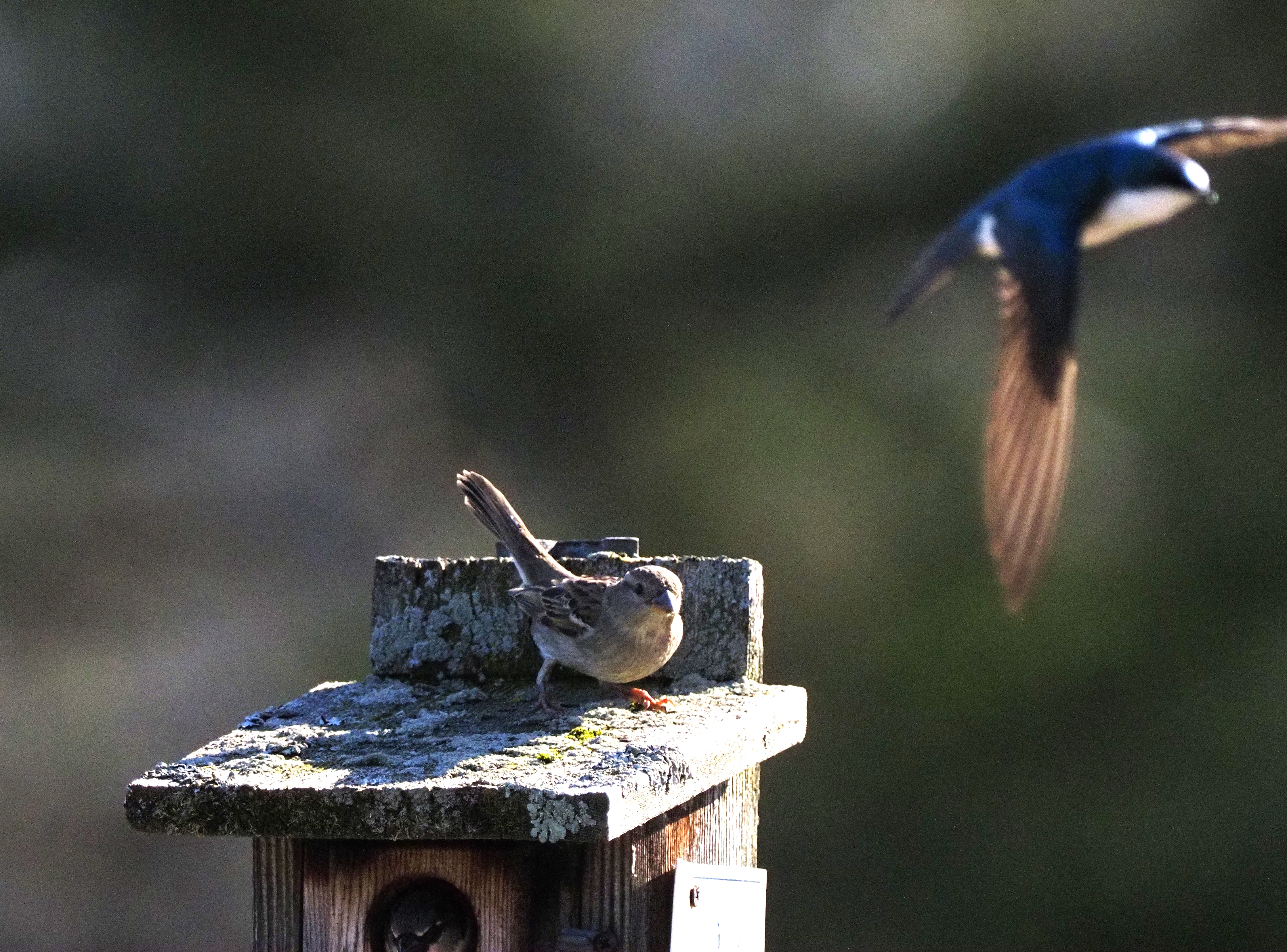
A tree swallow prepares for take-off. The whites are blown, but at least you can tell it’s a bird!
I think my next purchase will be the Olympus 40-150 f2 PRO, perhaps with an extender, but it’s going to have to wait a while. Not only am I short, round, and opinionated, I’m also poor. But in the meantime, I plan to improve my technique with the 100-400.
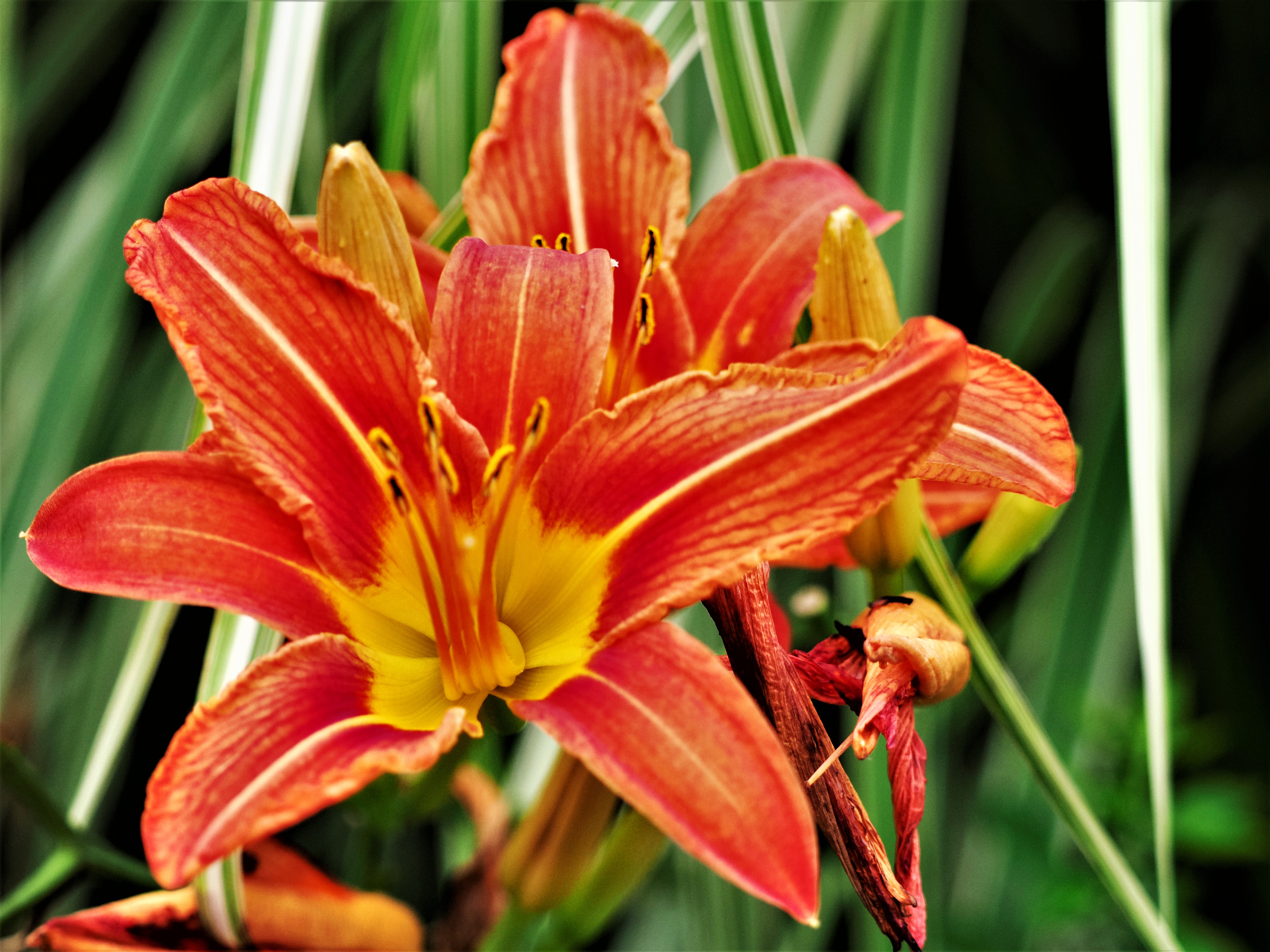
Roadside daylily in all its glory
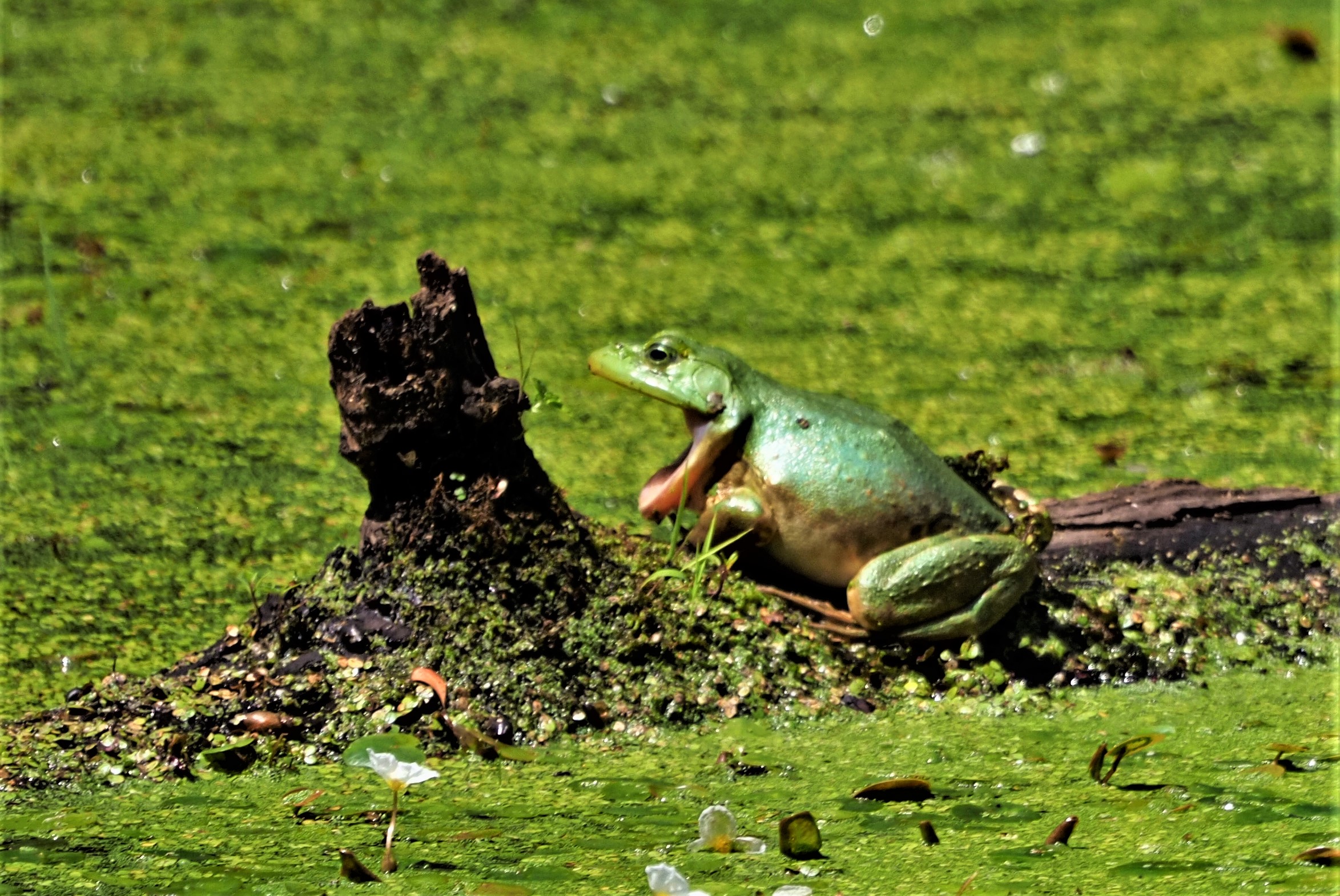
It was supposed to be a butterfly hunt, led by SNC Director Jim D’Angelo, but despite all good intentions it was upstaged by The Bullfrog Chorus, which put on quite a show.
I’m surprised I arrived on time, given the distractions presented to me along the Rt 104 drive. . .distractions that were just too beautiful and intriguing to ignore. But I didn’t dally too long because I didn’t want to miss the butterflies!
It was a lovely day. Some butterfly views were captured, but only briefly. A monarch or two were sighted along with a pearl crescent and a lovely tiger swallowtail.
 The star of the butterfly show was certainly the cabbage whites. However, they didn’t stick around long enough for a good photo. . .but I took some anyway :-)
Still, the hike was fun, and Jim proved to be a knowledgeable and excellent guide, pointing out the flora and fauna we encountered, including the poison ivy and the poison ivy look-alikes.
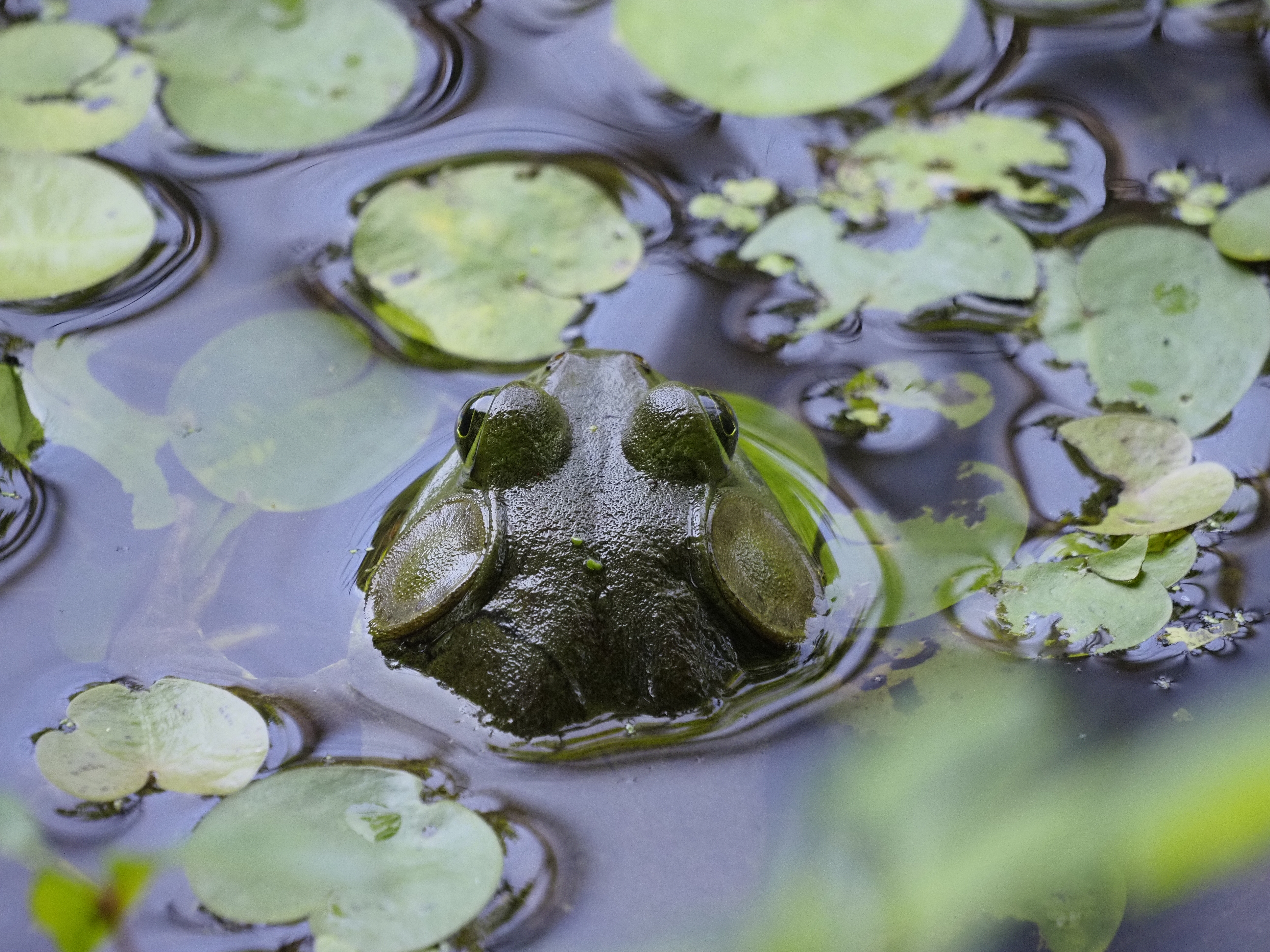 Bypassing the rookery (which is very difficult to do!), we were led to the banks of the beaver outlet stream, and we weren’t disappointed. The bullfrogs were calling, and their songs were delightful. And some of them were willing to pose for photos!
Thanks, Jim! Can’t wait til Dragonfly Days arrive!
A few more takes from the butterfly hike:
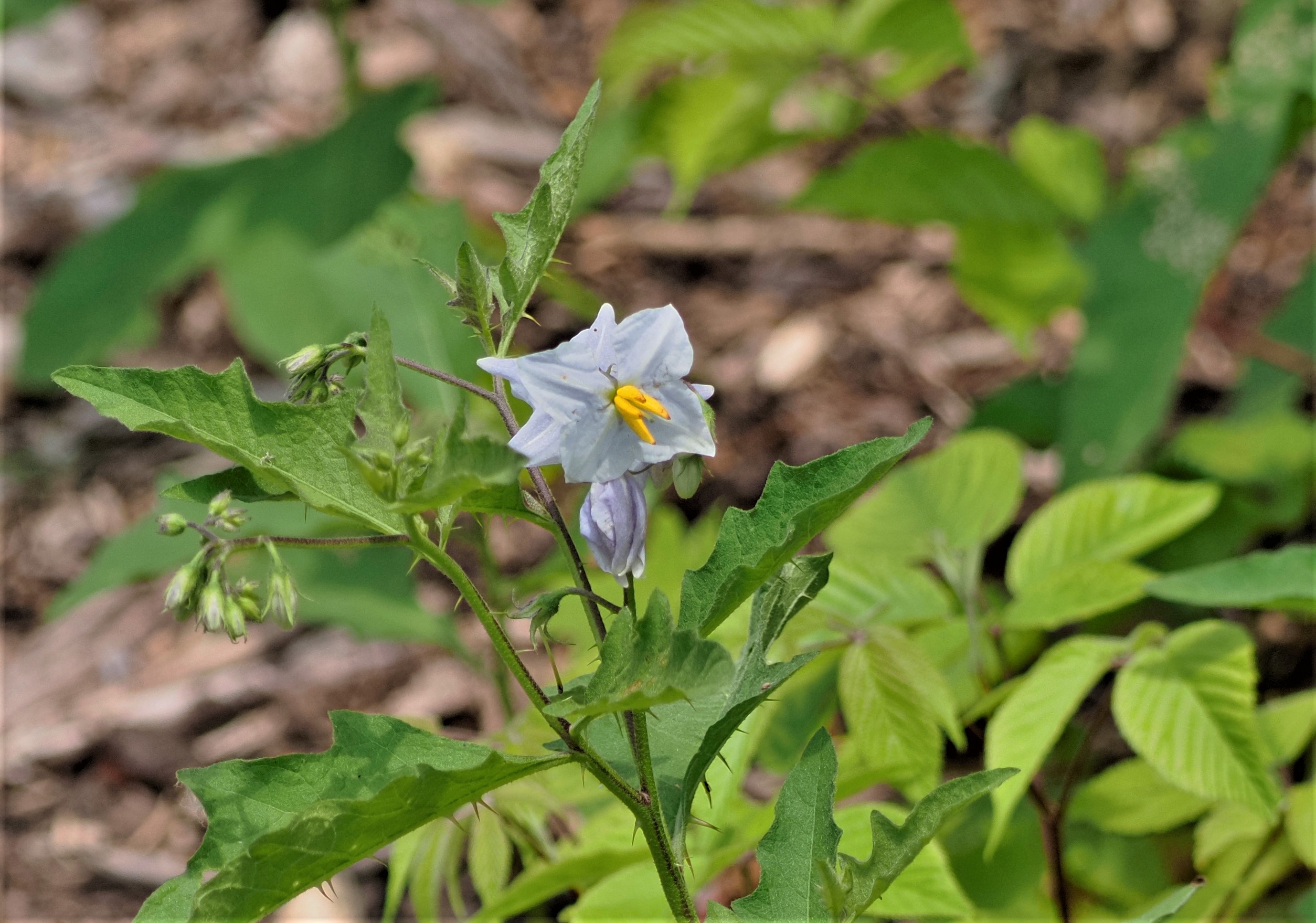
Horse nettle
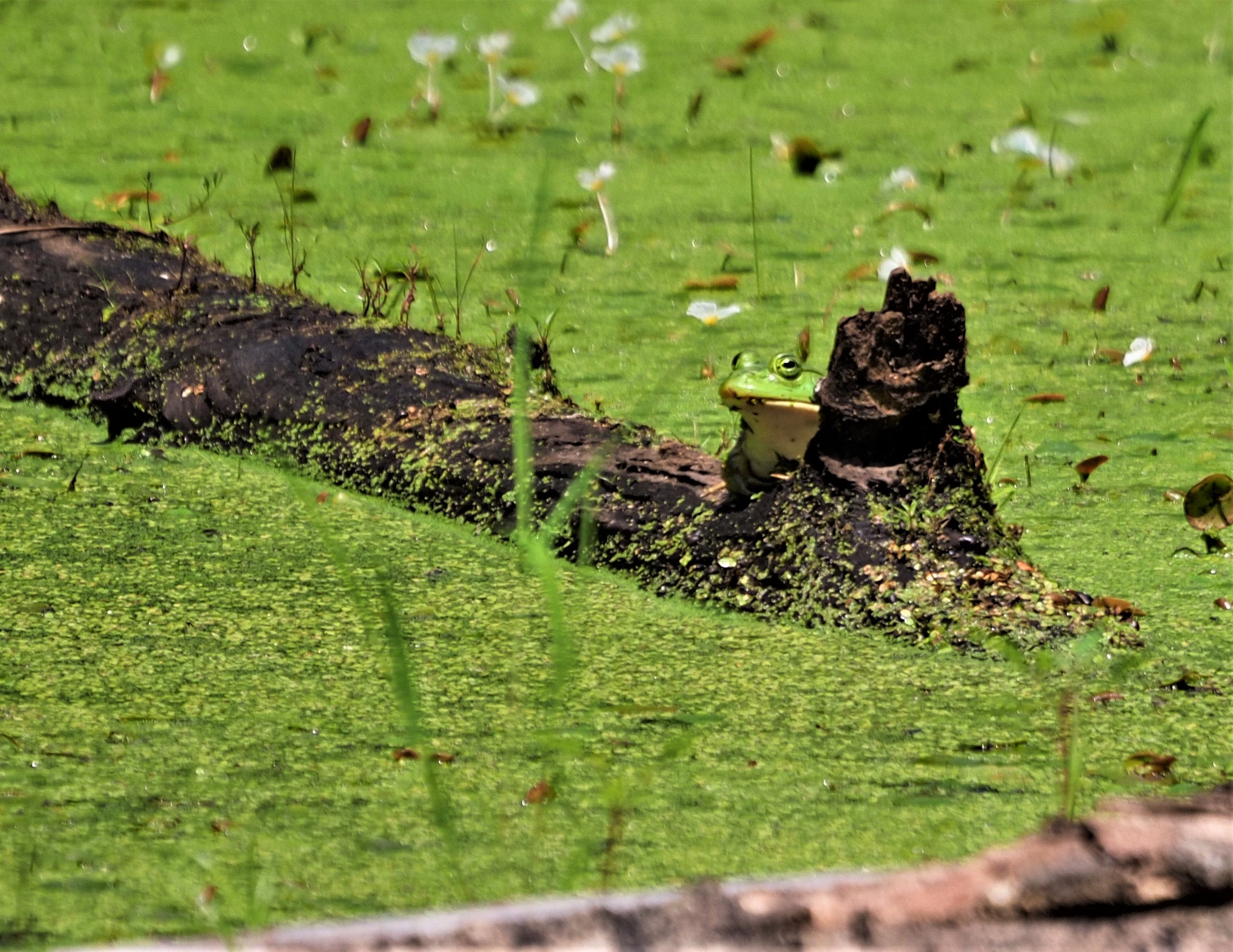
Peek-a-boo froggie
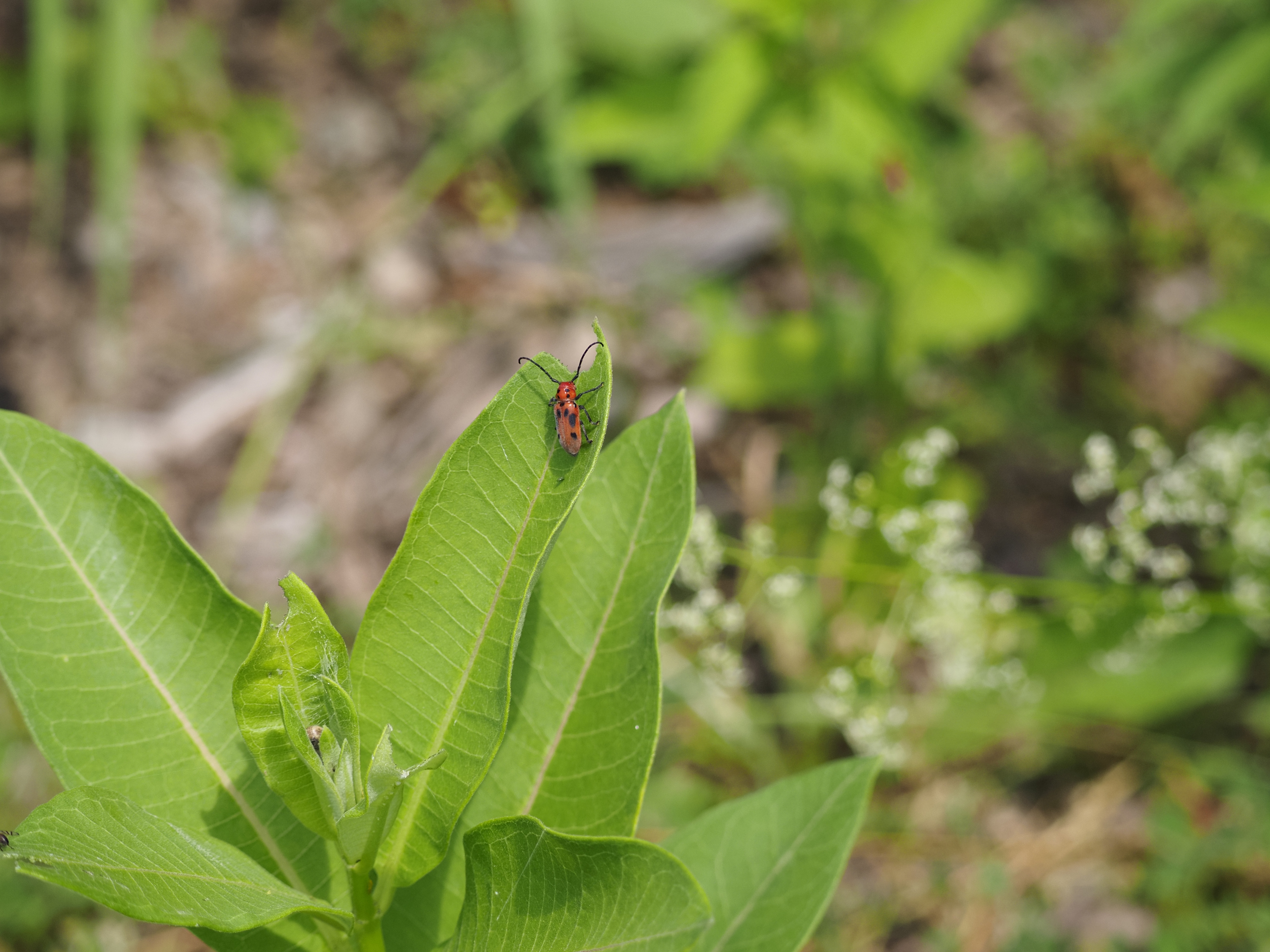
Milkweed beetle (ewwww)
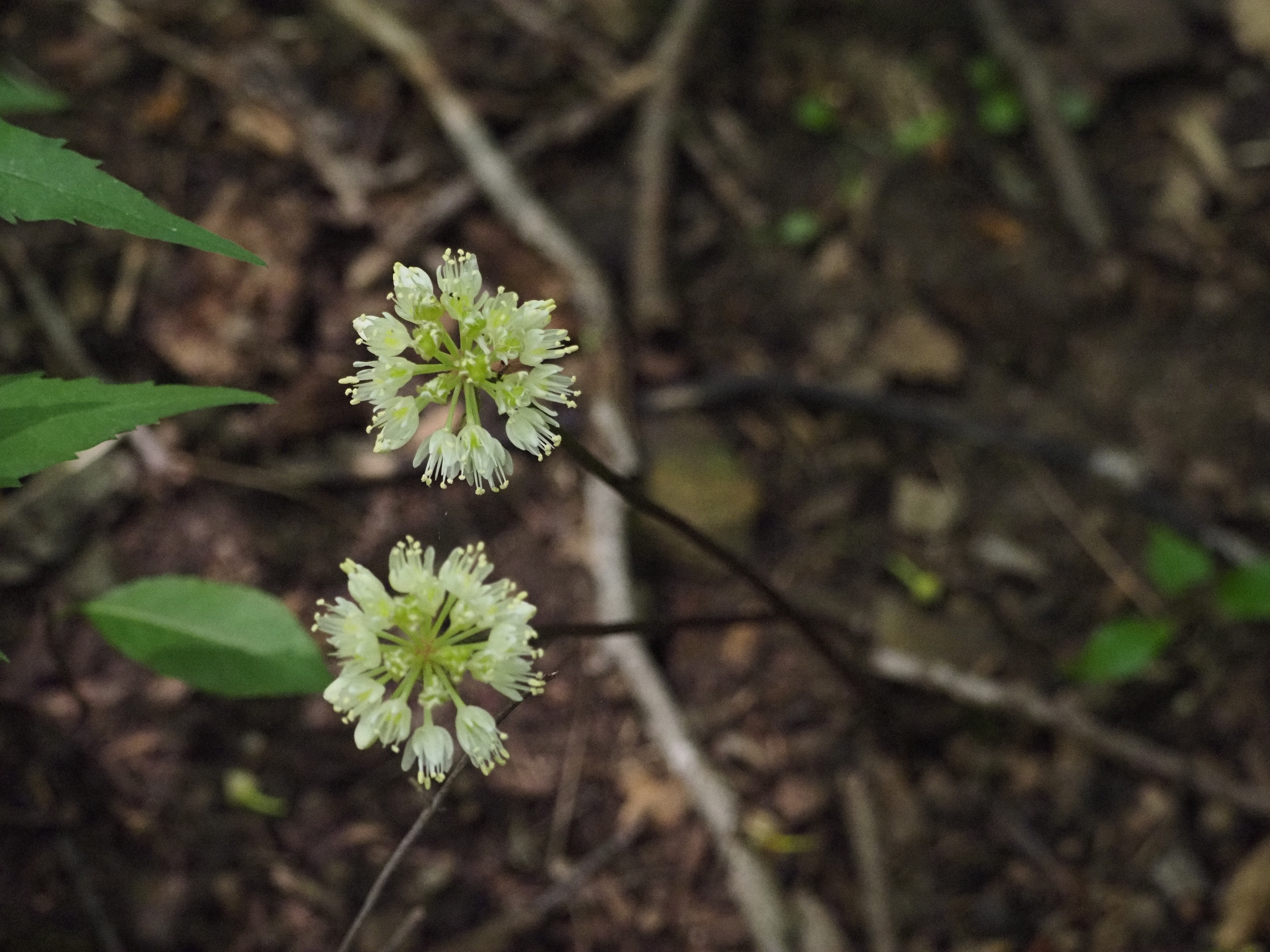
Something pretty growing in the woods
“Come to papa!”
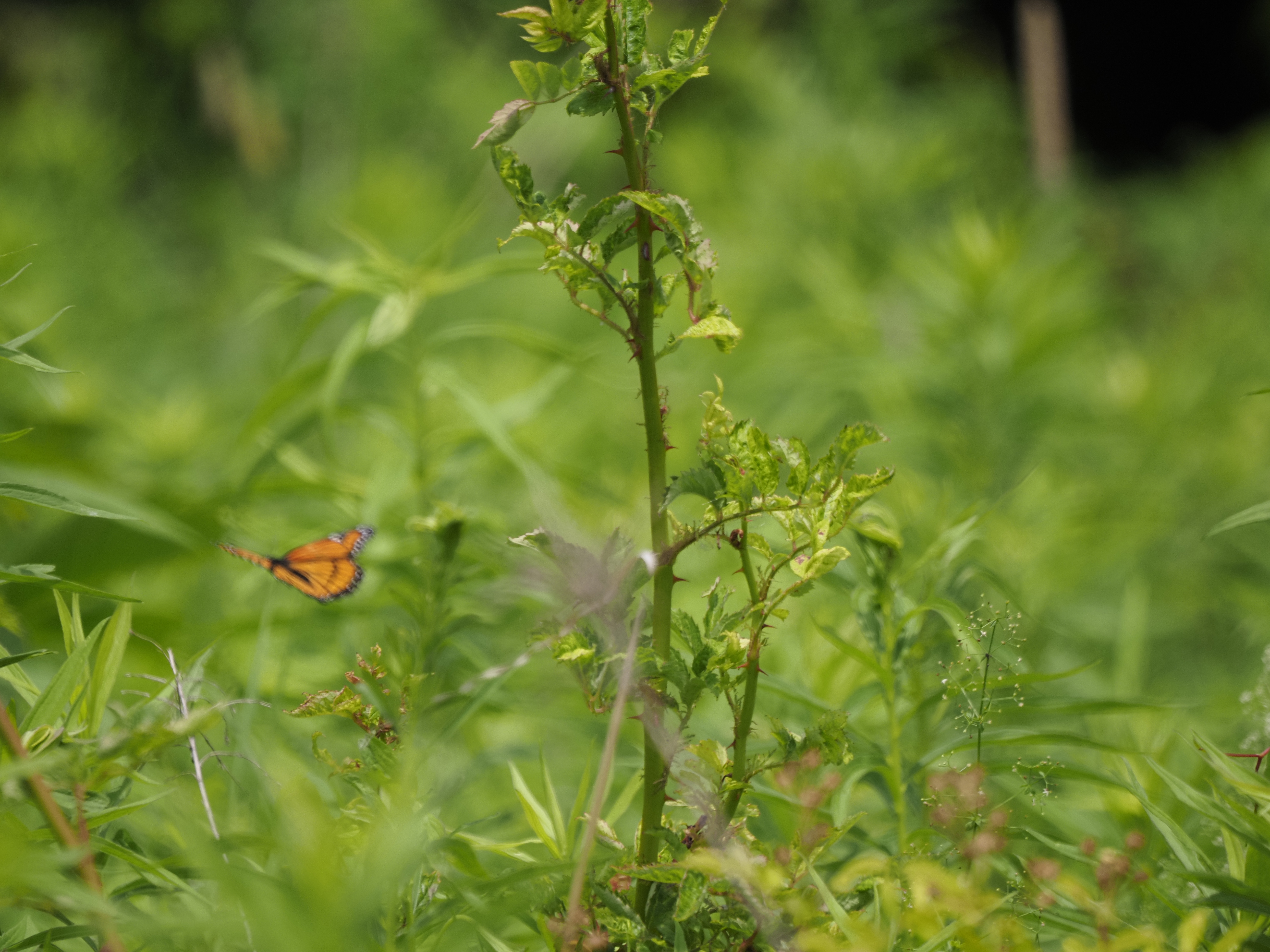
The only monarch capture I could get. Content over quality.
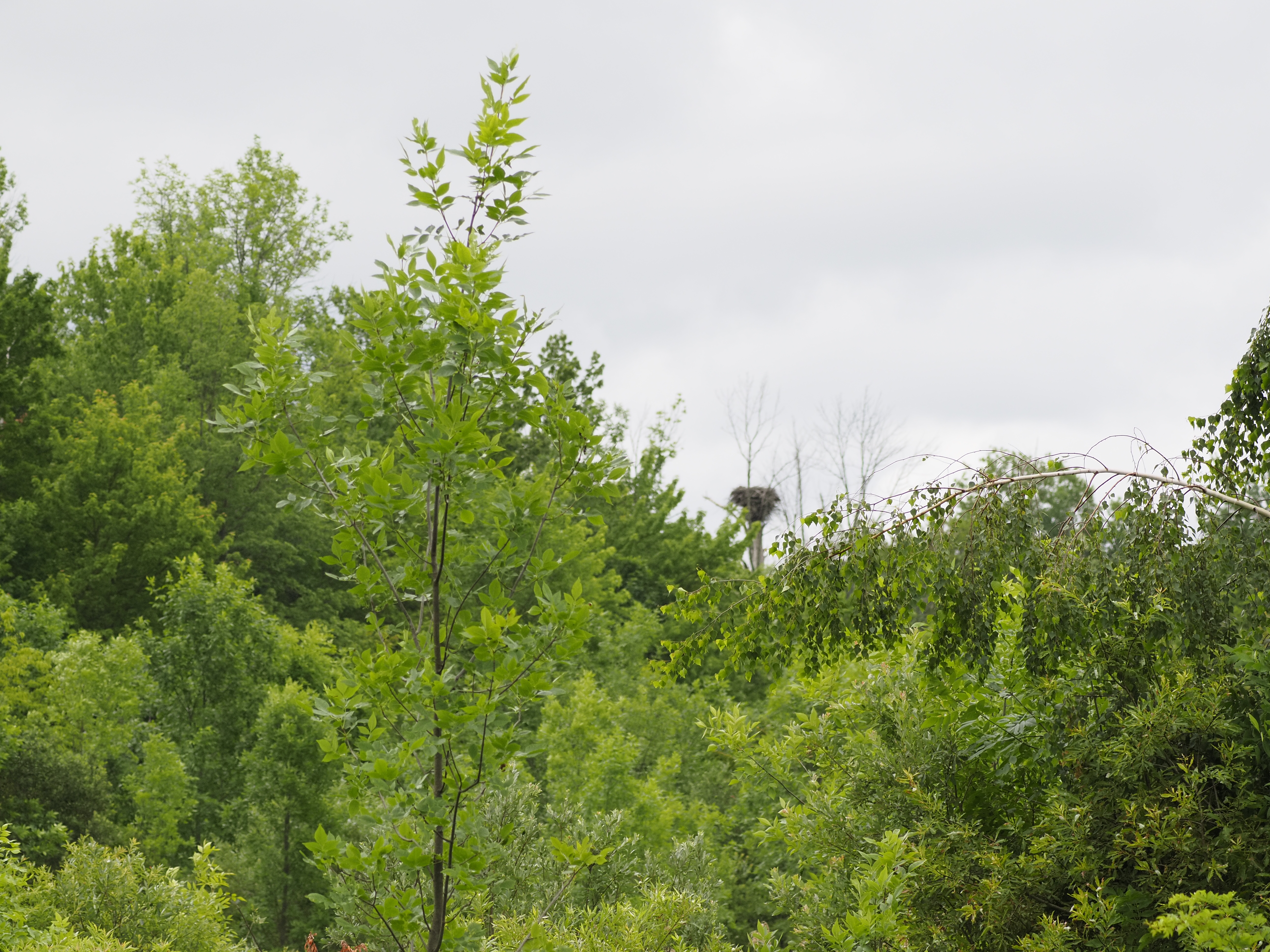
Another roadside view on the way to Sterling — looks like the resident eaglets have fledged!
 Seen by Susan: Fun with Flora and Fauna
Recent Comments