
Who’s back? The great blue herons, of course.

There are just a few right now. Maybe they are the hardy ones who stayed here over the winter, fishing in any open water they could find, or maybe they are the first to arrive after weeks of travel on the Atlantic Flyway. Who knows, but in any event in a week or so as the weather warms, we will see more and more of them returning here to mate and nest.
And I couldn’t be happier! These birds with their gangly legs and googly eyes are efficient waders and graceful fliers, so beautiful to behold as they fly over the marsh or stand stoically in the water awaiting the perfect moment to pounce upon an unlucky fish or a frog.
Herons aren’t exactly community birds — if you have ever seen two of them strut and posture in a turf war, you’ll know what I mean — but they are, strangely enough, community nesters.
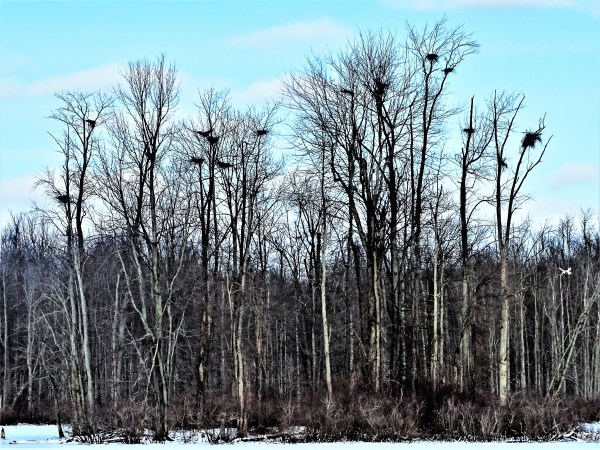
In fact, heron rookeries are found here in western New York just about wherever there is a marshy stand of trees, alive or dead, big enough to host 10, 12, or 30 nests. This rookery off Rt 89 in the town of Butler, NY had 18 nests last summer. Only 10 survived the winter. Hopefully, the returning herons will occupy these and even build more.
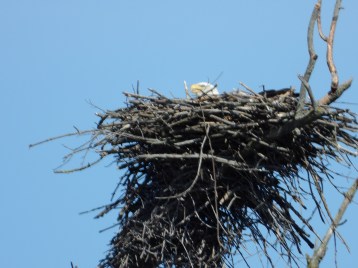
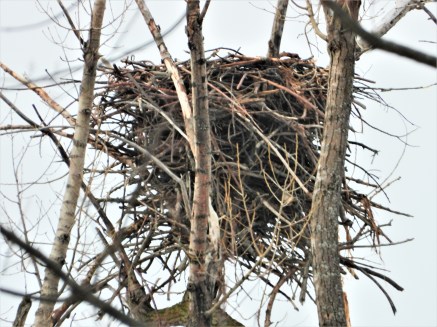
Mama Eagle should be finished incubating before returning herons will need this nest.
I think some of the returning birds will be a bit surprised to find that someone else has already grabbed prime rookery real estate.
Herons returning to the rookery off Rt 89 discovered an eagle mama inhabiting one of their homes. She has been nesting there for about two weeks now.
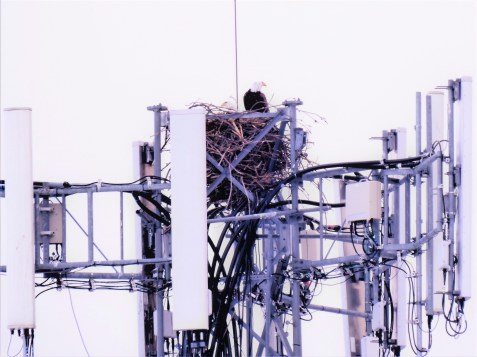
Apparently the eagles in Butler feel no need to build nests of their own when there are so many nice, big heron nests available for free 😉 And osprey nests! Last year an eagle family nested in a nest ospreys had constructed in this utility tower. They left days before an osprey family returned to claim it as their own.
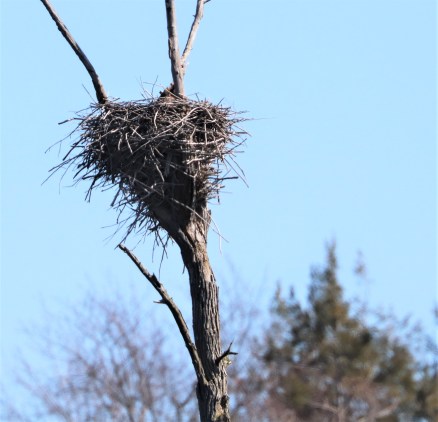
At the Sterling Nature Center there is a long-eared owl sitting on an egg clutch right smack in the middle of the heron rookery there. This isn’t very surprising since owls are shameless when it comes to building nests, because they don’t. Why bother doing all that work when there are so many tree cavities, hollows, and — better yet — sturdy, spacious nests built by hawks, ospreys, and yes, herons, too, available for the taking!

So far, the herons have paid little to no attention to these squatters. If they noticed them, they seem to have simply shrugged their shoulders and gone about finding another nest in the rookery to call their own.
Today I drove by the Butler swamp today to see how Mama Eagle was doingand then drove to Sterling Nature Center to hike up the Heron Trail. With two cameras and some trail mix, I settled in to watch The Heron Show, already in progress.

Heron #1
Here I saw one young heron claim an unused nest. He was soon busy at work, bolstering its walls with fresh twigs.
After some twitching of his head and nuzzling with his bill, the twig was soon lodged satisfactorily in place, and Heron #1 flew off in search of more nest-building materials. However, another young heron soon took his place.
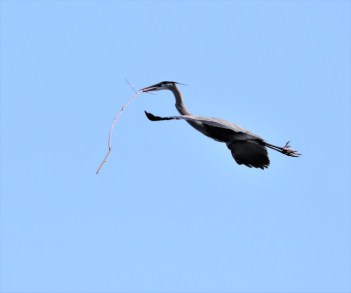
Heron #2
Heron #2 proved to be equally industrious, unraveling and then removing the twig that his neighbor had so carefully installed. Then, off he flew to present this gift to his beloved, who was waiting for him at home.

“Look, my love, especially for you!”
A brief inspection was all that was needed to approve the offering, which was then promptly incorporated into their own home. Then, Heron #2 bid his beloved good-bye and was off once more.

Unfettered by haste or any sense of morality and armed only with his wits, stealth, and a long pointy bill, Heron #2 landed on his neighbor’s nest and once more assiduously removed another twig. Again, off he flew, undiscovered, to present his lady with this second lovely albeit larcenous gift.
This activity went on, I suspect, long after I was too cold to continue counting and documenting his nefarious exploits.
. . .to be continued
The water was thick with them.
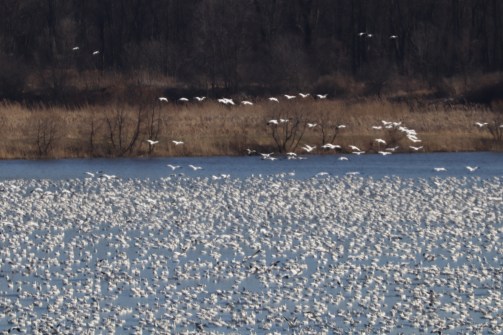 Snow geese are pretty smart — smart enough to winter in the warmer areas of North America and return each summer to their nesting areas in the Arctic tundra. It’s this summer sanctuary that provides us here in western New York a brief but beautiful glimpse of these birds as they migrate northward on the Atlantic flyway.
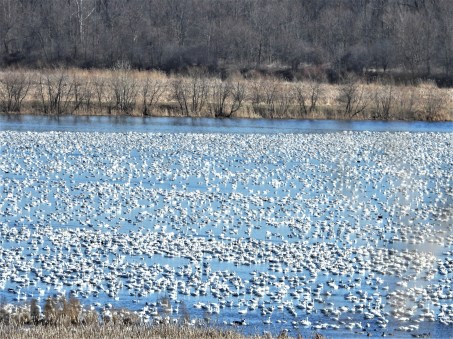 A favorite rest stop is the Knox-Marcellus Marsh, which lies in the northern part of the sprawling Montezuma Wetlands Complex. Hikers and birders are only rarely allowed foot access to the marsh, but you can get a decent hillside view of it if you can find East Street in the small town of Savannah. Bring a lens long enough to handle a distance of about 1500′ or so. That’s pretty far, but you will be close enough to hear the squawking of maybe 1,000+ snow geese (and a few ducks and swans as well). The geese won’t even know you are there!
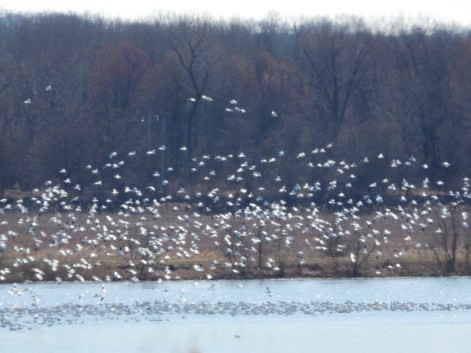 From such a distance it will be difficult to get anything that can be cropped into a close-up view, but the mass of white covering the water is awesome, to say the least. While I was there a nearby crop-duster went airborne, frightening at least one of the geese.
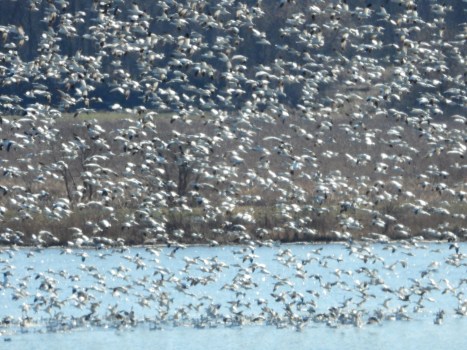
And when you frighten one snow goose, you frighten them all! A huge wave of white was the result, circling the water and protesting vociferously until they had calmed down enough to settle back and rest once more.
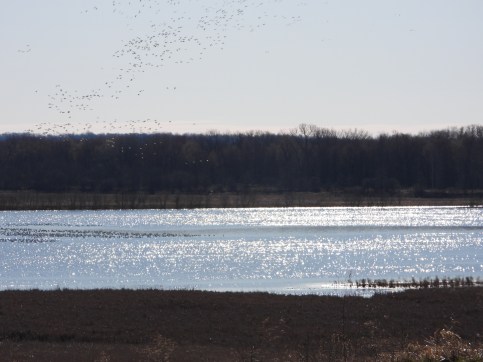
A few days of rest is all they need, so get your photos while you can. A day or two ago the last of the snow geese were gone. The water is now blue and still, awaiting the return of its resident wildlife — yellowlegs, egrets, and herons will soon be plying these waters as will the osprey and eagles who nest nearby.
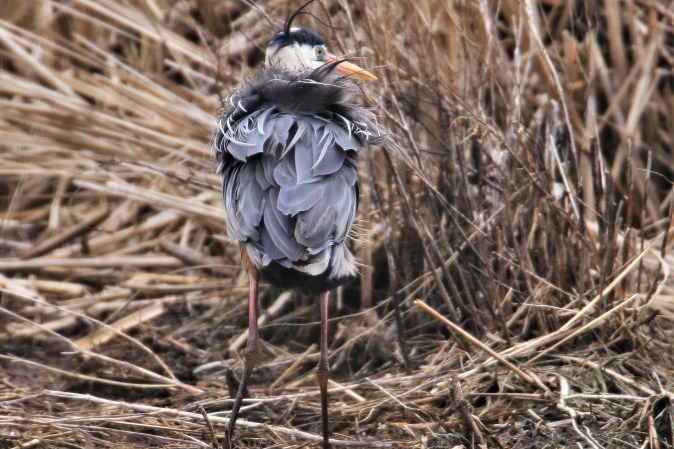
So keep that long lens handy!
Soon to be three eagle families!
Certainly a harbinger of spring 😉
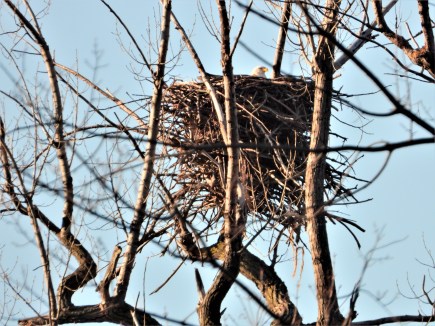
This young lady, who only a week or two ago was calling for a mate, is clearly sitting on something! The results are about 3-4 weeks away.
Getting better with the Coolpix p1000. . .as long as I don’t extend the telephoto to its full capacity. This was taken at 1/500 @ f6.3, 324mm (calculated to 1814mm). The bright sun kept the ISO low at 220. Distance is about 1000′.
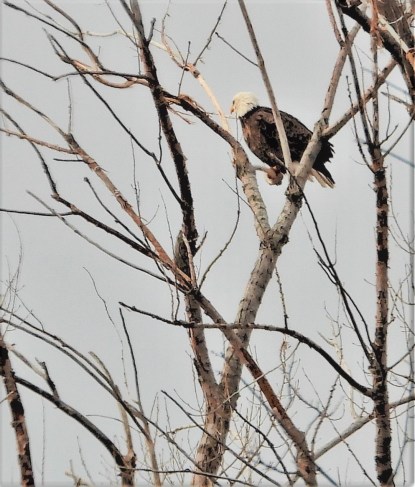
1/160 @ f7.1, 144mm (calculated to 806mm). ISO 110 at a distance of about 1000′.
Her mate is never too far away. They built their cozy home right at the lake edge, where Mama Eagle can watch Papa tend to the fishing.
Or, Papa can take over nest duty for a while if Mama needs to stretch her wings.
Yes, these are “beginner” photos, but I am finally getting the hang of balancing the exposure triangle in my favor 🙂 while fighting with the Nikon superzoom of nearly 3000 mm! which jiggles a bit at full extension.

There is a second family of eagles nearby, located at the edge of another good fishing spot. I suspect this may be an old beaver wetland, judging from the conical stumps poking up from the water.
This nest, like the one above, has been active for at least 2 years, probably more.
Bright sun works well with the p1000, or I should say the p1000 works well with bright sun. Taking photos of eagles on a gray day produces brown blobs flung against an 18% gray background. Very disappointing!
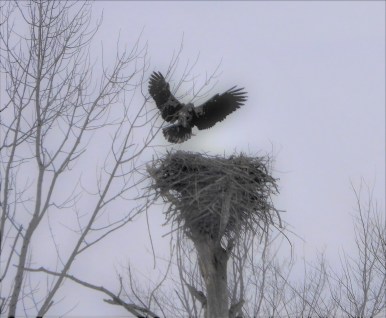
Anyway, nesting here wasn’t easy for this family. There was an eagle equivalent of a bidding war that occurred between them and this young juvie who thought he could just jump right in and squat.
However, he was eventually convinced to look elsewhere for prime eagle property. Perhaps he was outbid. More likely he was chased away by two angry eagles.

Everyone needs to get out of the house now and then. . .
This mama, too, is sitting on an egg clutch.
I’ve been trying hard with the p1000, but its awkward front-end heaviness at full extension makes things difficult. At this point I have to keep the superzoom at 2/3 extended or less in order to avoid camera shake (and photographer shake, too). This photo was only at 126 mm (calculated to 705) at a distance of about 1000′, which gives some detail, but I reallyreallyREALLY would like to get closer <sigh>.
This third eagle family was a big surprise to me. I’ve been following a heron rookery in the swamp lands that lie between the Wayne County towns of Butler and Savannah for about a year now.
 Last summer the rookery was full of great blue herons. There were about 14 nests, all of which supported a variety of great blue heron families.
By October, though, they had mostly gone south, and the nests stood empty, awaiting the arrival of both spring and the herons.
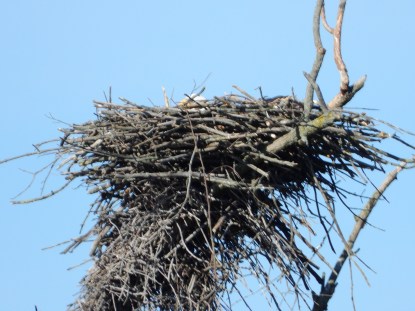
This year, though, an eagle family preceded the herons. This eagle mama certainly has something in the oven.
And she’s a smart one. Why go to all the work of making a nest when you can just borrow one that isn’t being used at the moment?
Look closely to see mama’s little white head. This time I used a tripod and mounted the p1000 on a Manfrotto 293. Tied down securely with a velcro strap, I could place it at near full extension and got a decent amount of focus, even in the eye. The bright sun was also a plus given the tiny sensor and the contrast focus points.
Anyway, the swamp is a great place to fish if you’re an eagle. There’s no one there to bother them, except for some geese, a swan or two, and some ducks. Occasionally the fishing will attract an few osprey, but the eagles don’t mind. By the time the osprey return, the eagles will have abandoned the nest, and neither heron nor osprey will be any the wiser.

Oh-oh, mama’s getting cranky and needs a break, so she summons Papa.
There is a changing of the guard. Papa agrees to sit for a while so mama can stretch her wings.

And it’s off she goes!
What a relief to scratch in places you just can’t reach while you are keeping a clutch of eggs nice and warm.
Again, it’s that Manfrotto 293 that keeps the p1000 still enough to get decent focus.
Wind is natural, right?
Except for today’s wind. Around 2 o’clock it was mostly from the west, gusting from the 20s into the 40 MPH range and one recorded as high as 57 MPH! So, I made the obligatory trek out to the Sodus Point Lighthouse.
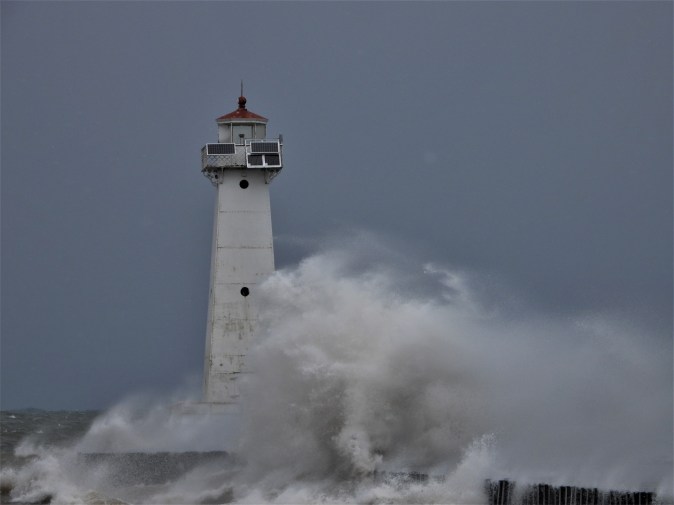
It was gusty enough to blow lake water onto the shore — and cold enough to freeze it, so I didn’t have to worry flying sand damaging the camera or lens. . .but I kept the UV filter on and wrapped up the lens barrel just in case.
3000mm of zoom! Thank you, Nikon!
Sodus Point has two lighthouses, but its most attractive feature — to me, anyway — is its eagle’s nest. This is the second year I’ve seen eagles here. The nest is right on the edge of the tree line hugging the lake shore, probably not more than a mile east of the lighthouse. It is protected by a 1000-foot no-trespass zone established by New York’s Department of Environmental Conservation. The DEC are pretty powerful when it comes to eagles, because they also issued a cease-and-desist order to a local developer, upon whose land the eagles have made their home. They even made HIM bulldoze around the safe-zone perimeter to discourage photographers and other foot traffic. Their order is good for 5 years, at which time it will be reviewed by the DEC and a new ruling issued if need be. So, this nesting area (and its nest!) are safe until at least 2024.

View from the street — that p1000 is great! (but only when it works — which, due to its small sensor and contrast AF, usually happens only on bright, sunny days)
Eagles have been hanging around all winter here — this part of the lake, unlike the bay, never froze over during the winter, and fishing must have been pretty good. In the past few weeks I’ve seen an eagle pair near and sometimes in the nest, but today they are wise to keep their heads low in the nest and allow its strong walls to protect them from the winds.
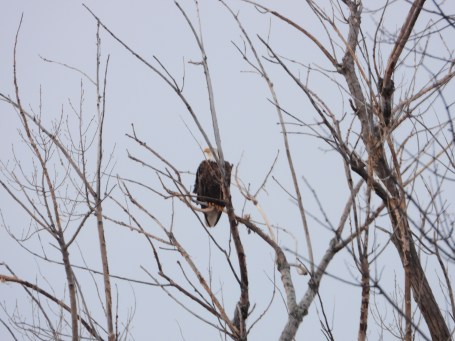
One day I heard this young miss calling to a prospective mate, but it appears to have been in vain — her intended was a fairly young, white-speckled juvie, who did not return her solicitations in kind.
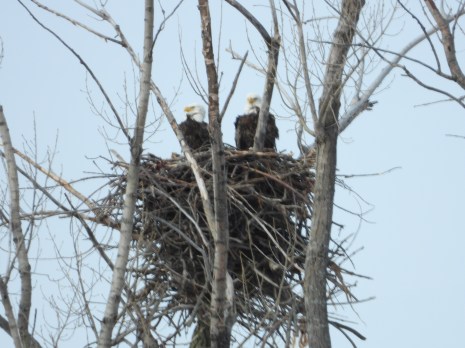
Not to worry, though. The amorous miss readily found another, more suitable partner

Now, if you travel a bit further east — OK, OK, a LOT further east, you may come across this eagle pair in another side-of-the-road nest. The missus has been sitting for the last few days, so I suspect there are eggs — a happy sign of spring!
But you can’t hide.
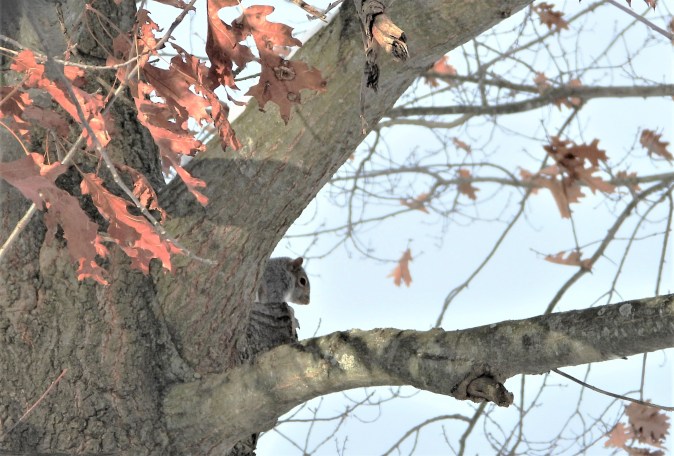
1/640 f4.5 320mm Nikon p1000. 02/20/2020 at 02:20 p.m.
Well, maybe you can hide a little bit.
I kinda hate this camera. I bought it for its long reach. It extends to 539mm, but with a 1.66 sensor (7.7 diagonal) it calculates to a whopping 3000mm on a full frame! What nature photographer doesn’t like that!!!
Unfortunately, what Nikon fails to tell you in the small print is this: The camera is significantly front-heavy at full extension. That means that even on a tripod it tends to dip a bit. . .so much so that the camera shakes to the point that it misses the target. At best the results are soft images. Really soft.
And since the focus points are contrast-only, don’t even try to take a photo of a mostly brown eagle sitting in its fairly brown nest on an 18% gray day. With full extension, the results you get could be captioned, “Guess what I took a picture of today. No, really, you have to guess.” Because by looking at the brown blob in the middle of a drab sky, it’s anybody’s guess as to what it really is.
But as you can see, at mid extension the camera performs quite well, even when taking a chance photo with one hand through a (dirty) car window. While driving! Which is why I’ve gone ahead and ordered a few things from B and H, to see if I can somehow stabilize the p1000 at full extension and get the awesome photos that Nikon tells me I can.
More later, once the B&H package arrives and I’ve had a chance to play with the toys.
P.S. Isn’t today’s date a dyslexic’s nightmare???
Well, they make a lot of noise, and they poo everywhere.
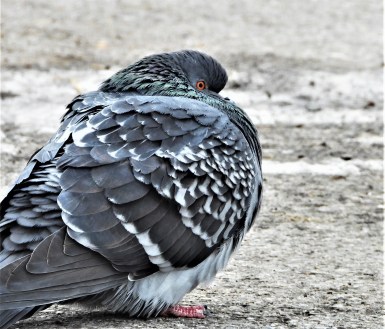
But pigeons are actually kind of colorful and cute.
With distinctive red eyes.
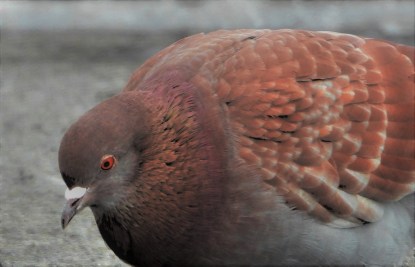
Turns out they are rather unique among birds, in that they produce “milk” to feed their young. The “milk” is not produced in mammary glands, so it is not really milk. It is produced in the crop, an enlargement of part of the esophagus in birds that stores food. In pigeons, the crop lining produces a thick, nutritious liquid that is fed to the squabs.

Interestingly, the crop milk is produced by both male AND female pigeons — so those 2:00 a.m. feedings are not solely a mother’s duty. . .not if you are a pigeon. Or a flamingo.
And if you are an emperor penguin mother, you don’t have to nurse the babies at all. You can go off to the sea ice and feed because it’s dad who produces the crop milk and tends the newborn.
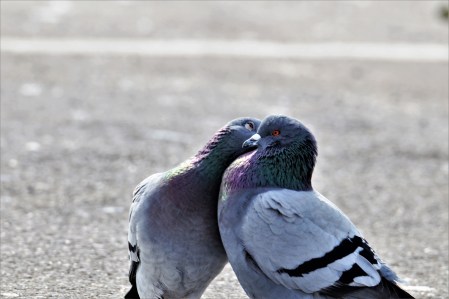
Psst — do you want to know a secret?
It’s not always golden in western NY on a winter morning. Sometimes it’s just plain dull.
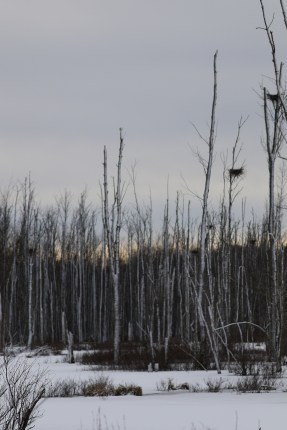
Oh, it started off all right. Just a little gray with a hint of sunrise.

In fact, only two days ago temperatures were in the 60s, fooling this great blue heron into thinking it was a lovely spring day.
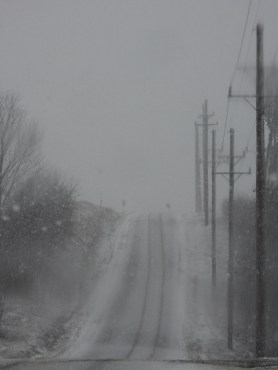
But today a passing cold front churned up the lake effect machine, darkening the skies and covering everything beneath them with a frozen concoction of groppel and snow.
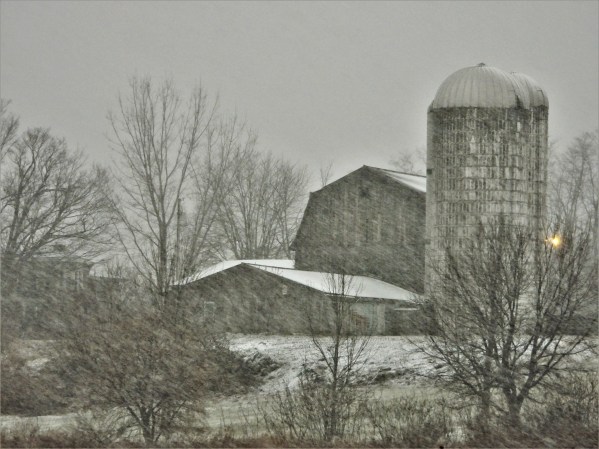
No golden hour for us! More like a gray hour. . .
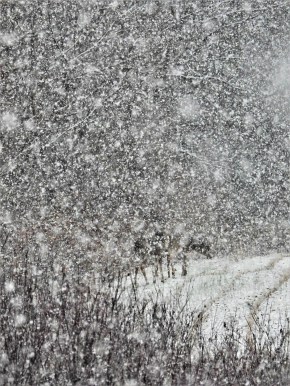
Today it was back to winter. Any photography would be challenged by low contrast, low light, and the risk of moisture driven into cameras and lenses by the wind. And any food forays would be snow-covered and difficult. . .
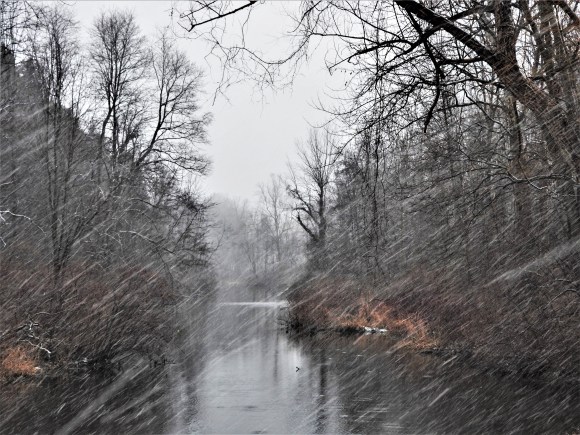
Grateful for my warm, dry car!
All upon a Saturday night, woo!
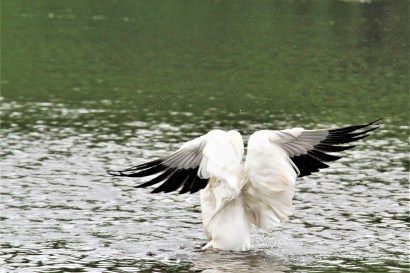
A little splishin’ and a splashin’ (one time), movin’ and a-groovin’ (ooo-wee!), reelin’ with the feelin’, dryin’ and a-preenin’ down at the marsh.
Gonna put their dancing shoes on and join Bobby Darin at the party!
You have to see it to believe it.
Lake effect occurs when cold winds blow across an expanse of (relatively) warm(er) water. That’s what caused Snovember 2014 in Buffalo, where the last remnants of that infamous storm coming off Lake Erie did not melt until the following July.
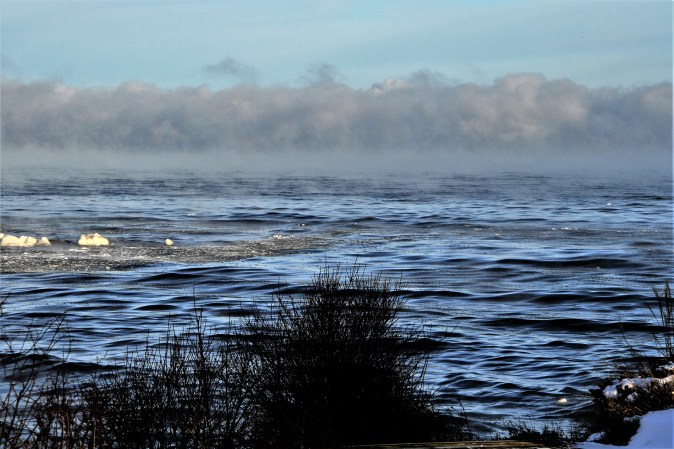
I watched this one being pushed over Lake Ontario by the prevailing westerly winds and knew that the Oswego and Binghampton areas would soon be covered in a flurry of snow. Lucky me, had the winds been from a more northerly direction it would have chased me home!
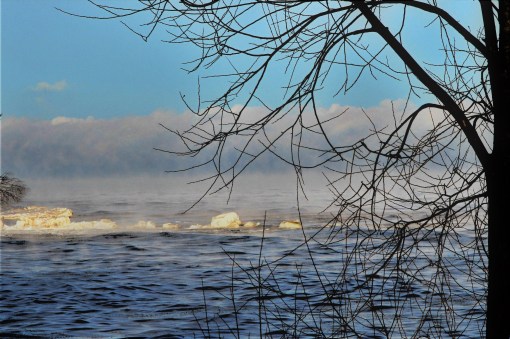 Lake effect snow forms in thin, low-lying ribbons, so it is not unusual for one town to be inundated with blinding snow while an adjacent one enjoys sunshine.
Luckily, lake-effect snow bands, while vigorous, are generally short-lived. They can produce whiteouts that dissipate quickly, sometimes after only a few minutes, but if the cold winds continue lake-effect storms can persist for days.
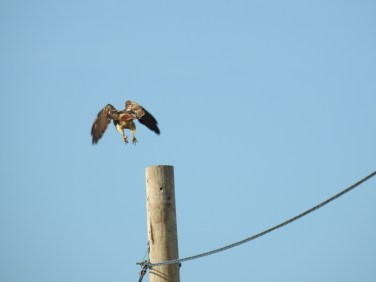
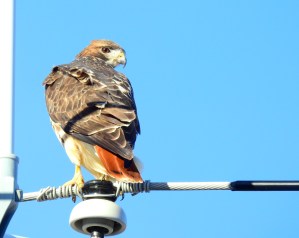 Finally, a photo of a red-tail hawk that isn’t just a dark blob against the background of a washed-out sky!
I learn the hard way…and the lesson I learned yesterday was to pay attention to the shutter speed, even with still photos. What they say about the shutter speed being the inverse of the focal length is very true — I have far too many bland and blurry photos to prove it. Now I have some much better ones!

Nice, clear light helped, too, but I even managed to get a good backlit photo, one that was sharp enough to crop a bit so as to enhance the rimlight.

These aren’t perfect but they are a heckuva lot better now that I know a little about shutter speed, focal length — and ISO. Mine is now set to automatic but only allows ISO up to 800. Maybe I will get braver as my focusing improves 😉
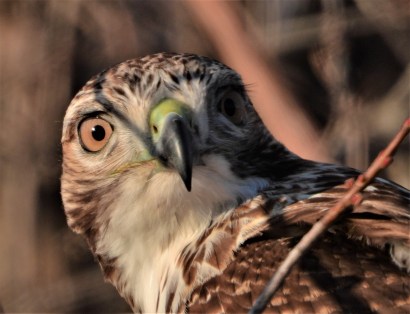
Next I will have to work with eliminating shadows…maybe with a fill flash (I can see all you nature photographers shuddering!) Or maybe I will learn to live with the nuances of the natural setting, shadows being only one of them.

Oh, and keeping a tight aperture helps, too. Who needs bokeh when you have a nice, sharp depth of field!
All-in-all, I’d say yesterday was a good day. Here’s hoping for more of them!
 Seen by Susan: Fun with Flora and Fauna
Recent Comments