
Not that society in 2020 was ever very innocent — not as innocent as, say, in 1820, when James Monroe was president, America was involved in no wars, and toasts were raised to “my country, right or wrong.” Certainly the sectionalism that would soon raise its ugly political head would put all that Era of Good Feeling stuff severely to task, and the several decades following would make Americans wise, albeit less innocent. But a trace of innocence persisted, in the sense that we are American, America is strong, and America will never be brought to its knees. . .
. . .and then the novel corona virus hit.
With CoVid-19 we lost our last shred of innocence. Even as we strive to flatten the curve, we know that the comfort we seek in returning to “normal” may not be found. . .because we know that we head towards a new “normal,” one we’ve never experienced before. Life will never be the same — CoVid-19 has made sure of it.
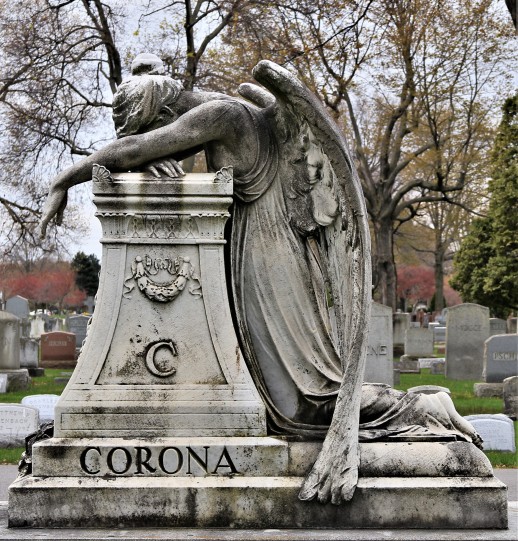
I’m not the only one who photographed this weeping angel because of its poignant present-day connotation; there are at least two others* (that I know of) and probably more. Even so, I felt compelled to post it here, along with my thoughts and with due acknowledgement to those whose photos came before mine.
* Stephen Ransom, https://www.stephenransomphoto.com/. Mr. Ransom mentions another photographer, Matt Emery, whose photo predated his.
+ Birds, Caspian Tern, Coots, Ducks, eagles, egret, Fish, Geese, grebes, heron, muskrat, Uncategorized
West Shore Trail
by Susan
West Shore Trail is in the northern part of the Montezuma Wetland Complex. It’s rather isolated; nobody seems to go there much except me. That’s too bad because now that the simulated drought is over, the water levels at West Shore have risen even higher than those at the main pool in Seneca Falls, and the resident wildlife is even more varied here than it ever has been.
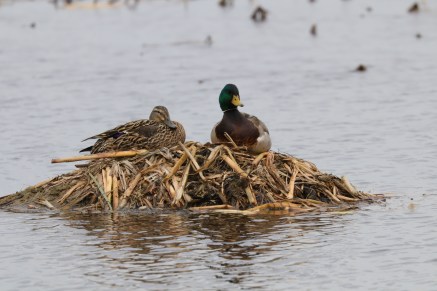
Unfortunately, the 2019 drainage practices forced nearly the entire muskrat population to relocate. There’s still a lodge here and there but nowhere near the hundreds that dotted the marsh last year. Though few, the lodges now serve double duty — one for the great blue herons (resting) and another for the ducks (nesting).
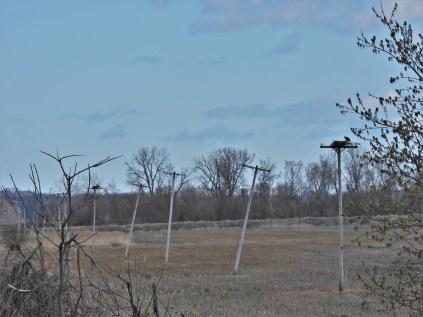
Nobody actually hikes the West Shore Trail. Part dirt road and part gravel path, it’s wide enough to drive, albeit slowly and quietly so as not to disturb the animals. The trail ends rather abruptly where the land is too wet to support a roadbed, but that is fine — looking up, there is a sturdy osprey nest resting atop an old utility pole. It hasn’t attracted any squatters yet, but it’s still early in the season. . .besides, if you look off in the distance at the line of poles running past the old bridge supports, you’ll see two new osprey nests that have indeed attracted family-loving osprey.
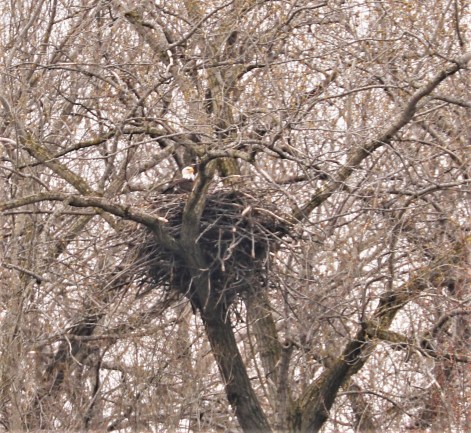
There is an eagle nest, too! I didn’t see this in years past, so it may be new. . .or maybe not. Maybe I just didn’t see it. In any event, an eagle pair has taken it over. It’s too far away to see any little ones, but there are signs of life in the comings and goings of the parents. There are probably other eagle nests deeper in the woods, because there is always a juvenile or two or four perched on trees, poles, or atop the muskrat lodges as they seek out fish, frogs, and other delicacies swimming in the marsh.
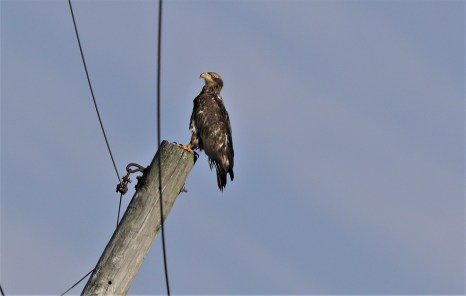
Jittery little guy
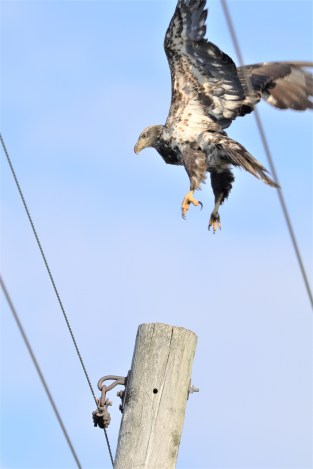
One camera click and off he went!
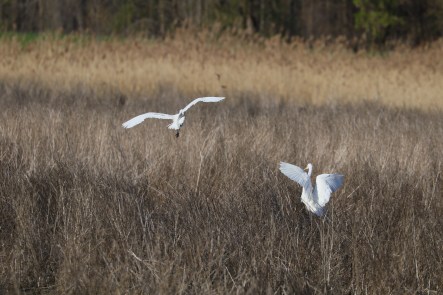
Great blue herons are also seen at the Trail marsh as are great egrets, which have only recently returned from migration. Beautiful birds!

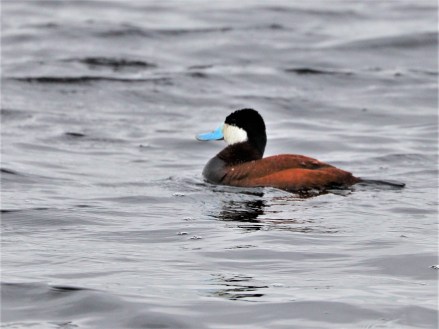
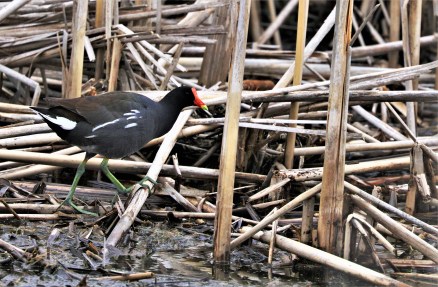
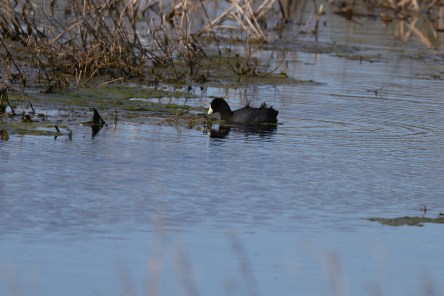
Ruddy ducks, redheads, and mallards reside here as well as pie-billed grebes and coots. They ply the water for an occasional fish, but their diet is mostly grasses and other submergents. Common gallinules (a fancy name for moorhens) like the grasses, too, but they will also forage for spiders (eww!), insects (eww!) and tadpoles. They are much better swimmers than they are flyers, although they will indeed fly if provoked by a heron, an egret, or maybe even each other.

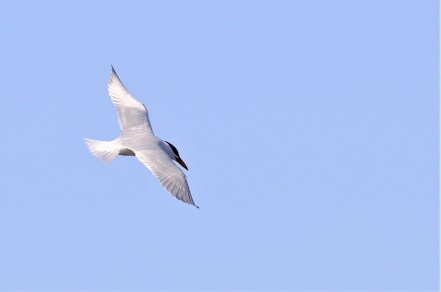
Gulls and terns are good fishers, too, and there are lots of them here at West Shore Trail.
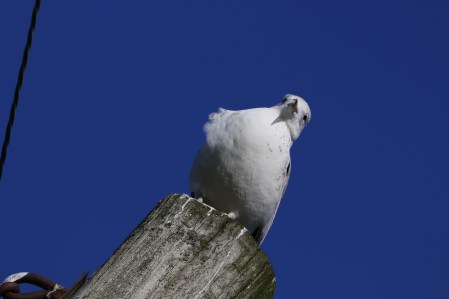
Curiously, this is one marsh that is nearly devoid of Canada geese! I saw a few the other day, but the others must have found a marsh that isn’t quite so crowded as this one.
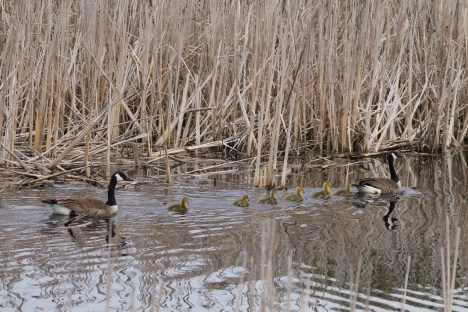
Even though the West Shore Trail spans just about a mile, the water is sparkling, clean, and deep enough to support vegetation and fish. . .just what a food chain needs!
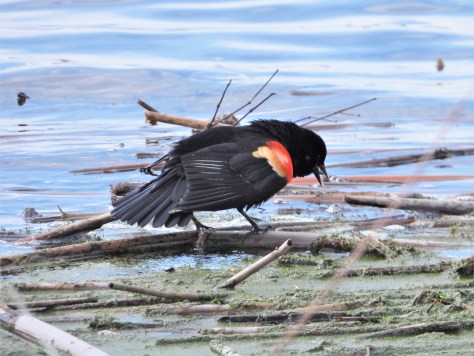
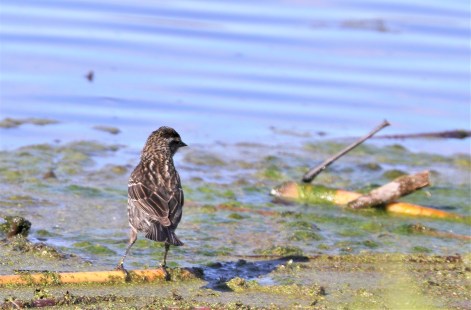
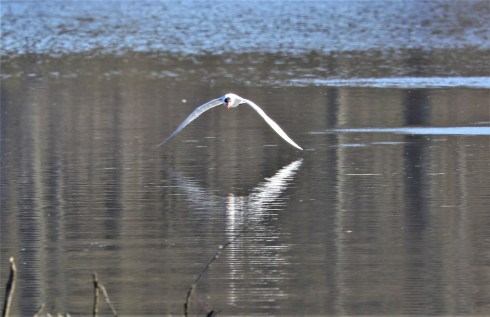
Just lookin’. . .it seems innocent enough. . .
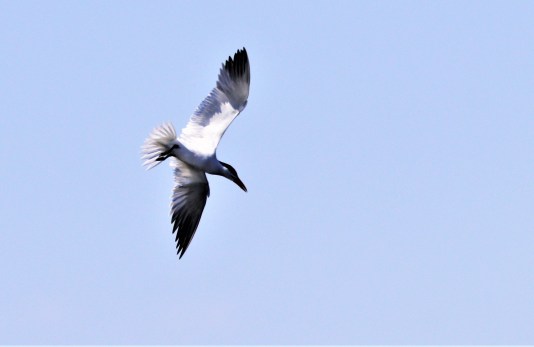
But that’s how the Caspian terns do it — a nonchalant flyover that begets a frenetic flying frenzy! They circle and hover for several minutes in crazy cycles before suddenly and spectacularly dive-bombing for the prize.
The prize could be a crayfish but more likely is an unlucky fin fish, which the tern will immediately make short work of. And as soon as it is consumed (or forwarded to the young ‘uns for breakfast), the frenzy begins all over again.

The cormorants stop fishing to watch. . .
Poor little fish! They probably never know what hit them!
Caspian terns look like gulls, but they’re not. They are slender, more colorful, and less annoying (unless you’re a fish — in that case, they are dangerous!). All About Birds, Cornell University’s website on all-things-feathered, states that “there is little information on Caspian Tern population trends,” but notes survival of the species is of “low concern.”
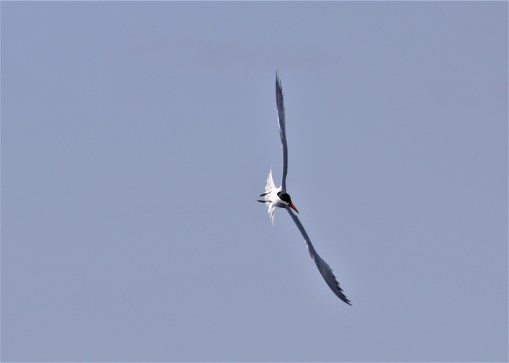
Getting ready to plunge
The truth is, Caspian terns are just about everywhere — they are found on every continent except Antarctica (environmentalists call this a “cosmopolitan distribution”).
There must be several colonies of Caspian terns where I live in western New York, because I see them flying over just about any of the wetlands I visit.
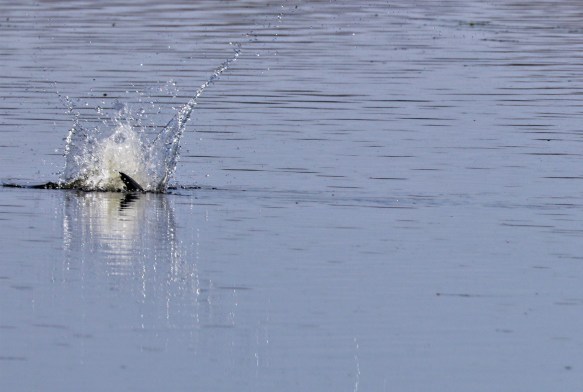
Touchdown!
And why not? Their diet consists of fish, fish, and more fish, but if they are reallyreallyREALLY hungry they are not averse to making a meal of crayfish.
Or snacking on big, fat insects.
(Insects — ewwww!)
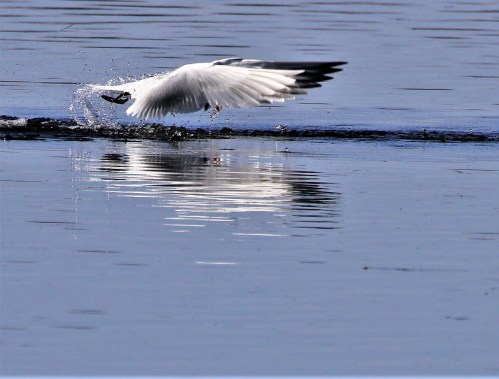
Upward and onward!
Caspian terns have to be alert and cautious while hunting, though, because any laggards could themselves easily become a tasty meal for owls or eagles. . .
. . .and maybe even gulls. . .
. . .not to mention foxes or raccoons.
If the terns leave their nests unattended for too long, they might return to find them pillaged, their eggs and little ones having been a delectable lunch for one of the above.
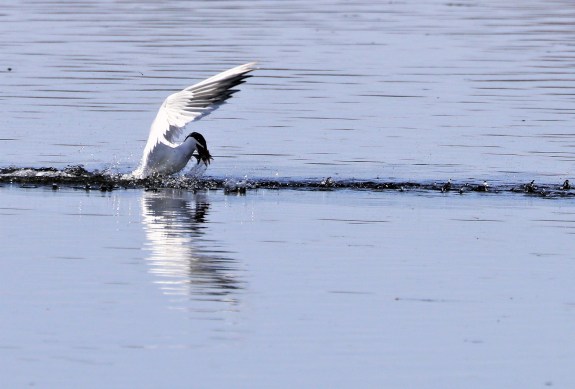
This one’s for the kids
I mean, who knows of a raccoon that doesn’t enjoy a feast of eggs?
However, Caspian tern predators must be stealthy and sly; otherwise, they might find themselves surrounded and harassed by a mob of angry tern parents.
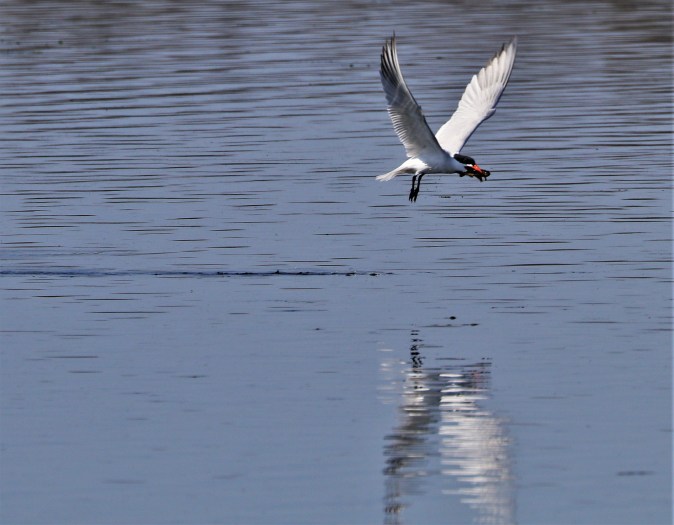
Caspian terns understand the harsh nature of nature, but they will fiercely protect their families from it!
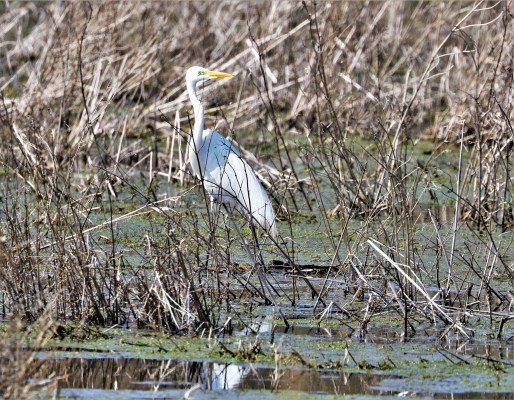
Wow, did you see that???
Happy Mother’s Day (a week early)

Babies! Just hearing the word prompts a smile. . .remember the debut of Baby Yoda?
Springtime in western New York means that there will be lots of babies born in the wild. . . little balls of fluff that elicit oohs and ahhs from each observer. Some of them eventually poke their tiny heads above the nest rim, waiting for a treat; others learn to waddle behind momma, heading for a swim — and just about all of them are trailed by a league of photographers lugging long lenses and tripods, hoping to capture some candid cuteness — from afar, of course. No one wants to disturb either momma, poppa, or their babies!
I’m one of those hopeful nature photographers who quietly pursue these family photographs. Having stalked no less than 3 eagle nests and as many wetlands since February, the appearance of the little ones was much welcomed.
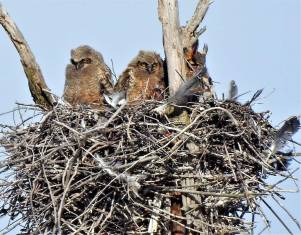 First come the owls. They are fairly lazy, you know. Rather than build nests of their own, they simply squat in someone else’s. Which is okay, I guess, since the great blue heron who built this particular nest doesn’t really care. So, momma owl sat there for over a month, watching the returning great blue herons repairing old nests and building new ones. Now her great horned owlets are getting ready to fledge.
I don’t think this momma owl likes me much — in every single one of my photos she turned her back. Silly thing! So, many thanks to Betsy Berglund, who took this excellent photo with her Nikon p900 and then posted it on the Facebook page of the Sterling Nature Center, https://www.facebook.com/photo.php?fbid=2987462564648057&set=p.2987462564648057&type=3&theater.
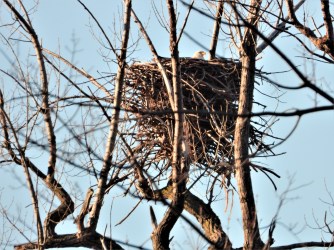
Sitting and waiting. . .
Bald eagles are next in the chronology of wildlife births. They generally build their own nests — huge things that measure somewhere between 4-5 feet across and 2-4 feet deep. The larger ones often represent the work of several generations. There is plenty of room here for mom, dad, and their one, two, or three eggs, but the hatchlings quickly grow tall enough to poke their heads above the nest and then gradually edge out mom and dad.
This particular eagle family settled upon a second-generation nest on lakefront property owned by a developer. The New York State DEC moved in quickly, though, to protect the nest from encroachment. They began by issuing a cease-and-desist order to prevent any development on the property. Then they established a 660′ perimeter around the tree supporting the nest. They promised the developer that they would revisit the situation in 5 years. In any event, this building lot belongs to the wild as long as the nest is not abandoned. Prime real estate, indeed! — but only for the eagles 🙂
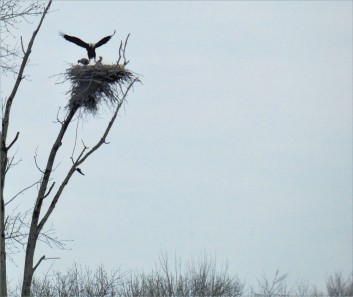 However, not all eagles are as enterprising as this pair — in fact, some are as lazy as owls. This eagle momma was happy to settle in another unused great blue heron nest in another rookery in nearby Wayne County. Her two babies are quickly outgrowing this small space! No artificial perimeter is necessary for their roadside home, as there is a natural 650′ barrier in the wetland surrounding the nest site.
Actually, this eagle is pretty smart. Heron rookeries are great places for birds of prey to match and hatch. Great blues build their nests on clumps of dead trees in the middle of marshes or ponds. Not only does this guarantee safety from predators such as foxes or coyotes, it also provides a ready supply of frogs, fish, and other tasty treats to feed the hungry young ones. Clever birds, those great blue herons!
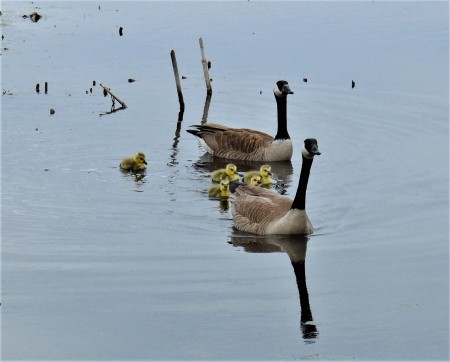 While most heron chicks are still a few weeks away, it’s not so for Canada geese. In a quick trip to the Montezuma Wildlife Refuge today I counted several new families as well as a few mommas who continue to patiently sit on nest mounds. Watching a line of tiny fluffy goslings toddling along behind their mommas is sweet indeed, making it rather easy to forget that these adorable little ones will soon be big, fat, and noisy — and just as annoying as their parents!
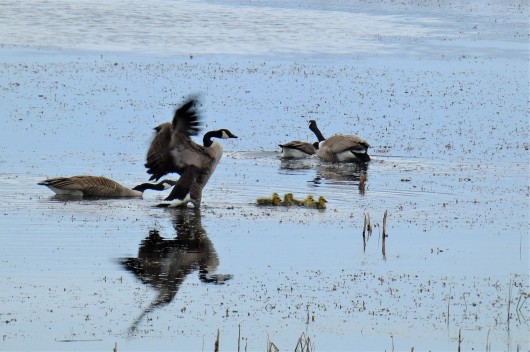
Shoo! Go away! Get outta here!
Unlike the eagles, owls, and herons, though, Canada goose families are not protected by isolated rookeries or DEC-enforced perimeters. So, beware the photographer — or other Canada geese — who dare to come too close to momma, daddy, and their precious babies!
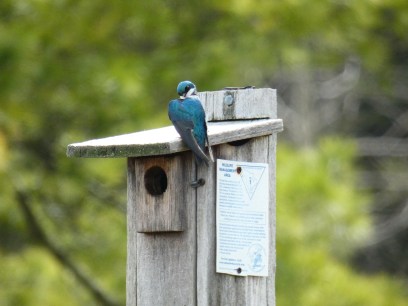
*Supposed* to be bluebird boxes, but the tree swallows don’t mind appropriating a few for themselves
Not too many ducks today. The migrators have been long gone, and the residents seem to be limited to northern shovelers and the ubiquitous mallards. I did see some swans and some blue-winged and green-winged teal plus a few coots but no babies yet. I did hear the wail of common gallinules, but they and their babies, if any, remained well hidden in the reeds and rushes.
Another few days will warrant another visit — springtime in western New York may be cool, rainy, and windy, but there is so much to see and enjoy!
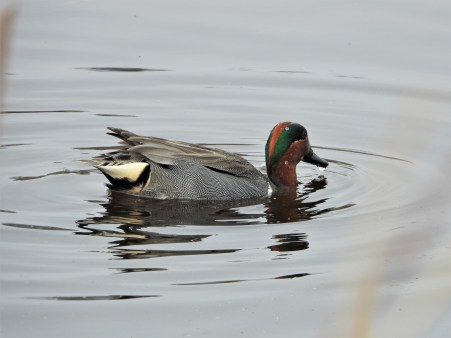
Green-winged teal
Wild, wet, and wonderful!
Grebes, they’re so weird.
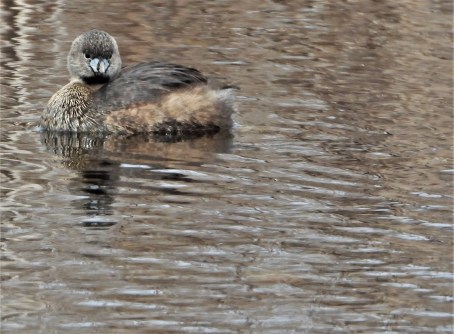 We have the (ubiquitous) pie-billed type here. They’ve come back stronger, I think, this year. . .or maybe I just didn’t notice them as much last year as I do now. They’re cute little things, like tiny ducks with a fancy-looking bill. But they’re definitely weird.
They like to hide in the vegetation that grows in marshy water, but they don’t eat it much. That is the stuff of which ducks and geese are made. The pie-billed grebe prefers food that wiggles, such as fish, frogs, insects, and the like — much tastier than a dried-up cattail or some soggy pickerel weed. Grebes, including the pie-billed type, also eat their own feathers (!), which they sometimes feed to their young. I have to say ewwww! to that.
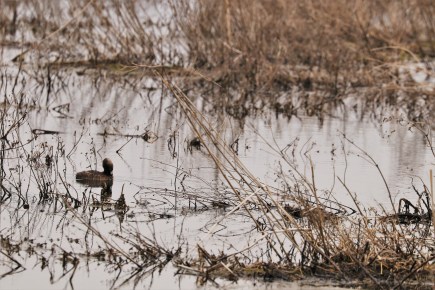 They build mats, not nests, from that marshy vegetation, and the chicks hatch on that. Babies can swim from the day they are born, but they spend most of their first 3 weeks on the mat — either that, or riding around on their parents’ backs. Lazy little things!
Grebes aren’t so good at walking and are worse at flying, but they are great swimmers. Those feathers, when they aren’t being consumed, hold a lot of water — fluffy feathers are a good thing when you’ve got three or four little ones riding on your back and you’re trying to stay afloat.
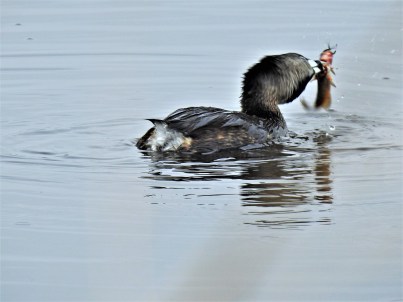
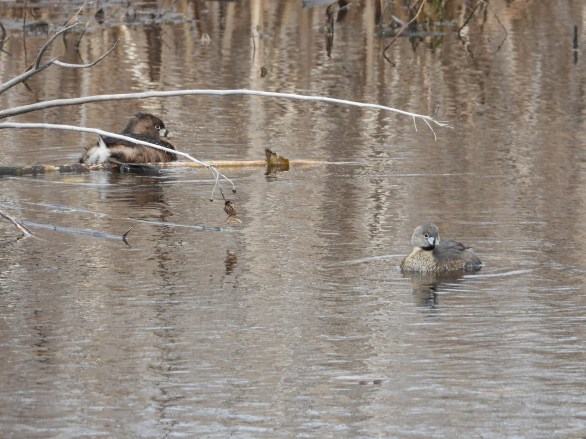
I’ll be watching, as the weather gets warmer, for those little ones to appear!
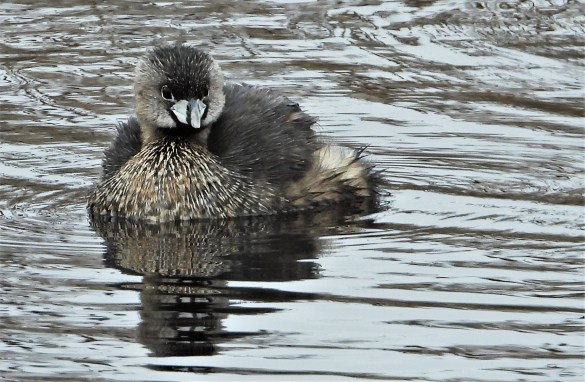
. . .the kind I’d like to meet (on the side of the road in an old cornfield!)
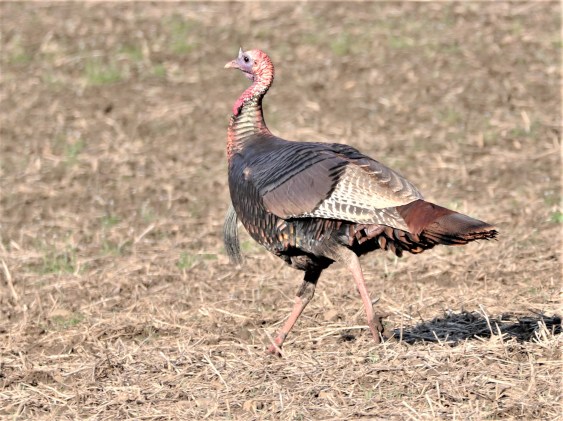
No one could look as good as you!
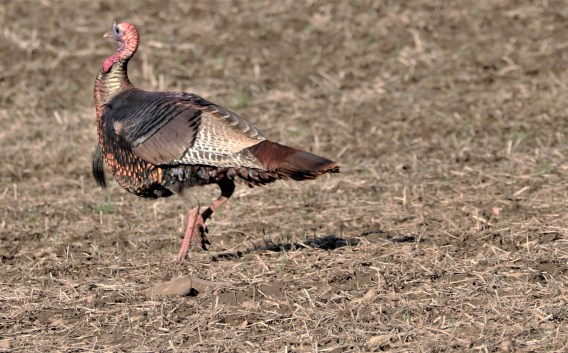
. . .don’t walk on by!
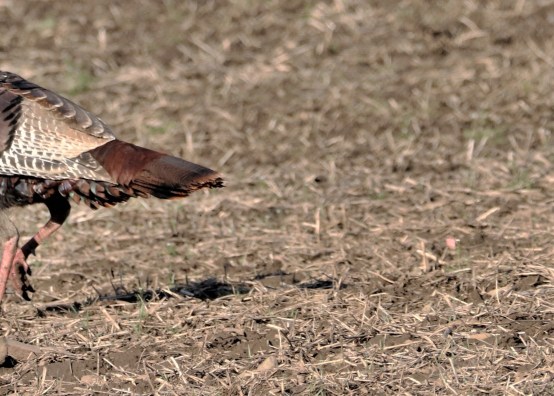
Buh-bye!
In a western NY winter the golden hour can quickly deteriorate. Then it becomes “The (18%) Gray Hour.”
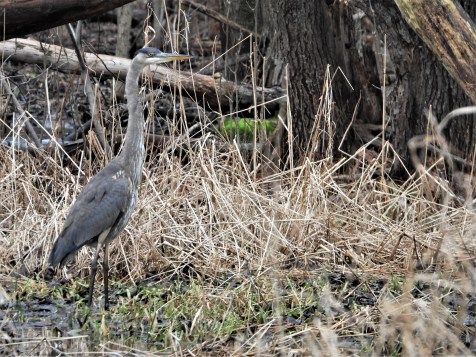
Oh, it started off okay. . .a little gray with just a hint of sun.
I mean, just yesterday it was in the 60s!
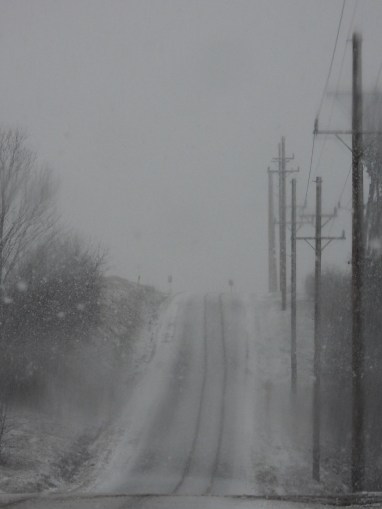
But a passing cold front darkened the sky and triggered the lake effect machine.
Gone was the sun as dark, gray skies and anything beneath them were pummeled by groppel and swirling snow.
No “golden hour” for us!

The Gray Hour might last for only an hour — or it could persist for days, challenging any camera’s autofocus.
Neither contrast nor phase detection work well in the low-light monotone of The Gray Hour.
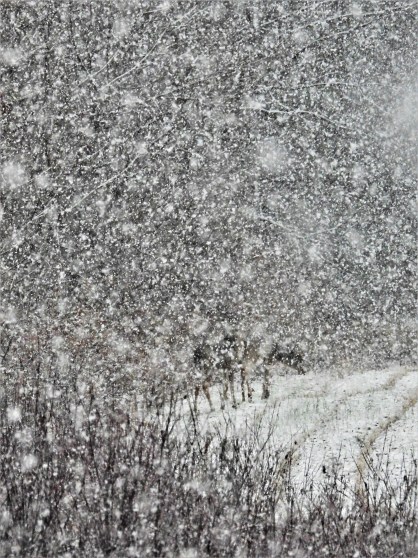
Still, it is possible to get some interesting photos. . .but I suggest you do it from the relatively warm and dry confines of your car.
No need to test the weather resistance of your expensive gear!
Watch as this great blue heron starts a brand-new nest.
A humble beginning with sticks and twigs. First one stick, then another — which is presented to his bride. They work together to build their new home.
Probably the most visited part of the sprawling Montezuma Wetlands Complex is Wildlife Drive, a 3.5 mile loop that allows visitors to take a hike from the comfort of their own cars.
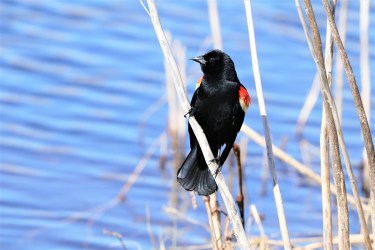 And today, April 1st, the gates were opened to welcome birders (and photographers) to the 2020 observation season. Even CoVID-19 could not prevent this long-awaited event — in fact, it’s one of the few things that can be safely accomplished “alone together” and six feet apart.
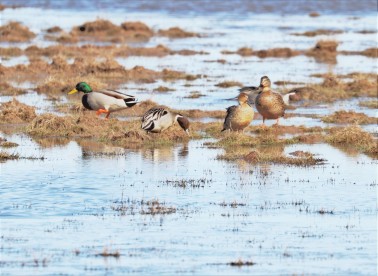 The Drive closed a bit early in 2019 due to the unfortunate combination of low water levels and an early freeze (see What, No Ducks? on this blog). The levels are still not back to “normal,” (whatever that is) but they are deep enough to support a modest muskrat population and a few ducks, mostly northern pintails, northern shovelers, and the ubiquitous mallards. Pairs of Canadian geese, of course, were in abundance; some were nesting on top of the muskrat lodges while others were busy constructing their own mounds with grasses, twigs, and other marsh debris.
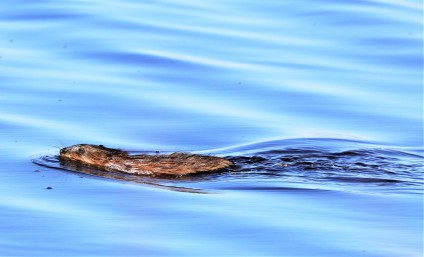
Muskrats are making a comeback this year.
I saw only two great blue herons fishing in the Benning Marsh; doubtless there will soon be many more. No great egrets as of yet, no swans, and none of the small waders, but it’s still early in the season.
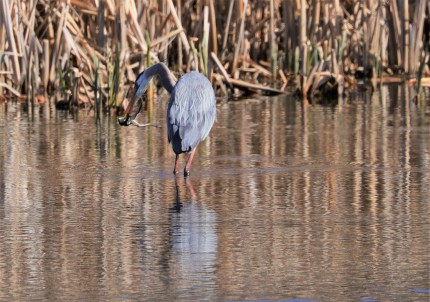
Sometimes nature is harsh. . . but it all fits in the plan
Capturing these tiny snippets of life in the natural world is comforting. Here on Wildlife Drive no one judges the carnivorous heron or urges it to “go green.” No one attempts to improve the sparrow’s song. Life on the marsh is beautiful and balanced. . .there is no need for human intervention. Our job is to watch in awe and admiration — and don’t touch!
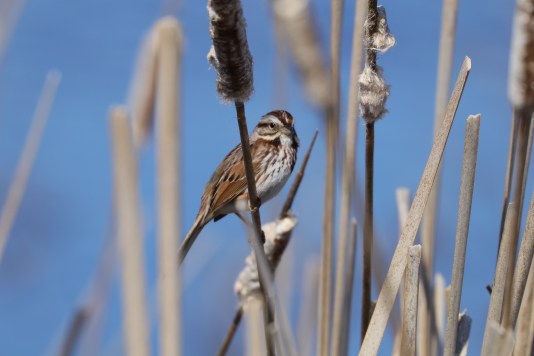
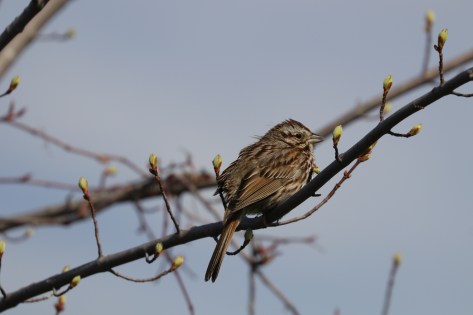
Song Sparrow — brown and beautiful!
This is something I hate to do, but hard times come with hard choices 😦

Wolcott Creek
New York City has a big problem. And the residents of the small Wayne County town of Butler want it to stay in New York City. They want no part of it,
And why would they? Raise your hand if you don’t mind having 10 tractor-trailers, each bearing 30 tons of people-poop, depositing said tonnage in your town.
EACH DAY.
EVERY DAY.
. . . well?
Someone? Anyone?
Hmmm. Just as I thought.
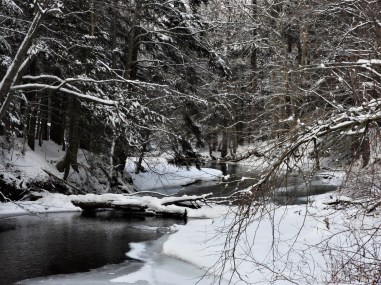
Another view of Wolcott Creek in another season
Nonetheless, Tully Enterprises, which already does quite a business hauling sewer waste out of the city for treatment elsewhere, thinks the residents of the Town of Butler, the smallest town in rural Wayne County, should be pleased to host a facility to treat that sludge right on the banks of Wolcott Creek.
But they’re not. And on March 10 they crowded into — and overflowed from — the 150-seat Butler Town Hall to express their displeasure.
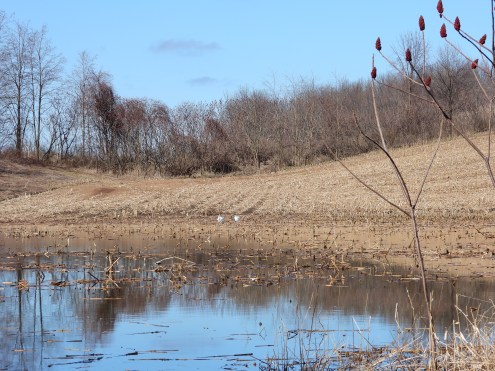
Muckland farming is still carried on in Butler and in the adjacent town of Savannah.
Peter Mantius writes a blog about the “environmental politics in New York’s Finger Lakes” (https://waterfrontonline.blog/2020/03/10/butler-town-hall-overflows-with-crowd-fiercely-opposed-to-sewage-sludge-imports-from-new-york-city/). He described a “raucous” and “energized” crowd and noted that “roughly a dozen speakers spoke in opposition.”
” No one,” he reported, “spoke in support.”

Beaver, ducks, swans, and birds currently nest alongside Wolcott Creek
Although Mantius thought that the town board remained “noncommittal,” it would appear otherwise if you read the Finger Lakes Times. One board member, Duane VanGelder, commented that Butler residents should “have a right to do what they want with their own property, within the law.” Apparently this right extends to Ricelli Enterprises, owner of the 30-acre tract where the proposed facility would be constructed. Ricelli Enterprises, by the way, has offices in North Syracuse, Fulton, and Phelps but none in Butler. Nonetheless, VanGelder went on to further support the project by dismissing outright any complaints about the odor that would inevitably result from treating 300 tons of sewage a day. “We are in an open rural area, and we expect these things.” These things? There is a big difference, my friend, between farming and treating your town like an unflushed toilet. Maybe HE expects “these things,” but WE don’t!

Heron rookery on Route 89 in South Butler. The right-most nest currently hosts a nesting eagle.
Tom Mettler, Superintendent for Waste Water in the adjacent Village of Wolcott, disagrees with VanGelder’s assessment of “these things,” too, and he told a 10NBC News reporter why. “I did visit [the sludge dumping site] in Pennsylvania that they [Tully Enterprises] have, and the odors were absolutely horrid,” Mettler said. “You can smell the stuff for miles.”
 Mettler explained further to a reporter from The Finger Lakes Times. “That’s because the sludge is human and animal feces, industrial chemicals, medical wastes, oil products, pesticides etc.,” he said. “Curing sewage does not remove toxins. Pathogens, chemicals, heavy metals, pharmaceuticals, poisons, and toxins settle into the sludge.”
“What is surprising is that “[t]he product of all this is sold as fertilizer to farmers and gardeners and can be labelled as organic. It ruins farmland [and] people’s health. . .”
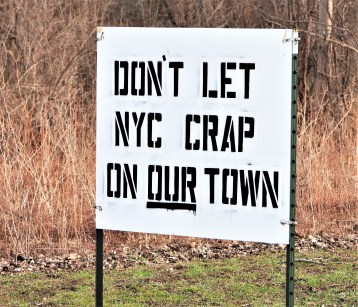 He predicted what is likely to happen if the treatment facility is built. “The odor from this composting [would be] carried possibly miles from 89.”
Well, I am possibly miles from Route 89, but not very many. So I am adding my opposition to this proposal in full support of the residents. The Town of Butler is where many of my nature photos originate, and I shudder to think of what would happen should this facility be built.
Butler’s population is 2064, only 140 of whom are registered voters. New York City, though, has a population of about 8.7 MILLION. Maybe a city that large should secede and become their own state. That way they could keep their problems to themselves instead of dumping them in the small towns of “upstate,” which to city residents is just about any town located in that nebulous area north of Yonkers. In any event, listen up, Tully Enterprises! We don’t want any of that city %$%#$! The mess was made in NYC, and NYC is there it should remain.
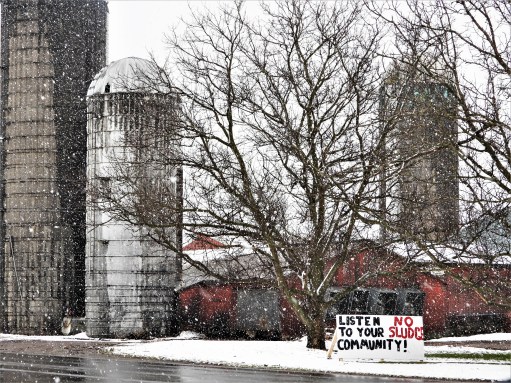
Update, July 7, 2020: They won! Tully Enterprises has withdrawn their interest in the Town of Butler, citing (among other things) the “lack of utilities” and the expense of “the necessary odor control system to treat all that air” — you can read it for yourself right here:
 I hope Tully Enterprises now realizes that any facility required to treat NYC sewage should be built in NYC. Congratulations to the citizens who spoke up to protect their town!
And, let any other endangered upstate town learn a lesson from the citizens of Butler. They may be few in number, but the are mighty when united in a common cause!
Maybe CoVid-19 can afflict the world population and threaten the global economy, but it can’t stop the world from turning or the seasons from changing.
And yes, my dear readers, spring is here! If you don’t believe me take a look at some sure signs of spring:
Pussywillows!

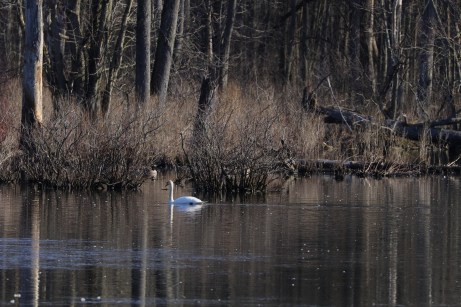
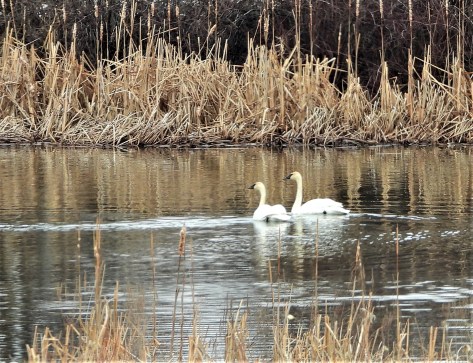
Swans gliding upon silky water
Winter aconite (?)

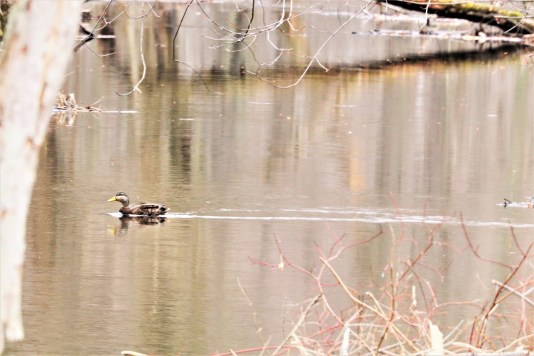
Ducks,
Daffodils

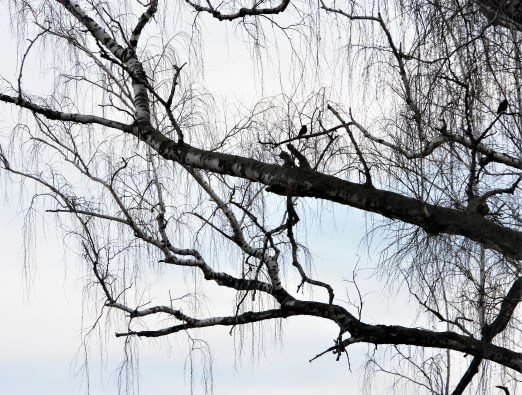
Blackbirds singing (look closely)
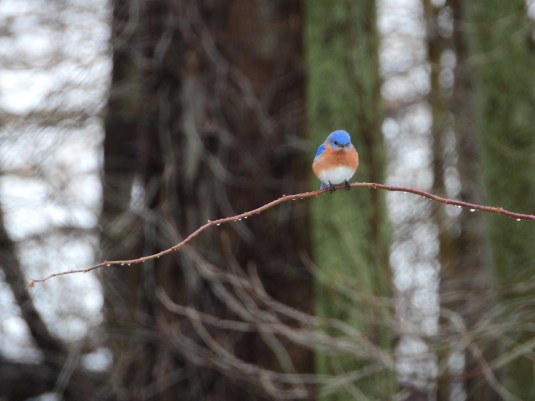
And bluebirds nesting!
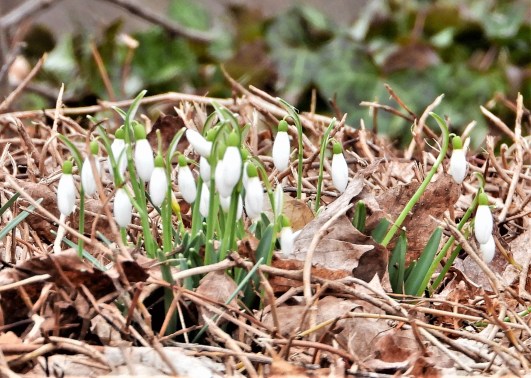
Spring in western New York. . .it may not be green yet, but at least the ice is gone! And the only snowdrops are these:
 Seen by Susan: Fun with Flora and Fauna
Recent Comments