
It seems so long ago now that there is snow on the ground and more on the way.

Here are a few summer memories of the ubiquitous-but-awesome great blue heron to keep us warm while we await the return of spring and summer. (Sorry, I slipped one in from autumn!)
Whatcha got cookin’??
How about cookin’ somethin’ up with me!
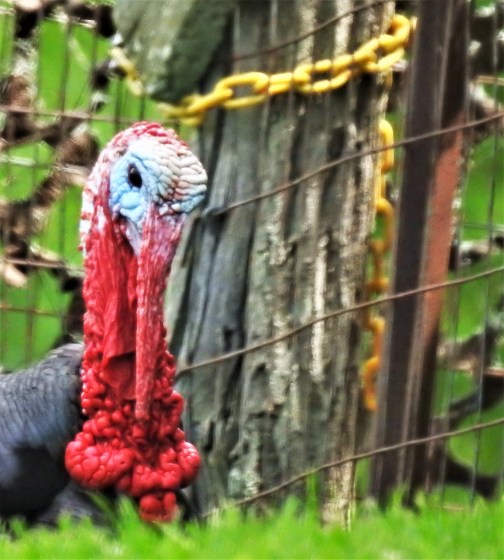
Happy Thanksgiving!
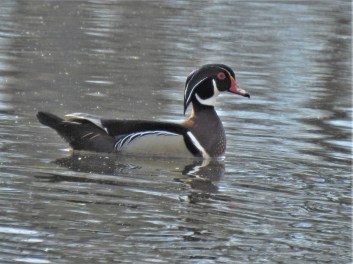 Officials have announced that the unusually cold weather may have prematurely ended duck-watching at Montezuma this year.
But I suspect it has more to do with the induced drought. Draining the pools over the summer (2019) was done with good intentions and fairly good results. The lush grasses that re-grew on the marsh beds crowded out the unwanted plant life and promised a veritable oasis to lure hundreds of ducks and other waterfowl to stop for a rest and a hearty meal before resuming their travel on the Atlantic flyway.
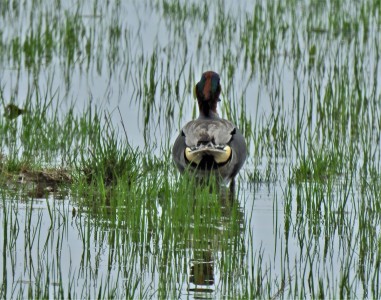 But refilling the pools, begun in September, has so far produced only low water levels, so low that the recent cold wave froze them over. . .and the ducks are gone. It definitely, as one reporter said, puts a crimp on bird-watching at Montezuma National Wildlife Refuge.
 You can read about it here: https://www.newyorkupstate.com/outdoors/2019/11/wintry-weather-puts-crimp-on-bird-watching-at-montezuma-national-wildlife-refuge.html.
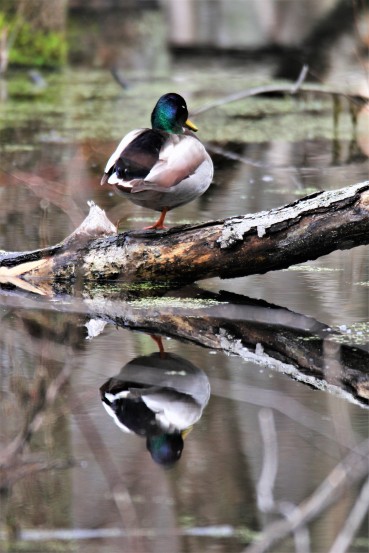 Or, you can check out nearby Cayuga Lake, West Shore Trail, or beaver pond at Sterling Nature Center where the water (not ice) entices hungry, travel-weary ducks. Irondequoit Bay is another popular avian pit stop — last time I was there it was dotted with swans as well as ducks, geese, and gulls.
All for the watching, though. They are much prettier in real life than they are in a roasting pan, surrounded by onions and potatoes.

The best things to shoot a duck with. Or a deer. Or a turkey. 🙂
The West Shore Trail water levels are finally high enough to support fish. . .and where there’s fish, there are eagles not far behind.
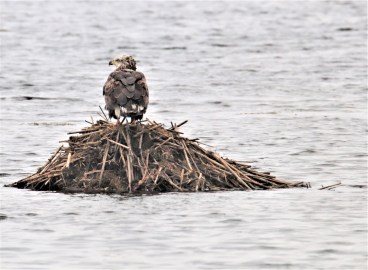 There would be heron and osprey, too, except at this time of year they are long gone to the southward. Not so for the eagles, who generally stick around in the winter until the lakes, rivers, and marshlands freeze over, forcing them to find open water.
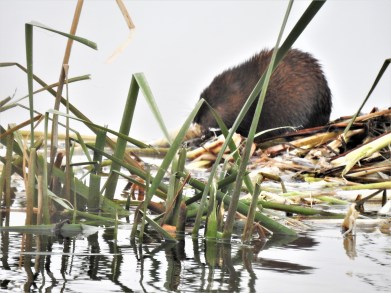
Muskrats are back, too. Their lodges serve a double duty, as home for the muskrat family, and a stable perching place for anyone looking for a fresh fish dinner.
West Shore Trail, at the northern part of the Montezuma complex, had a large population of muskrats earlier in the spring with lodges too numerous to count. However, these numbers diminished markedly as the marshes dried up under an induced drought so that by the summer there were less than 100 lodges. It’s great to see them back again!
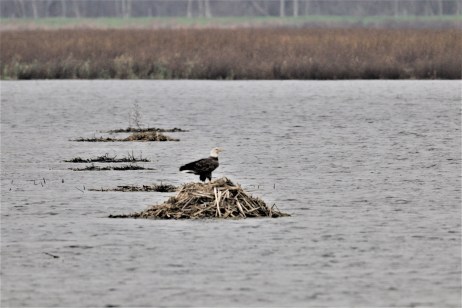 The marsh itself is huge. From the West Shore road facing south, it stretches as far as the eye can see. When the flyway is active you can hear sandhill cranes and tundra swans in the distance, but the distance is so far away that even a 600 mm lens or a superzoom bridge camera can’t catch them.
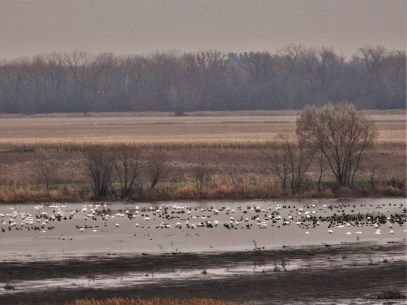
Another stopover on the Atlantic Flyway is the nearby Knox Marcellus marsh. Right now it is hosting a flock of migrating tundra swans — tundras, I’m pretty sure, as the calls I hear are the coo-type whistle of the tundra and not the harsh honking of the trumpeter. Still too far away for any portrait shots, but just documenting their presence (and their numbers!) can make for a lovely and interesting landscape.
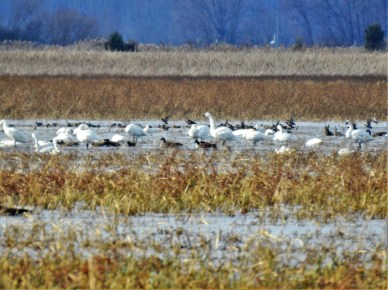 It would make a more interesting shot had the leaves not succumbed to our last windstorm, but the swans did not come to view the foliage. To them, the marsh is a pit stop between their breeding grounds in the Arctic and their winter homes in the Chesapeake area. They won’t be here for long, so, enjoy them while you can!
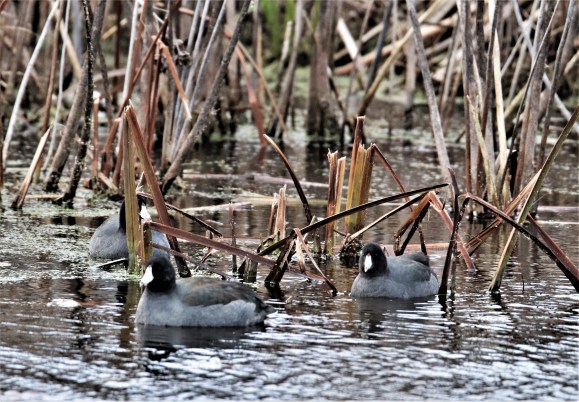
When it’s a rail. And if it’s black (mostly) with ugly striped feet, it’s a coot.

Right now, in the midst of the fall migration, coots are plentiful here in Western New York. In fact, they are plentiful just about anywhere there is fresh water — the experts call that “cosmopolitan distribution.” I call it ubiquitous. In fact, coots are so ubiquitous that academicians regard them as bioindicators of environmental health. In any event, I’ve seen coots on Irondequoit Bay and the Montezuma wetlands, so now is the time to snap an image or two of these sleek black divers.

Coots like swimming with ducks. . . but not this duck.
Coots and ducks get along very nicely, probably because they have a lot in common — they are both expert swimmers. So it’s not unusual to find mixed flocks plying the marsh pools for vegetation; however, both ducks and coots find small fish and insects just as tasty as duck weed and swamp grasses. It’s this carnivorous part of their diet that gives ducks and coots a “gamey” flavor — strange, though, how many a hunter will dress and roast a duck but not many (if any) will make a coot stew.

Oh-oh. . .
Which is just fine with the osprey, eagle, and fox populations, who don’t mind a coot dinner at all. Coot eggs and nestlings are fair game, too, if you happen to be a hungry raccoon or snapping turtle.

Coot cousins
Despite their similarities, though, coots and ducks are unrelated. While ducks share an ancestry with geese and swans, coots belong to the same order as cranes and limpkins.
P.S. By the way, coots love their ugly striped feet, thank you very much. They are almost as good as webbed feet for swimming and for getting a running start for flying. They are pretty good for walking, too. In fact, those oversized gangly toes are what allow coots to walk so nimbly on the matted, half-submerged plant debris that forms the muddy border separating water from dry land. . .I’d like to see a duck try and do that!
Whoever called it that probably hasn’t seen the Grand Canyon. But Letchworth is definitely worth seeing in its own right, especially in the fall.
The “Mighty Genessee” doesn’t appear so mighty here at Letchworth. It’s the ancient gorges through which it winds that provides an awesome view. The best place to start is at the Mount Morris entrance and follow the twist and turns of Park Road to Portageville.
No wildlife other than an occasional deer, unless you take one of the trails leading into the woods. But three waterfalls, the rapids at Wolf Creek, and amazing views of the gorges plus the Glen Iris Inn, a small museum, and the Mary Jemison cabin are enough to put Letchworth high upon your fall bucket list.
 Traffic has resumed on the Atlantic flyway as fall migration begins.

American robin — see ya next spring!
The songbirds have been gone for a few weeks now — the blackbirds, marsh wrens, and kingbirds have all left the watersides, leaving only tree sparrows behind. The osprey nests are empty, and just the hardiest egrets and herons remain, stalking the waters of Montezuma for fish and frogs. And there are a few swans swimming alongside their almost-grown-up offspring, if you know where to find them.
Although the Montezuma wetlands remain an important rest stop for migrating birds, this year (2019) was a tough one for resident wildlife. Caretakers spent most of the year draining the main pool in attempts to replicate a drought. The exposed nutrient-rich marsh bed was then allowed to nurture a variety of grasses in hopes of attracting migrating ducks in the fall. As the water levels receded, though, so did the balance and types of resident wildlife.
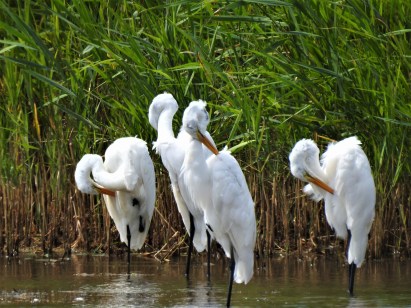 Herons, egrets, and other waders coped well at first, congregating in the smaller wet areas that remained, but once the low water levels could not support a fish population the waders left for more lucrative grounds. At one point early this summer I noticed deer romping in the grassy field that once was the main pool. Refilling the pool began in September, and the fish are beginning to return; however, the levels are nowhere near last year’s, and wildlife numbers remain comparatively low.
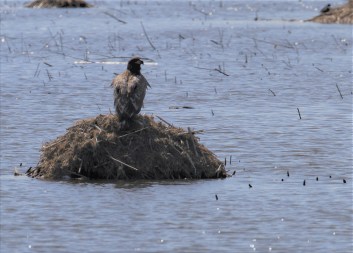 Draining the main pool affected several of the outlying marshlands, too. To the north, the large muskrat population was dried out of their lodges on West Shore Trail. For a few weeks the lower water levels attracted a significant number of juvenile eagles, who sat atop the vacant lodges searching for fish. But they, too, left once the water level dropped even further.
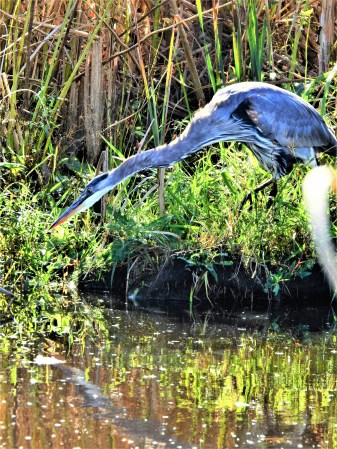 However, there is still wildlife to be seen at any of the several wetlands included in the Montezuma complex. Approaching from the north via Rt 89-S and Rt 20&5, I’ve counted 12 osprey nests, half of which lie atop the utility towers leading to the Seneca Falls entrance. Occasionally a turkey vulture can be seen resting on the nests or the towers that support them. On a good day there will be an eagle or two perched in the tree near the spillway, and on a sunny day you may have to help a painted turtle across Wildlife Drive (be careful of the snappers, though!). Yesterday I spotted an American bittern looking for lunch — not an easy find since it is easily camouflaged in the emergents growing along the shore. And it was only a week ago that I spotted some sandhill cranes feeding in a harvested cornfield along Rt 89 (there were 10 of them!).
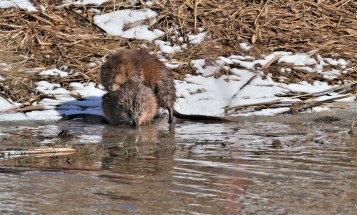
“Am I in your way, Frank?” “Nope, Harold, I got this.”
More common are the flocks of Canada geese, many of which do not bother to migrate as long as some open water remains. Herring gulls, ring-billed gulls, and Caspian terns are common, too, although the terns won’t be back until spring. Less plentiful are the varieties of ducks and rails that ply the grassy waters. Their numbers will, hopefully, increase as the water levels rise and the fall migration begins.
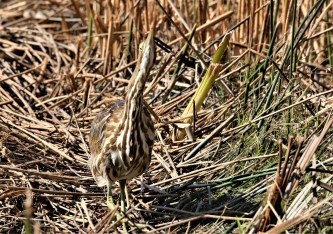
Reclusive and rare
The Montezuma Wetlands Complex is a series of reclaimed marshes and swamps that presently consists of about 50,000 acres, although the refuge itself is just over 10,000 acres. The Montezuma Wetlands Complex Land Protection Partnership oversees its operation and maintenance. The partnership includes two public agencies, the US Fish and Wildlife Service and the New York State Department of Environmental Conservation. They are joined by representatives from private agencies — the Finger Lakes Land Trust and The Nature Conservancy — as well as some private landowners. See what the NY DEC has to say about the Montezuma wetlands (https://www.dec.ny.gov/outdoor/55687.html), and be sure to check out the Friends of Montezuma website (https://friendsofmontezuma.org). Freshwater Future, an organization dedicated to the “healthy future of our waters in the Great Lakes region,” weighs in on the wetlands here: https://freshwaterfuture.org/services/publications/freshwater-voices-newsletter-archive/volume-9-number-2-%E2%80%A2-march-april-2001/balancing-ecology-and-economy-earns-montezuma-wetlands-complex-uncommonly-good-award/

But most importantly, be sure to get a good look for yourself. You won’t be disappointed!
“He had the eye of a vulture,” Poe wrote. “Whenever it fell upon me, my blood ran cold.”

The eye, nose, and mouth of a turkey vulture partially obscured by apple foliage.
It isn’t so much the eye of the vulture, it’s the entire head. Small, smooth, and featherless, with flaring nostrils not found on any other raptor, the vulture is downright ugly, ugly enough to provoke an “ewwww!” from just about any bird fancier. Yet, if one can look beyond its regrettable face and its prime source of diet (carrion), it’s possible to see a graceful bird of prey soaring overhead with a wing span rivaling that of an eagle.
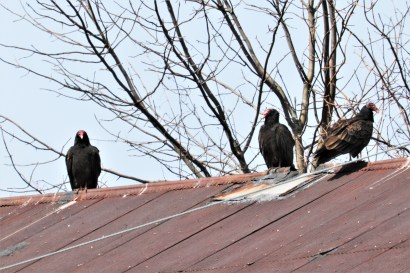 Turkey vultures are common to this part of western New York; hundreds are counted each month by watchers at Derby Hill and Braddock Bay. They are easily identified by their red heads and silvery underwings. In flight, turkey vultures could easily be mistaken for an eagle if not for their penchant for holding their wings in a slight V-shape. And unlike the eagle, turkey vultures are community birds. If you see one gliding overhead, look again; you are likely to see a few more.
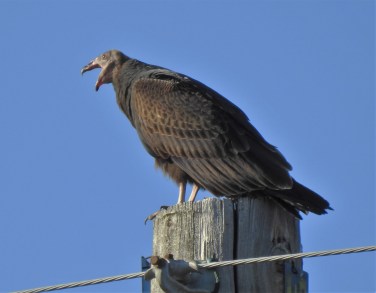
Juvenile turkey vulture. Probably a teenager, judging from its attitude.
If you are lucky you might see another type of vulture sitting atop utility poles with outstretched wings and ugly heads. Black vultures are more common in the mid-Atlantic and southern regions, but they are occasionally seen up here near Lake Ontario. They are distinguished from their red-headed cousins by their black heads and whitish wing tips, which are held in a straight plane while in flight.
Neither turkey vultures nor black vultures can predict death, nor do they await it by circling in the sky. That’s the stuff of which 19th century Gothic novels were made. Besides, that would be a waste of time and energy. Vultures — turkey vultures, at least — are smarter than that. They conserve energy by riding the thermal columns that rise in the air, using their dihedral wing shape for stabilization. As a result they rarely need to expend energy when flying. They rely upon their keen sense of smell to detect the byproducts of decay — mercaptans — which lead them to dead deer and other carrion. They can eat just about anything — even sickly or infected flesh — with impunity, protected by their highly acidic digestion and natural immunity.
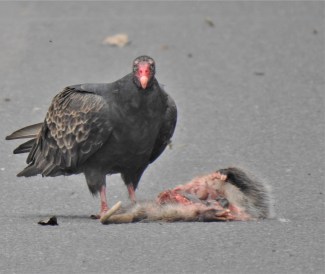
‘Chu lookin at?
Turkey vultures, though, are picky eaters. They will pass if the animal has been dead too long, unless they are unusually hungry. Roadkill is not particularly favored, especially if it is too old, but a dead raccoon tenderizing in the road for up to 2 days could provide a mighty fine feast for a couple of turkey vultures. However, in so doing they run the risk of becoming roadkill themselves, since turkey vultures consume their food right where they find it.
Black vultures, though, are lazy and not too bright. They work their wings harder, so flying takes up more energy. They lack that keen sense of smell, so the search for carrion is by sight alone. Either that or they will follow their turkey vulture comrades and steal their food. Black vultures are scavengers but will also eat live food. They will prey upon small wildlife, even young livestock (watch out, farmers!), especially if it is weak or has been injured.
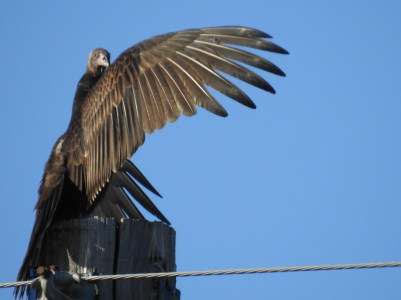
Juvenile turkey vulture A black vulture has a similar head but lacks the large nostrils.
Vultures are at the top of their food chain. I mean, who wants to eat a vulture? Answer: No one. They stink to high heaven, and that is enough to scare just about any predator away. Both turkey vultures and black vultures pee on themselves (to cool their legs), and they will not hesitate to vomit up an odiferous half-digested meal if they feel threatened. The foul odor of the vomitus (plus the possibility of it being flung into one’s eyes) is enough to scare away any but the most persistent fox or hawk.
 If a vulture is going to die, it will probably be from old age. Or from flying into a high-tension power line. Or into a tractor trailer doing 60 MPH on Rt 104.
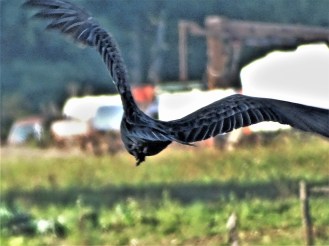
Scavenging. It’s a dirty job, but someone’s got to do it. And the vultures do it very well.
They really didn’t do anything to deserve it. Nonetheless, they are the birds we love to hate — crows, starlings, and mute swans.
Actually, they are kind of pretty. Crows are dark and sleek. Starlings have such cute little polka-dotted tummies (much like a miniature Kate Spade bag). They both make a terribly unpleasant noise, but crows are quite useful to the human population as a bioindicator of the West Nile virus (thanks, Wiki!). They eat insects that would otherwise torment us humans. They’ve always been here and therefore belong here. We should really be more tolerant — and appreciative.

European starlings guarded by an American crow.
No such luck for the starlings, who were imported from Europe in the 1890s. . .and not for any particular reason, either. They were imported for ornament, just because. Now they are nothing but a nuisance, and bird fanciers have been given permission to disdain them by none other than the prestigious National Audubon Society (https://www.audubon.org/news/birdist-rule-72-its-okay-hate-starlings). I mean, they do nasty things like chase native birds from their nesting places and stare them down — or even attack them — while feeding, but they haven’t caused any species to go extinct. They are really just little bullies who annoy their avian comrades. . .even so you often find them feeding alongside many other birds without incident. True, flocks of starlings do pose a risk for airline pilots, but so do native geese and gulls, and no one talks about mass-murdering THEM. Rather than annihilate an entire bird species, we might instead investigate ways to coexist and decrease the risk. (https://www.skybrary.aero/index.php/Bird_Strike).

Uh-oh, little trumpeter! You are being stalked by a mute swan!
Starlings aren’t the only imported species to grow like weeds and displace native wildlife. Mute swans were imported to the US in the mid-1800s, mainly because lots of rich people thought they looked pretty floating over their private ponds on their great estates. And they are pretty! But like starlings, they are aggressive birds who chase the native species away. Surprisingly, perhaps, mute swans are far from mute. They can and do emit a harsh hissing sound just before they start to beat you with the sharp, bony aspects of their wings. If you are a photographer getting too close to their nests, they will simply chase you away, but if you are a duck they could catch you by the neck and fling you across the water.
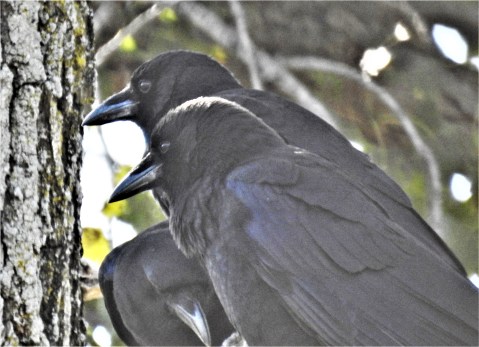
The Three Ami-Crows (“Well you slime-eating dogs, you scum-sucking pigs, you sons of a motherless goat!“)
Some states have enacted mute-swan control policies. Here in western NY, the DEC patrols search for mute swan nests starting in early spring and oil any eggs they find to prevent them from hatching. But nature also helps with population control — foxes and raccoons like to sneak an egg or two for lunch. One mute swan family I watched this year started out with 12 hatchlings in May, but by September only 2 were left, thanks to a bevy of snapping turtles who think nothing of feasting upon the young ones.

The starling tree at Montezuma.
Life. It comes in all shapes, colors, and sounds. And there’s room for all of us here.
I mean, these aren’t exactly the Black Mountain Hills of Dakota.
But this little one didn’t mind at all. The roadside vegetation — and whatever insects hiding therein — was just fine! A brief but enjoyable stop while on my way to Montezuma.

The light was fairly harsh, and he was blasted with toplight, but I got some nice rimlight around the ears and a glisten in his eye. Love this little guy!
Saw them near Montezuma today.
Such beautiful birds! Could use a little post-processing, maybe, just to correct the color (these are jpgs, so were processed in-camera), but I think their natural beauty shows through without it.
Wildlife. It’s all around us. All you have to do is look 🙂
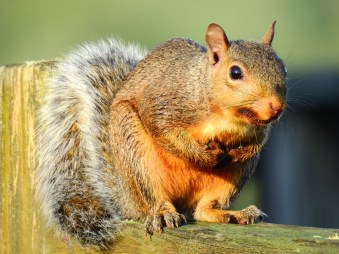
Well, yeah, that’s true for the easy ones, like squirrels or chipmunks in the backyard. Hawks are easy, too, sitting atop utility poles, as are turkeys pecking in harvested cornfields, ducks bobbing on the lake, and the occasional deer grazing along the roadside are good practice. Most of them –except maybe the deer — will stay fairly still long enough for you to fiddle with the camera settings and compose your shot. But there’s a world of lesser-seen animals all around us, too, if we know how to find them. How do you know where they are?
Two of the best ways (for me) are to look and listen. Look up all the information you can find on wildlife and their habitats. There are so many books and YouTube videos on birds that I couldn’t begin to list them all here, but that is the best way to start. Oh, I suppose you could do a google search, but you can get a good idea of what to search for by reading a few books first. Besides, there’s nothing like the feel of a real book in your hands, one that you can go back to for reference without it disappearing into cyberspace.
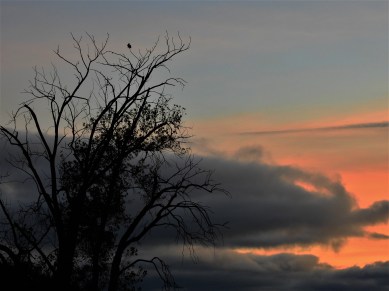
Eagle watching the sun rise at Montezuma National Wildlife Refuge. September 28, 2019
Anyway, I like to shoot life, and lots of life begins (and ends) at the marshlands, both in it and in the vegetation around it. I had already been hanging around wetlands for about a year before I found Wetlands of North America by William A. Niering (1991) at my local thrift store. From it I learned about the varieties of wetlands and the different wildlife they support. The photographs (Bates Littlehales) are clear, bright, and perfectly exposed. This is a book you can learn from! Best $1.50 I ever spent.
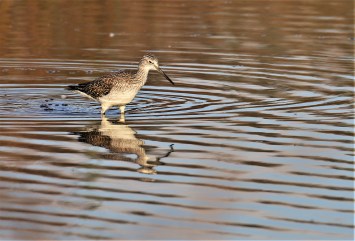
“. . .gotta kiss myself, I’m so pretty!”
If you like to shoot birds of any kind, there are literally thousands of books from which to choose. Anything by Crossley or Sibley is excellent, both as reference and as learning guides, and they aren’t too expensive, either — especially if you shop as thrift stores or used-book shops. There are also websites such as Cornell’s AllAboutBirds.com and eBird.org to help with identification and even hot-spot locations for birding in your area. There is also a Facebook group called What’s This Bird, whose volunteers are at the ready to identify that strange bird you just can’t find in your resources.
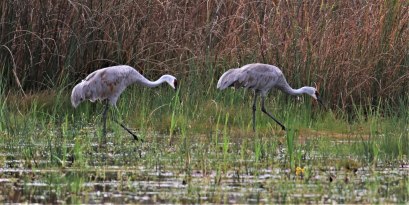
“Walk this way. . .”
Of course, this assumes that you already know how to handle your camera. Even if you have memorized the settings suggested in your users’ guide, it’s always helpful to see how the experts do things. For this, I would recommend anything by Brenda Tharpe or John Shaw. They have been around since the film-camera days, and sometimes you can find their early and now-out-of-print books on nature photography in the second-hand market. They have both written updated guides. Tharp’s Expressive Nature Photography and Shaw’s Digital Nature Photography are both excellent and are the ones I go to most often for review. That’s because my BetterPhoto Guide to Digital Nature Photography is falling apart, Jim Miotke writes a good book with lots of useful tweaks and tricks, but he’ll spam you with requests to join the BetterPhoto web$ite. That’s okay, you can ignore it until it stops. . .or pay the fee and see what more he has to offer.

Bye-bye, Birdie, it’s almost fall!
Once you feel confident with both your camera and your hotspots, it’s time to listen. Listen to what YouTube has to offer regarding your camera, settings, and wildlife. Listen to other people who have been there, done that, and have a lot to share. Meetup groups can be good for this — or not, as the case may be. I discovered (the hard way) that the fearless leader of the Nature Photography Meetup in Rochester [NY] does not welcome newbies, just saying. Although they advertise over 500 members, only about 12 or so showed up at the group excursions I attended; maybe 20 or so were at the monthly gatherings. But give it a try, you may have better luck in your area, https://www.meetup.com/

However, there are many other places to meet people and share your work. Hiking groups is an option as is attending any lectures, demonstrations, or classes sponsored by your local library or nature center. Nature photography websites and Facebook pages abound all over the ‘net, and some of them hold real-time group meetings or hikes. The problem with the ‘net, though, is the same problem I encountered in the Rochester meetup — some of them are for the expert photographer, so you will have to weigh the benefits (of posting your photos, making new contacts, and finding new hotspots) against the possible downside (of being judged too harshly or having your submissions ignored) before you commit to membership. I don’t know which sites would be best for you, but the best sites for me are those that offer helpful suggestions, not criticism, and share their photos for inspiration, not praise — although who can’t help but admire the wonderful photos that are posted by some truly talented people on these sites?

Real or fake? Read The Guardian to find out what happened to this award-winning photograph
Another thing about Facebook pages — be sure to choose a closed group. You may have to answer a few questions before they let you in, but any photos posted therein, including yours, will be protected from unauthorized use. It will also protect the animals you photograph by screening out hunters and poachers. And you will be protected from fake nature photographs — if you don’t believe they exist, or if you think they are harmless, think again. If you look up this group on Facebook — Truths Behind Fake Nature Photography. — then you may not be so shocked when you read about fakers and how they hurt and injure wildlife in The Guardian (https://www.theguardian.com/environment/2010/jan/20/wolf-wildlife-photographer-award-stripped).
This is just a short list for now; I will add to it from time to time, so keep checking for new and helpful references. And feel free to submit some of your own!
 Seen by Susan: Fun with Flora and Fauna
Recent Comments