by Susan

It’s winter out here in the western/northern Finger Lakes region of New York, which means there’s not much going on.
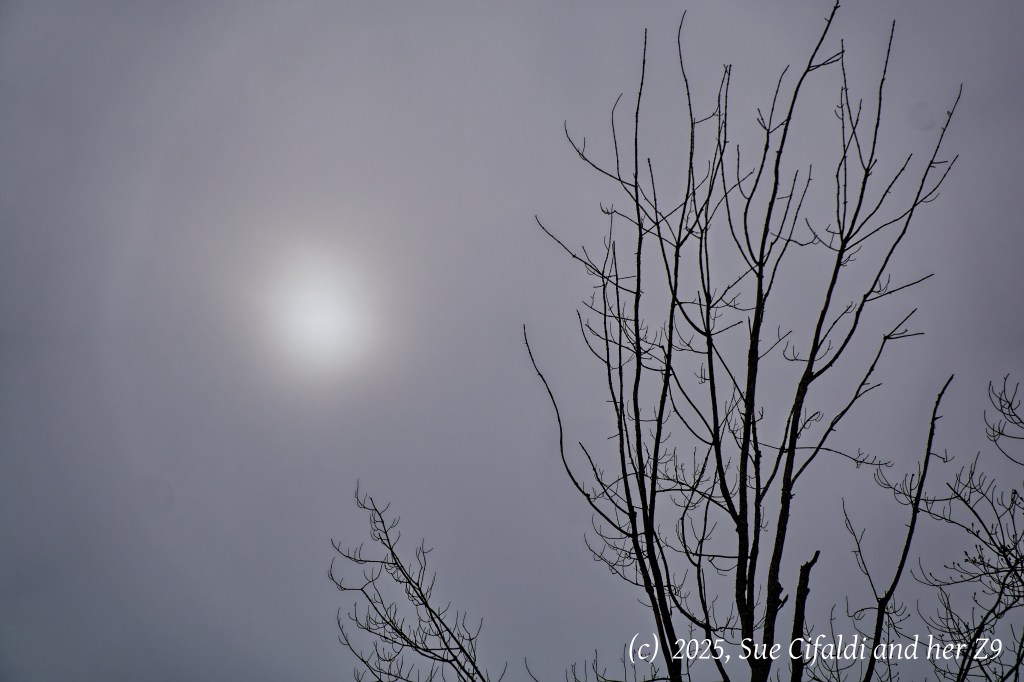
So, I spent a few minutes today looking at all my blog posts. . .okay, more like a couple of hours. Some of my photos downright embarrass me! A few others are so good I can’t believe they’re mine. Most, though, are mediocre (according to REAL photographers), but who cares, I see pleasure and improvement over the years, and that is very satisfying. 🙂
As I ponder, I regret some of the gear choices I have made. I started with some inexpensive Canon gear and then downsized (by necessity, thanks to a rogue sheriff who totaled my camera and my car) to a couple of older, gray-market gifts. I ended up with a seven-year-old, inexpensive, gifted gray-market Canon. . .hey, don’t let anyone tell you how bad these products are! I got some pretty good shots, especially from my 1100d, before they all passed, one by one, into that 18% grey stratosphere far above, the final resting place of all good cameras once their time on earth is done.

I fooled around with a few different brands for a while, trying to find the one with the best results. As I look back, I think I miss my Olympic gear the most. Loved the color science, the IBIS, the lenses, the weight (or lack thereof), but was convinced by a former mentor to ditch it — well, I ended up ditching him, but not before selling all my Olympus gear (wahhh) and investing in Nikon . . .but I might try to find some lightly used Olympic stuff, to see if I reallyreallyREALLY like it or if I’m just being nostalgic.
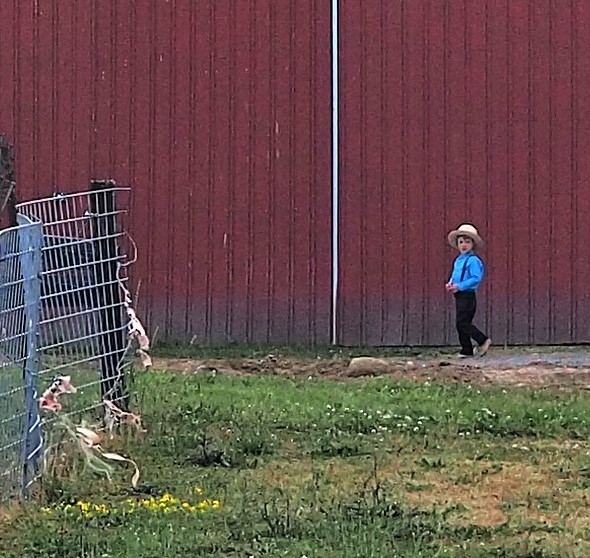
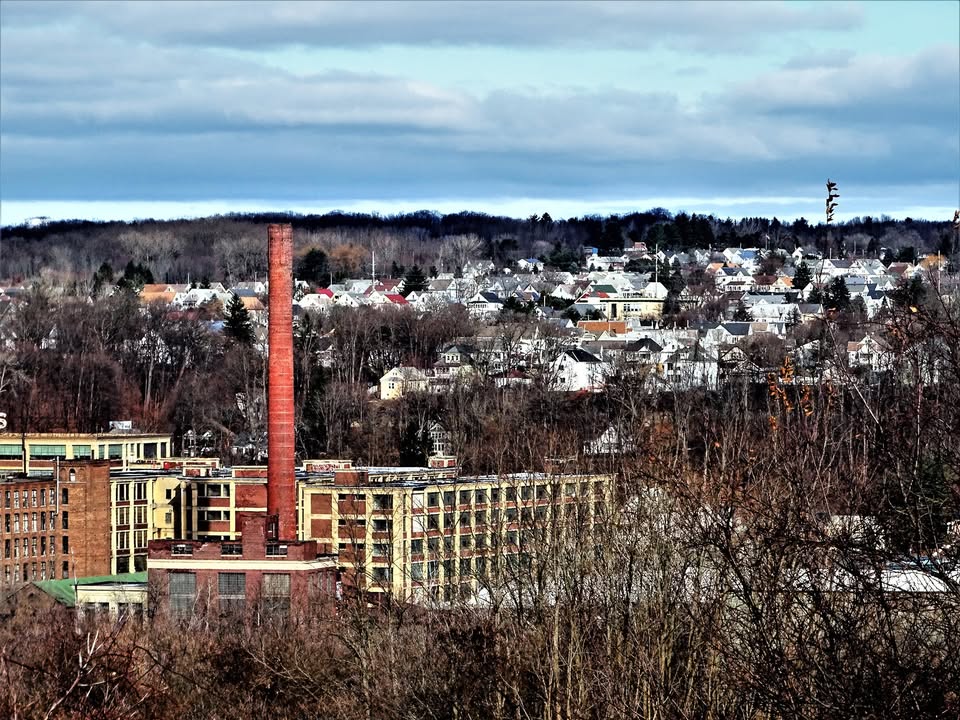
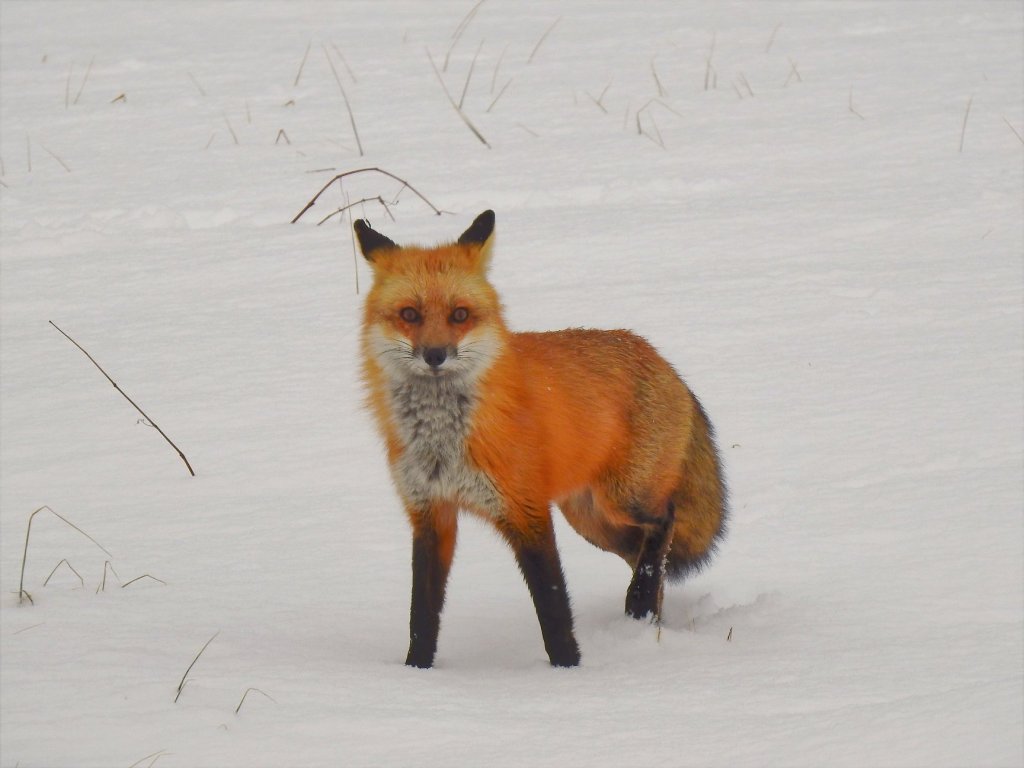
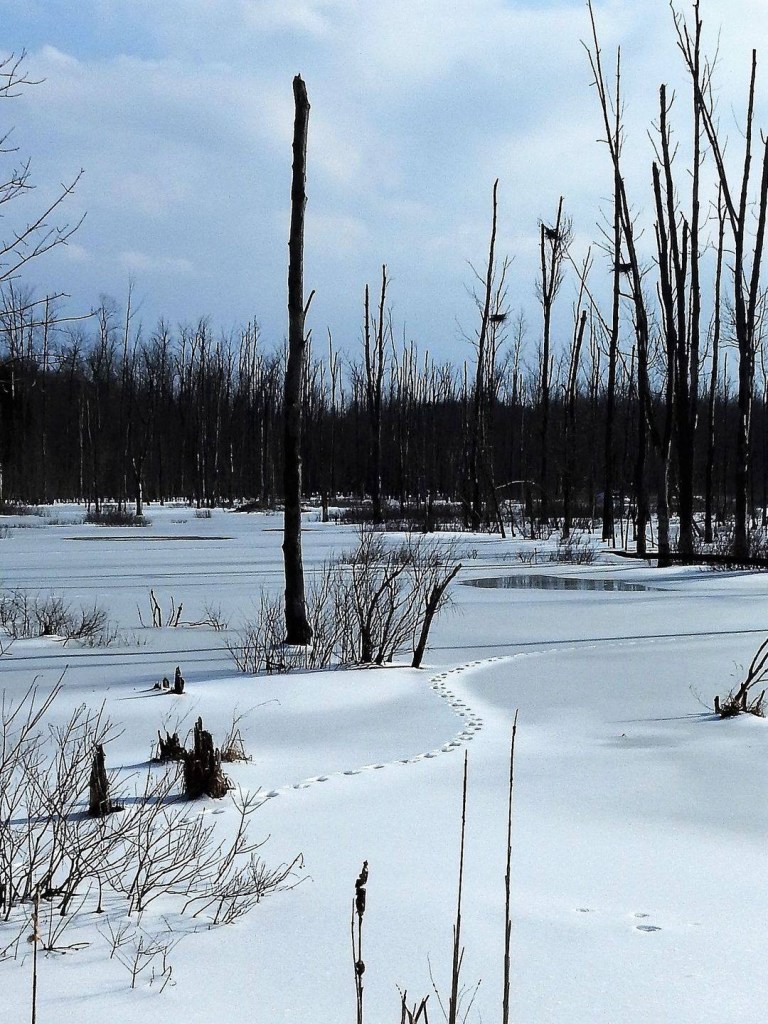

These photos could use some improvements, I know, but considering that they all fell out of the camera as untouched jpgs, they really aren’t that bad. What I find really curious, though, is the noise factor — none were edited for noise (or anything else other than an occasional crop), but noise doesn’t to be much of a problem with the small-sensor Olympus and Panasonics. Even my Sony Rx10iv doesn’t produce much noise, and that sensor is downright tiny. Huh?
Anyway, in 2023 I began shooting with the Nikon d500 and d800 along with a 200-500 lens. Later on I added a Z9 and a 500 PF prime with an FTZ adapter and 1.4 extender (that was back when I had some leftover sheriff money). Under the tutelage of the aforesaid mentor, I learned how to shoot raw and to make simple corrective edits with ACR. Even so, I was still disappointed with most of my photos, and a good number were best treated not by ACR but by <delete>. I didn’t need anyone to show me how to use THAT.
Nonetheless, I remain determined to improve my technique — that’s an achievable goal, right? even for a short, round, opinionated old lady.
So, once the mentor had outlived his usefulness, I graduated to the self-education available on You-Tube. Much cheaper!
However, I really didn’t get significantly better photos despite wasting a lot of time (and brain cells) worshipping YouTube’s guru-du-jour. Oh, these guys are well known among Nikon and Canon crowds, so it’s really no secret who they are. They make a lot of noise and a lot of money enthusiastically preaching about photography done right (which translates to “done my way”), but all I learned from them were some specialty terms and how to select (what I thought were) the best lessons from all the conflicting advice. And I still returned from the field with a camera full of soft, flat photos.\

Ewwwww.
But then I learned something astonishing. It struck me one day like a snowball thrown by a giggling, pimply-faced 14-year-old: YouTube lessons work best when unlearned. I discovered this after finding a Facebook group called Nikon Teaching Photography. The admin, Bob Scola, has a large following and a stellar online video library hosted on EyeSo100 explaining all things Nikon. You can check it out here:
https://www.eyeso100.com/spaces/10626684/content
and for $100 a year (or $10 monthly payments for us poor folks) it, too, can all be yours. (Actually, I’ve wasted more money at McDonald’s, where I could sit undisturbed, shaking my head while previewing and deleting the day’s photos. . .)
My first Bob Scola lesson — a mortal sin in the eyes of the YT deities — was removing “back button focus” (Holy Skepticism, Batman!). Because, really — what does it accomplish, other than move the shutter button functions elsewhere? Actually, it does exactly what The Temptations told us back in 1969 when they sang about “war, humph, good God, y’all, what is it good for” (answer: “absolutely nuthin! (say it again). . .). But I suppose it can be quite entertaining if rearranging camera button functions amuses you — and if it does, congratulations! You’re in a cult!

And thus began my foray into real photography education.
(HINT: If you do join Nikon Teaching Photography, don’t even try to defend BBF. Just go watch the EyeSo100 video, which clearly debunks all the hype, and if that doesn’t help you then go back to YouTube. Because just a few days ago someone got blocked for ignoring the video and arguing on its behalf, even though he was very polite about it, just sayin.)
I found Bob after an outing where I had captured a stunning composition of two young foxes playing on some railroad tracks. . .until an oncoming mile-long freighter sent us all running. Once safely seated in the car, I eagerly opened <preview> — and found that every single photo was just awful. . .I was horrified! Every, Single. One. Oh, they looked great on the microscopic camera screen, but at 100% they were unbelievably bad — soft focus, poor exposure, glaring white areas — despite completing my You-Tube checklist:
- meter and exposure-compensate for good exposure
- use “telephoto feet” to avoid direct harsh light
- capture adorable images using the Rule of Thirds
- steady the camera, lens, and photographer against the side of the car, using VR to prevent movement and camera shake
- spot-meter (actually, I used highlight-metering) the white areas to avoid blow-out
- use combination of a wide aperture (to get the best bokeh) and a fast shutter (to lessen harsh light and capture any unexpected action)
. . .and none of it worked. These photos punched me in the gut every time I looked at them.

Desperate to salvage at least one of them (I felt the composition was that good), I sought advice from a “beginner’s” FB group that I had found (where else but) on YouTube.
Big mistake. It was a public group whose resident exclusionary experts offered unintelligible advice gathered from the most esoteric parts of the 300-page Nikon manual — all of which they knew by heart and performed on a regular basis, which is why they were all photography oracles. But in truth what they said boiled down to “sucks to be you but not to be me.” All I got from them was embarrassed, especially when the admin featured my horrendous photo AND MY NAME! (without my permission) on his world-wide YouTube channel as proof that some photographers are so lousy they shouldn’t even waste their time. Or his.
Speaking of wasting time, he wondered out loud why I didn’t correct the slightly-off horizon. Dude, what for? Why would I bother with a one-degree horizon correction on a photo that clearly could not be salvaged?
(I’d tell you HIS name, but I hate him, so all I will say is that, should you wish to be insulted (free of charge!), you can find him on YT and FB as “Photography Explained.” I would propose a more appropriate title, something along the line of “Photography Explained by Arrogant Dummies,” but what do I know.)
Anyway,
after suffering a severe existential meltdown (complete with tears), I blocked the arrogant Professor Explained and his equally arrogant (and nasty) FB disciples. I then contemplated selling all my gear at bargain prices — why not, I was hopeless! — but after a couple of weeks I had recovered enough composure to try just. one. more. time — and that’s when I found Bob Scola. No shame! No bragging! No snarky comments! No swaggering self-promotion! Just good, solid, workable advice explained in a way that even *I* can understand.
And it really helped! I found features on my cameras that I never knew existed, which allowed me to better utilize my gear. I learned new and effective techniques that were easily replicated and produced the predicted results. But most of all, I regained my confidence, which allowed me to remand Photography Explained to a level so low that they had to look up to see the electronic basement — a place where all public groups, world-wide YT channels, and their pompous keyboard elitists are free to spend their days impressing their friends and confounding their enemies and spend their nights — well, I don’t want to know what they spend their nights doing.

So, I decided to test my new knowledge and took a ride out to my favorite-ist dirt road in Savannah, NY, where I had originally found the foxes but now hoped to find a few hardy winter birds. Maybe my photos won’t be perfect, but at least now I will understand why and will be able to take the necessary steps toward improvement.
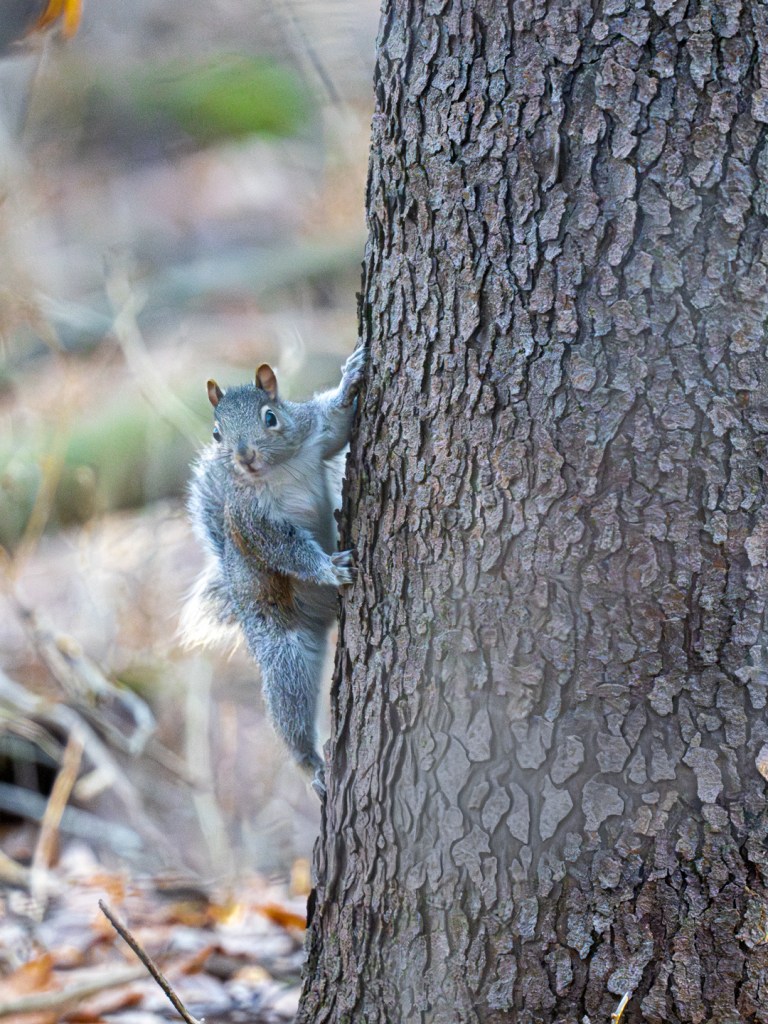
The first lifeform I found was this inquisitive squirrel. A little soft, but better soft than no shot at all (the tree bark, though, is nice and sharp — I mean, it’s not like I didn’t have the focus box squarely on his eye, but on the z9 it has a way of jumping around at the last nanosecond, especially if there is more than one plane of focus).
There were sparrows galore, all feasting on the dirt-road grit. Of course they scattered, despite my sly attempts to keep my distance.
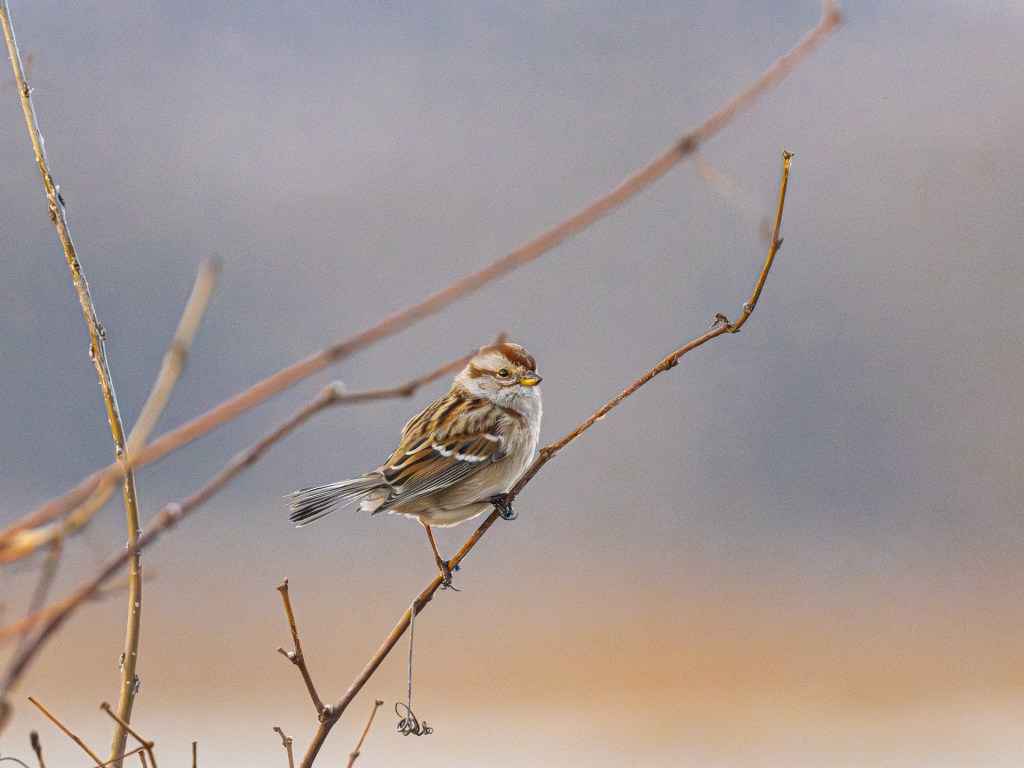
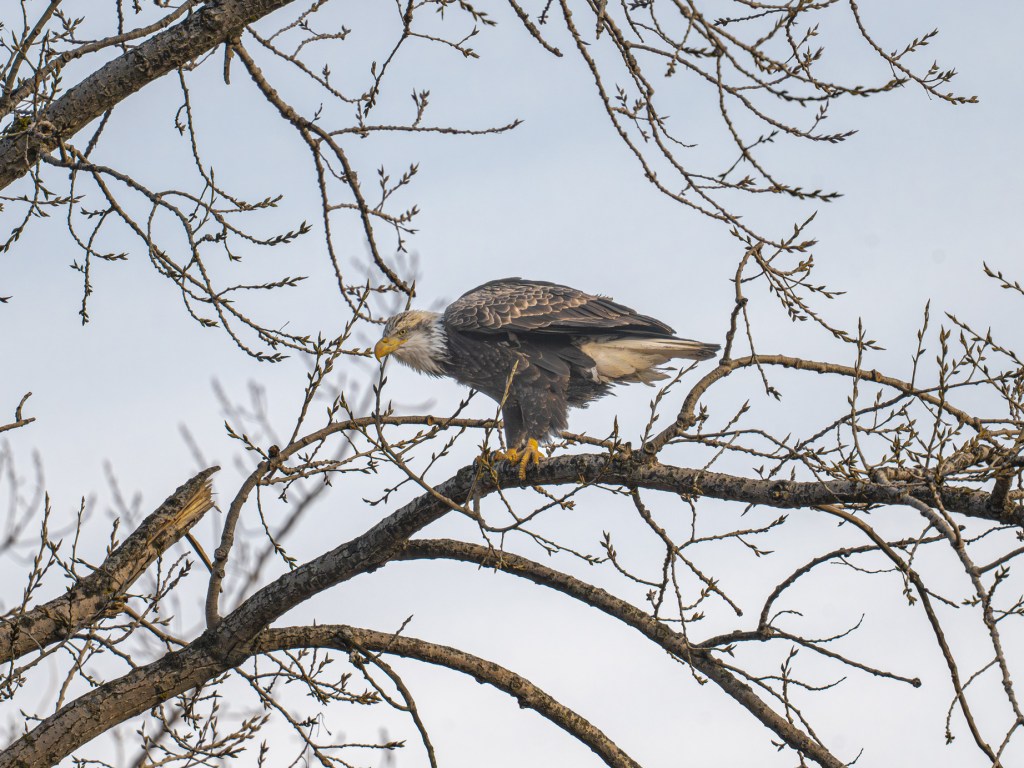
In fact, I was so intent on (visually) capturing a few more tree sparrows that I nearly missed this guy, watching the show from his (her?) perch high above the fray.
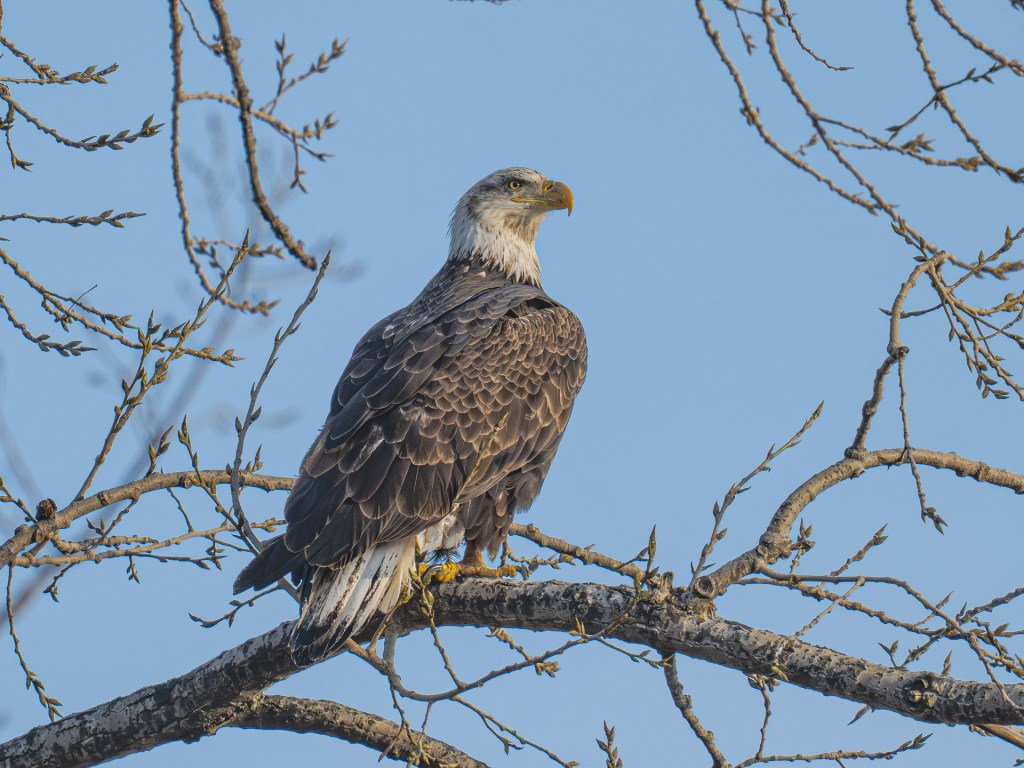
I waited about 30 minutes for him to take off, but no go. He did, however, have an itch. Or maybe he was looking for his keys:
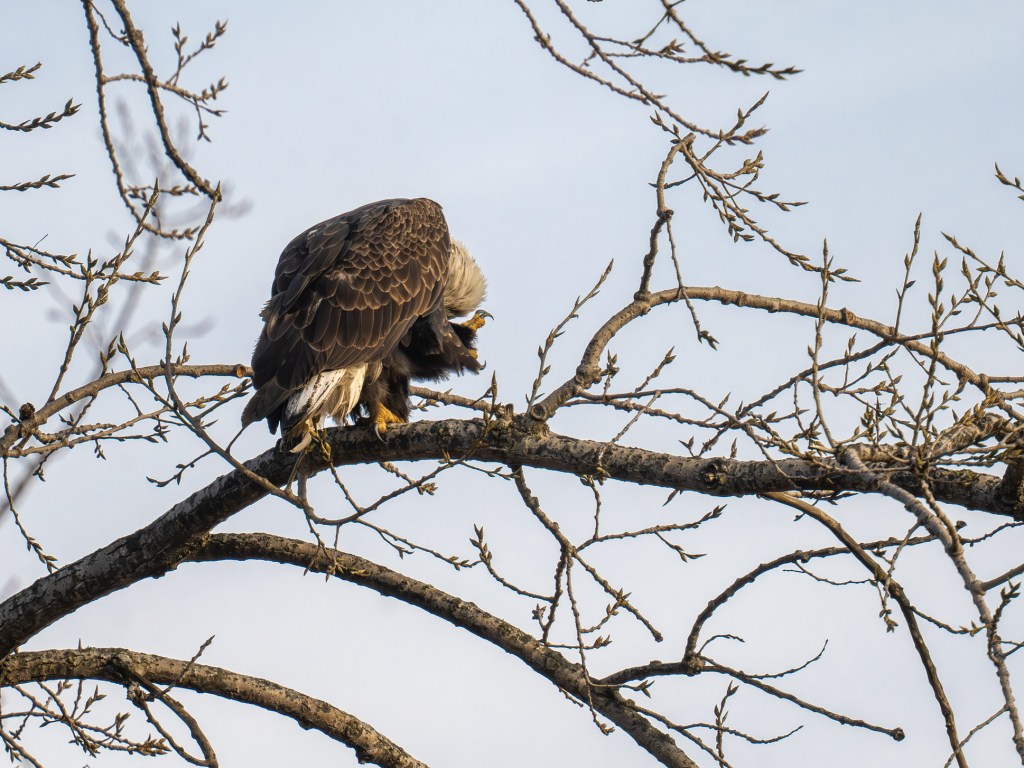
Eh, the most exciting thing I could catch was a sudden spook, which caused a rapid spin-around that almost dislodged the poor thing:
The Merlin app thought it heard a screech owl, so I was off to find it. No luck, but I did find a heap of trumpeter swans, a bunch of gulls, and a variety of geese hanging out in the mucklands.
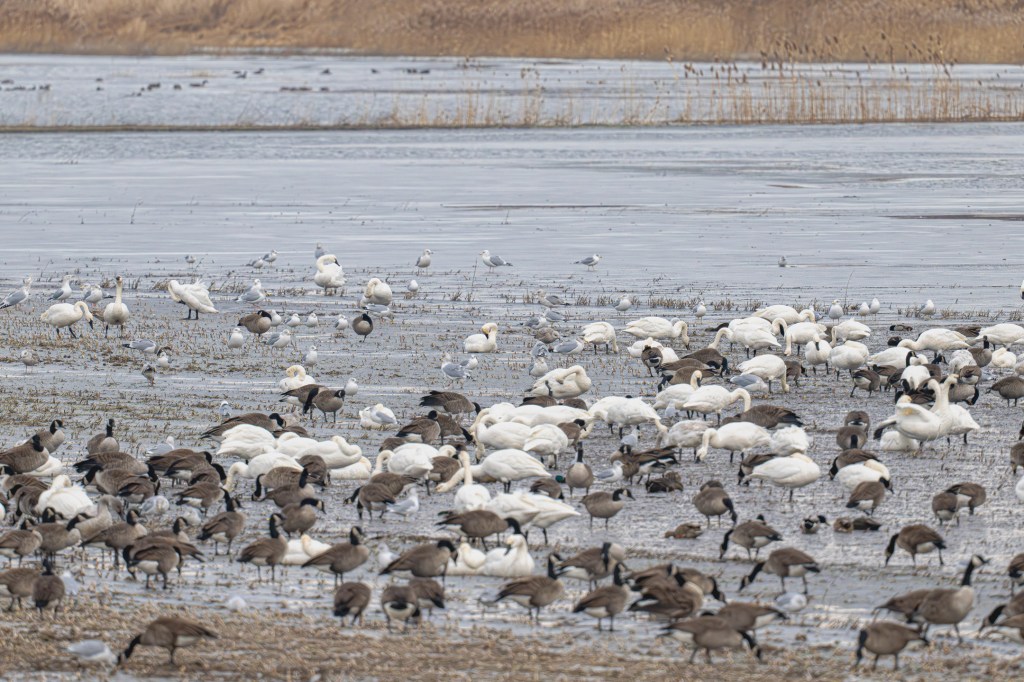
Savannah’s mucklands are a unique geophysical attribute resulting from Seneca River overflows, which happen when even a hint of of wet weather threatens to descend (the water table is quite high in this area and the river hasn’t been dredged for decades). The town is proud of this feature — they even have a road named Muckland Road (…as well as another named simply “No. 39.” Gotta luv beautiful downtown Savannah!). During migrations the mucklands provide a resting place for ducks, geese (sometimes even a flock or two of snow geese), and swans. They are safe from hunters here, because the mucklands are also farmlands whose harvest litter attracts foraging birds and other animals; therefore, hunting is prohibited by local, state, and federal regulations.
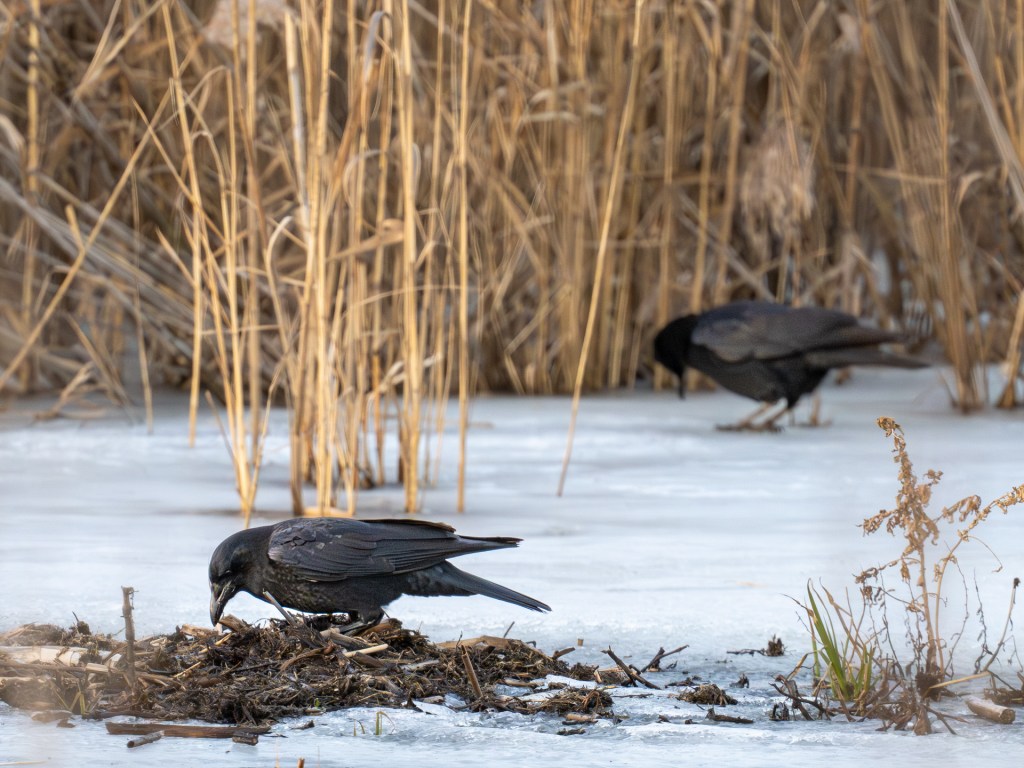
The crows were not welcome in the mucklands, but they amused themselves by annoying each other while foraging in the adjacent icy marsh.
Off to the B&H site to check out some Olympus prices!
(published January 17, 2026)
 Seen by Susan: Fun with Flora and Fauna
Recent Comments