by Susan

I’ve been photographing for several years now, but I still feel like a novice. It’s not that I haven’t learned anything — I certainly have — but I don’t feel like I’ve learned enough of the right stuff.
Recently I’ve noticed the difference between photography and good photography. Photography — anyone can do that (just ask Aunt Doris to show you her cellphone photos), but good photography requires a technical understanding and an artistic appreciation for both the process and the result.
I think there is a stage in between these concepts, which is where I’ve been stuck for a while. I’ve been doing mostly plain old Aunt Doris photography, but it’s quite depressing. I hate wasting my batteries (and my time) on far too many “only if” images (you know, “this photo would have been good ONLY IF _____________ was better” (fill in the blank with what bothers you the most — the exposure, the ISO, a fuzzy focus, a composition that just didn’t work out, or maybe (my favorite) capturing just the feet of a heron or egret taking off). It’s enough to make you want to sell your gear and take up crocheting or something. . .
However, lately I’ve been able to recognize the little bursts of good photography that pop through once in a while. Coming across a real keeper shows that I am capable of doing everything right! I just don’t seem to be able to do it consistently.
I call this hit-or-miss photography.
My Aunt Doris photos reveal several problems, but I am going to tackle them one at a time, starting with light.
I can’t always tell where the light is coming from, not until I see a terribly backlit muskrat family. Or that the light is harsh, until I see the focus on my sandhill crane virtually melting in the too-bright light.
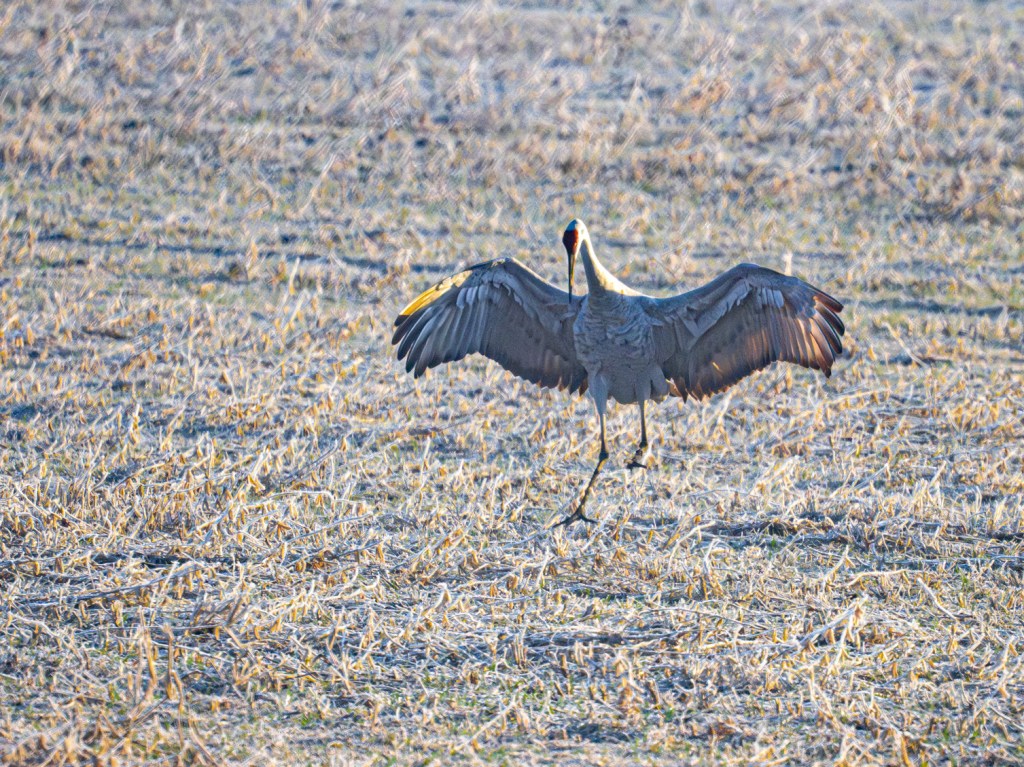
MISS: Ugh, it wasn’t even 8:00 a.m., but the light was BRIGHT.
(If you ever tell anyone that I took that photo, I’m gonna say you lied like a Republican press secretary)
Sometimes it’s hard for me to tell whether there’s even enough light. That’s when I have to slide the exposure in post all the way to the right — well, maybe not all the way, but certainly beyond what I feel comfortable doing.
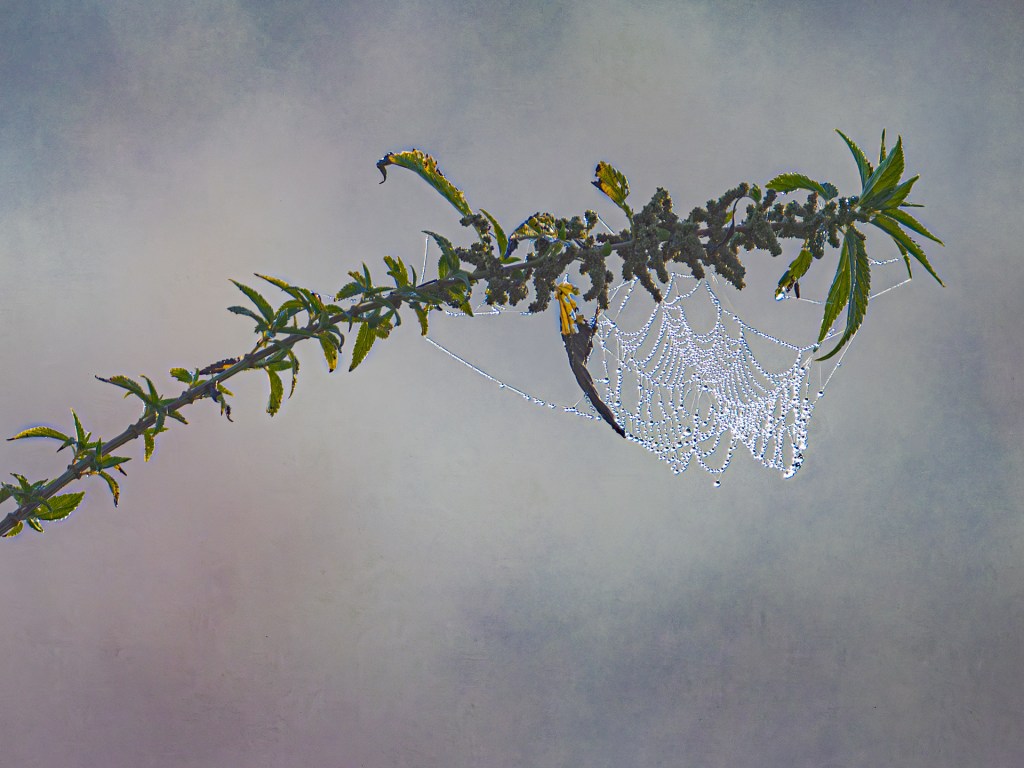
MISS: That spider web should pop against that dark background. . .but it doesn’t 😦
And sometimes (my latest disaster) I ruin a great composition, like that of two playful juvie red foxes, by failing to understand reflected light — there was good exposure in the entire photo except for the white around their mouths. Reflected light blew out all the highlights so severely that even Aunt Doris would gasp.

(Not putting that photo up here, it’s so bad, just sayin)
So, I’m studying light. . .which means for now I am confining my excursions to either early in the morning or late in the day, when the sun is at a low angle and provides that golden light that highlights (but doesn’t clip) the bright areas of my subjects. Once I master good light, I will see if I can handle light that’s not-so-good.
I think I had some success recently. Take these great blue herons, for example. They aren’t just big, pretty birds with a predominance of blue and white feathers, which is what most of my miss photos show. Using the light to its best advantage, in this case oblique and backlight, makes these photos a hit rather than a miss:
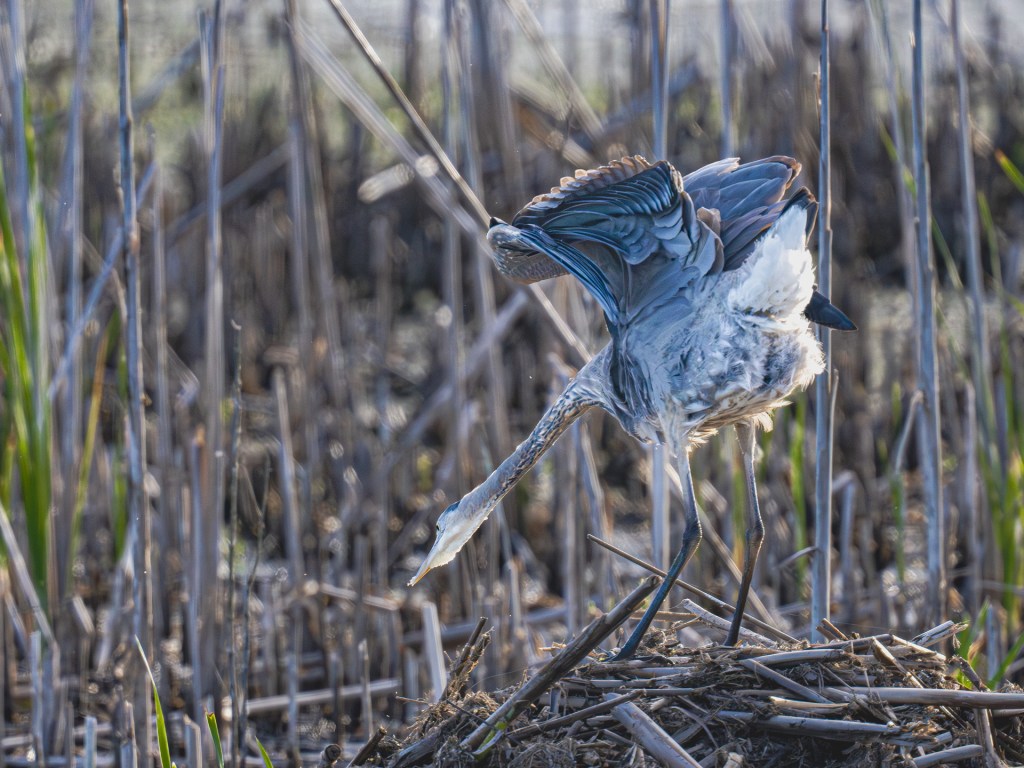
MISS, albeit a slight one: The focus is good, composition tells the story of a hungry GBH searching for lunch, and the colors are good — would have qualified as a hit were it not for the just-barely-blown-out butt feathers taking the brunt of the late afternoon sun (if you enlarge it, you will see what I mean).
Had I seen the problem on the EVF (Nikon z9), I would have dialed in a stop or two of negative exposure compensation. Or I might have moved more to the right to see if a different angle would have reduced the glare. Or maybe fooled with the ISO. . .but I didn’t see this on the EVF.
I would have if I had the <zebra> function enabled. Does the Z9 even show zebras? Yes it does, and I see I have mine all set up — but in the <video> menu only. According to a DPReview blog thread on this very subject, “there is no zebra in photo mode.” Maybe Nikon thinks that if you can afford a Z9, you should be skilled enough to not have to rely on a zebra function. Well, I could barely afford even a used one, so <zebra> would be right up my alley.
Stupid Nikon!
But I can work with the histogram. . .if I can get it to show up in the EVF. Seeing it in the <preview> (which is really a post-view) is after the fact. A true preview definitely would have helped here, but it would be useless with BIF or any other fast-moving subject.
Anyway,
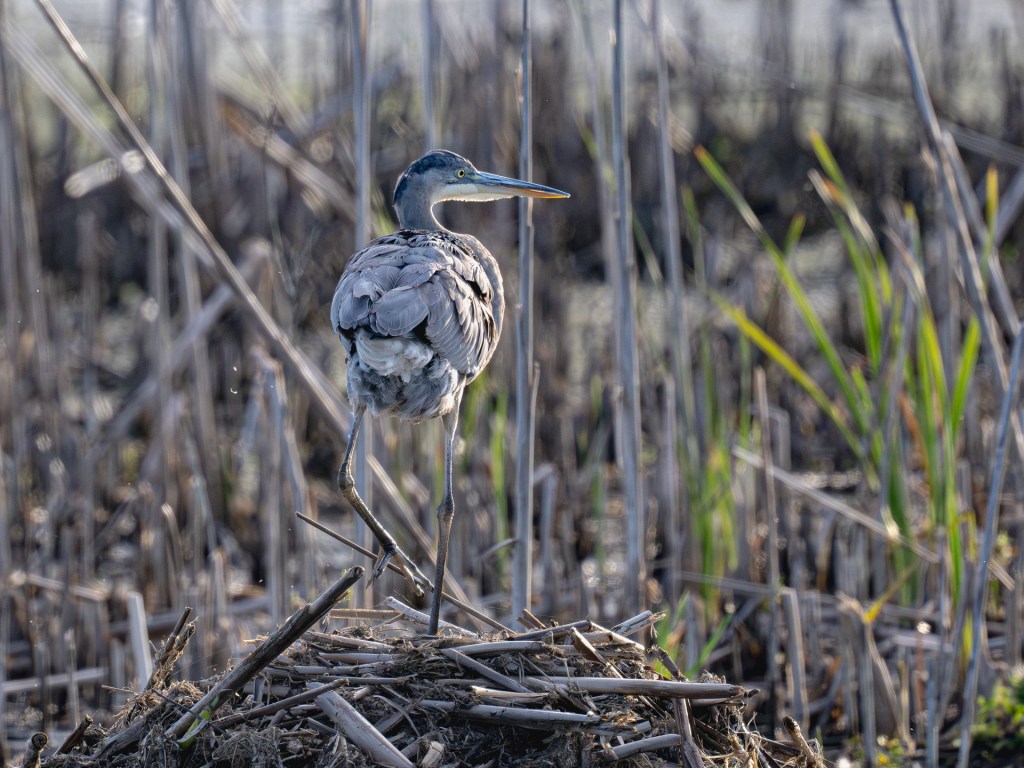
HIT: Now, that is one cooperative great blue heron, and for that I thank him/her very much. The sun is still angling from the right, but now it’s hitting the blue feathers head-on rather than the white ones. Composition, focus, exposure are all okay with me. It’s a butt shot, which most photographers avoid, but this guy (or gal) turned its head very nicely so I could get a sharp eye (yay me!), telling a story of an alert bird scanning the environment for danger. Or for food lurking in the rushes, perhaps.
These next several are an action series! 😉

Eh, I’m calling it a HIT: Composition — check, focus — check, exposure – check, highlights – There is a sliver of clipped whites around the backside (again, worse on an enlarged view), but I’m gonna call it “rimlight” and therefore give it a check. It’s more than an amusing image — is there no privacy?? — because it lets us know that s/he’s getting ready for action.
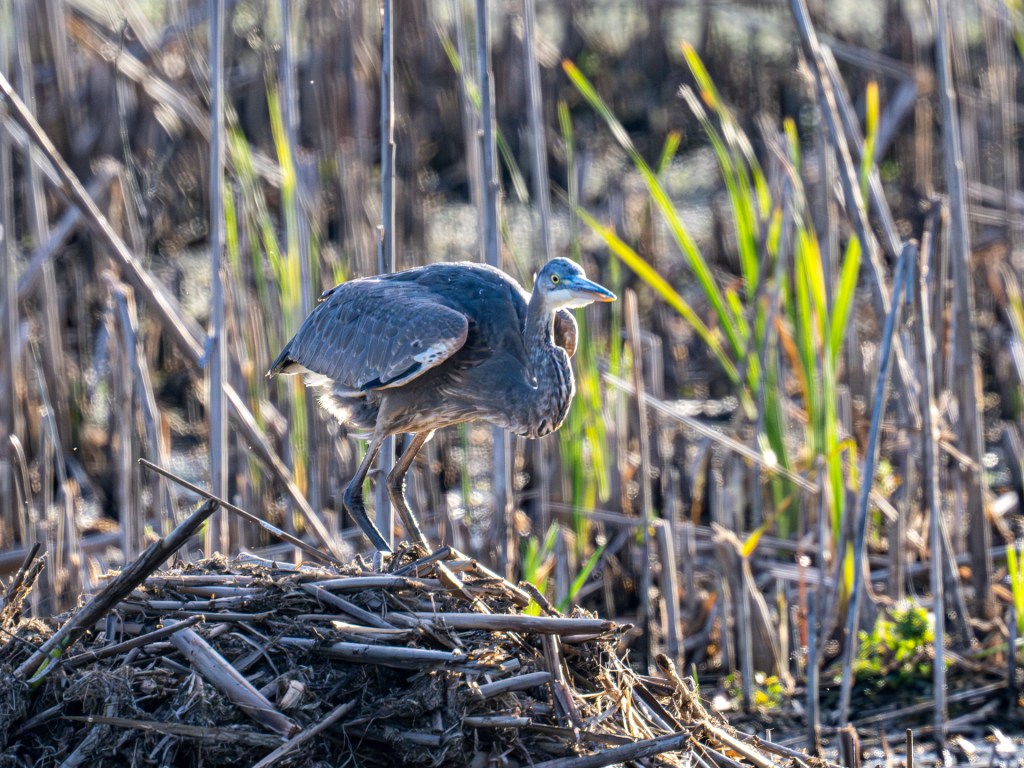
HIT: Good light hitting at an angle that keeps details clean without clipping (so happy!). Everything else is good, too. The story is getting clearer — if this were a cat I’d be expecting a leap, but it’s a heron who just offloaded extra weight, so the next two images will complete the story.
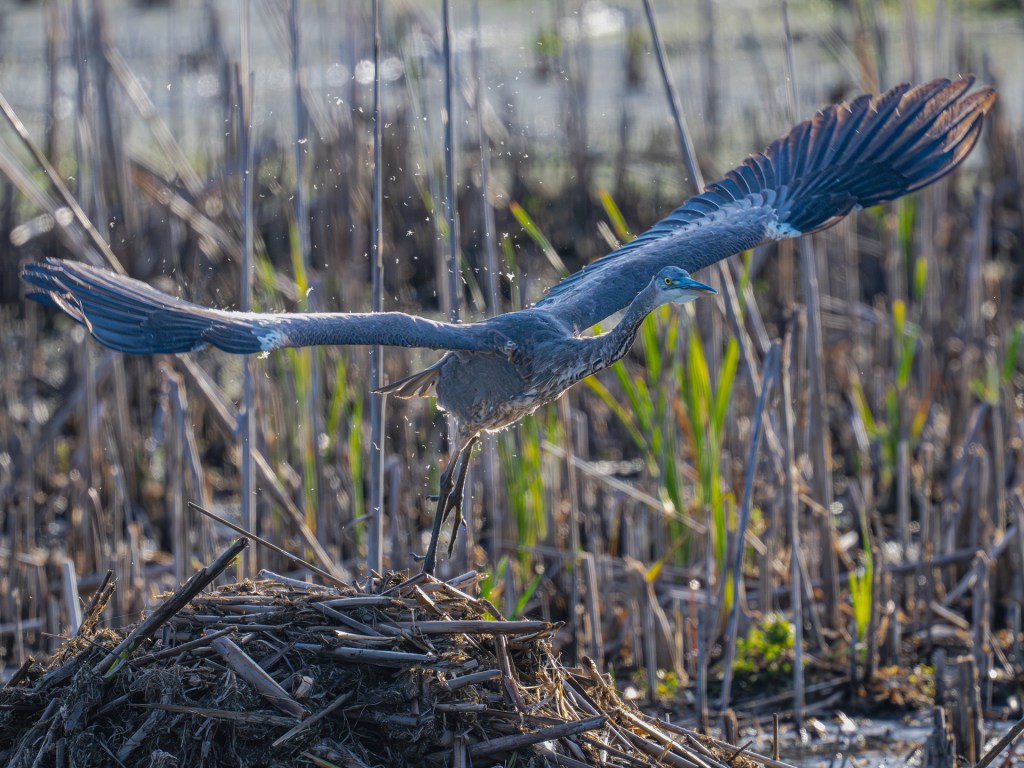
HIT: Satisfied with everything — exposure with nothing clipped, a little bit of rimlight, focus without fuzz, composition showing some action, maybe just a bit too dark but who cares. Houston, we have liftoff!
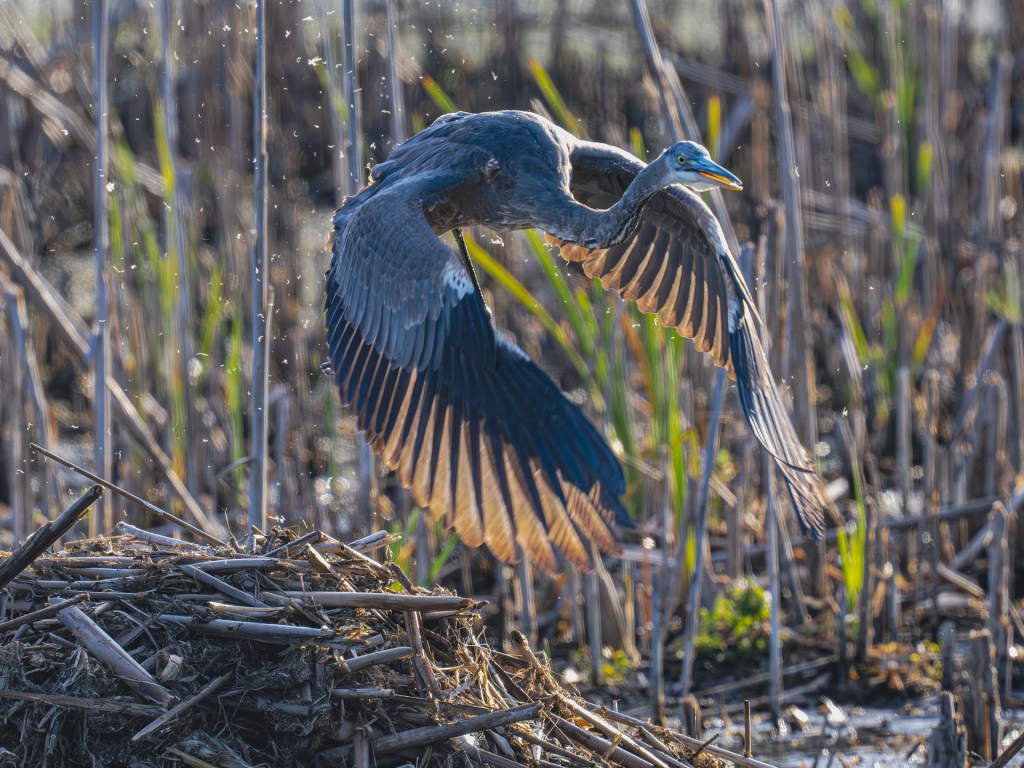
HIT! HIT! HIT! I really hit it with the light. The backlit primaries actually glow with the setting sunlight, and the feathery down that exploded into the air on take-off reveals how powerful those wings are.
All in all, a good day at the soggy bog bottom.
There is more criticism that I did not consider, such as the background. Some might say a dark background would be less distracting, and I could achieve that with a little Photoshop, masking the background and darkening it without affecting the subject. And some of those dead gray rush stems could be removed, too, making the subject stand out more. But, you know what? The title of this blog is “Straight From the Camera,” not “Fixed by Photoshop.” This is what I saw, so this is how it stays. Oh, I did a little bit of denoising and sharpening, but just a little. And I did dehazing, too, but these are adjustments, not changes. That is what allowed me to preserve these images as WYSISYG (remember the good old days of DOS and Lotus 1-2-3?).
Just for fun: Here are some bad guys
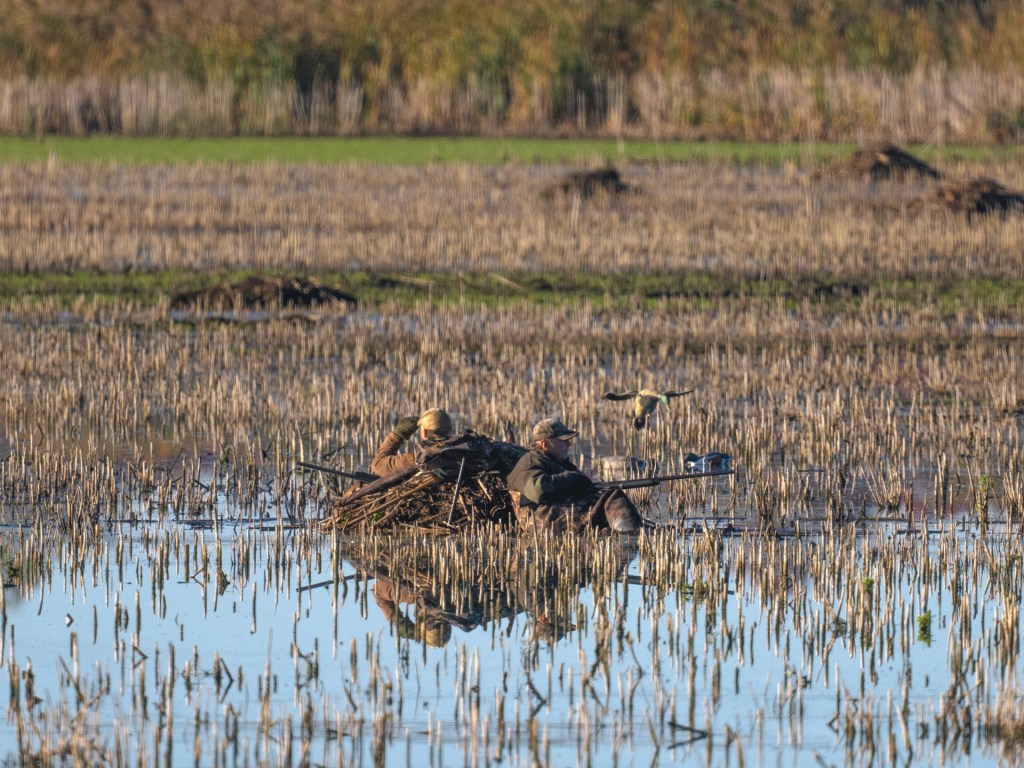
. . .and some ducks escaping the bad guys:

. . .while a few others watch the show:

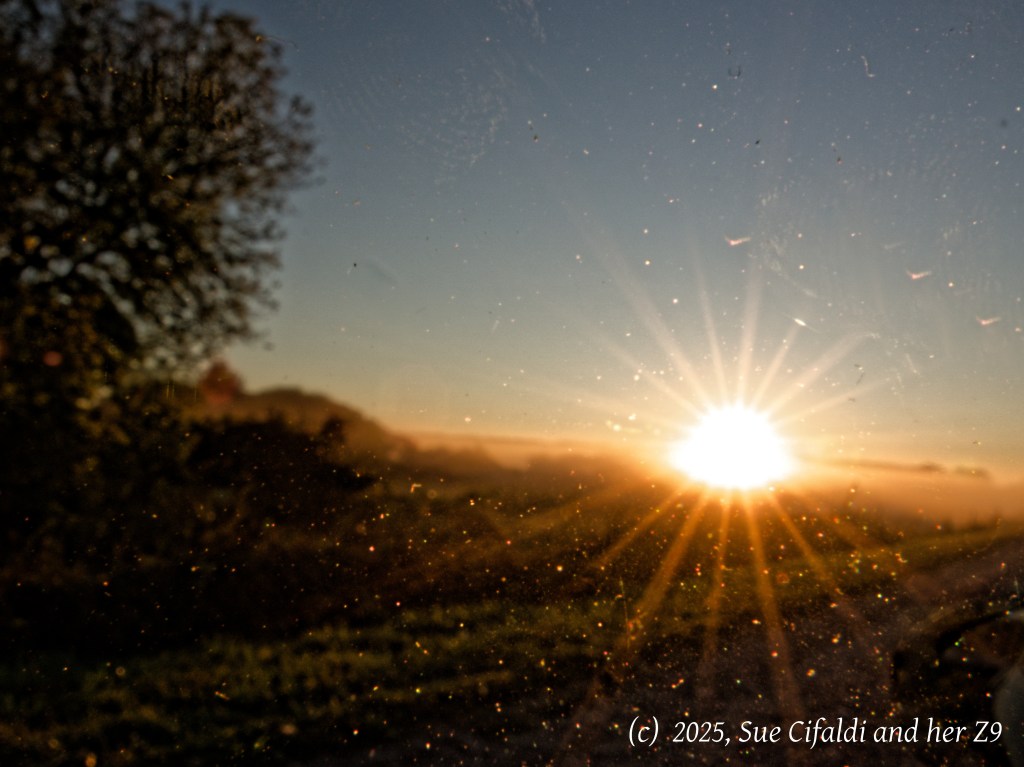
Finally, if you want to make the sun explode, hit it with f16 on a 1-inch sensor (don’t believe the watermark, it lied and said it was a Z9 sensor) — you’ll get instantly bombarded with tiny glary bokeh balls:
 Seen by Susan: Fun with Flora and Fauna
Recent Comments